

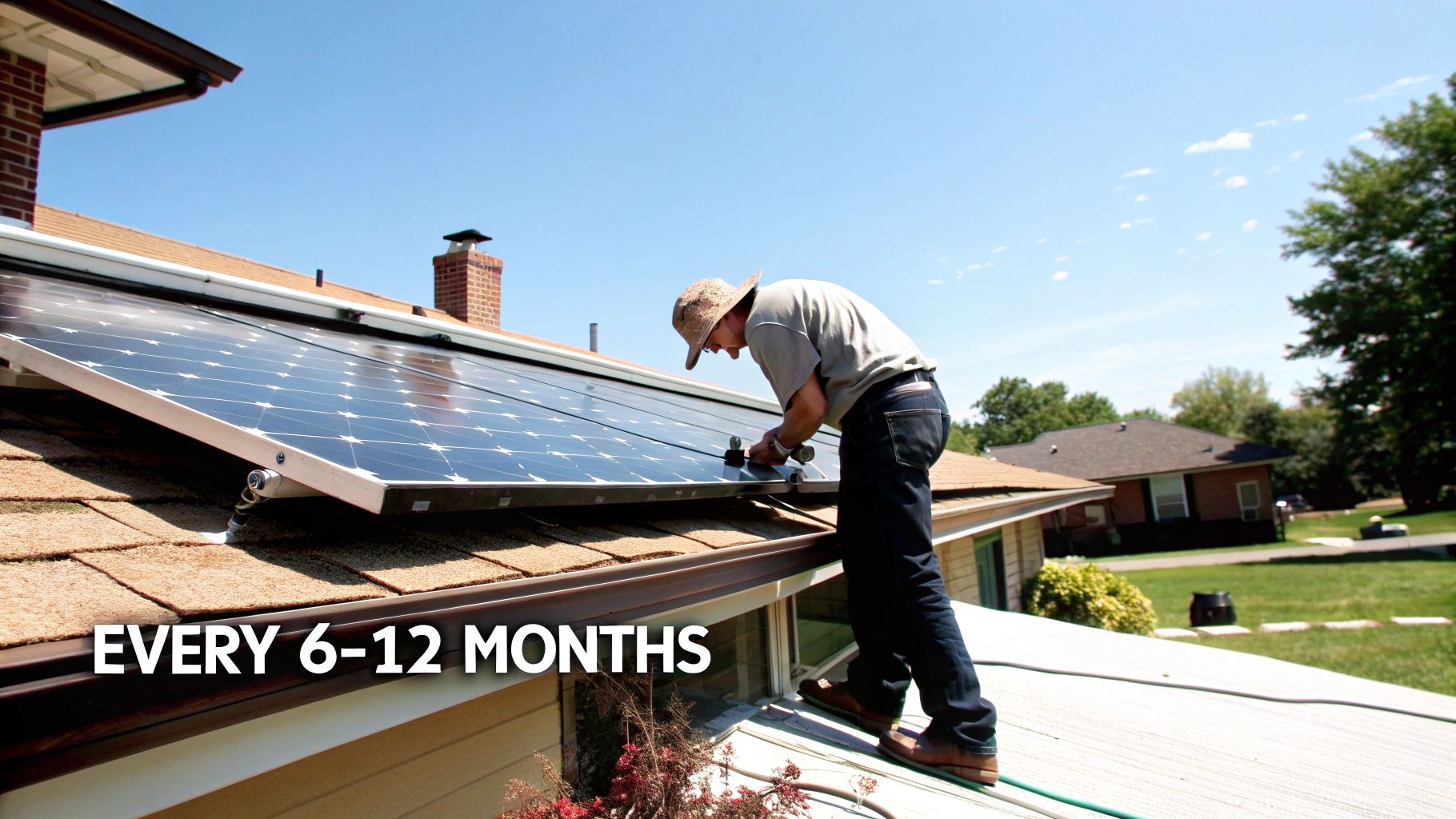
As a rule of thumb, most solar panel systems will perform their best with a good cleaning every 6 to 12 months. But let's be realistic—here in the Scottsdale and Phoenix area, we live in a dust bowl. For local homeowners, a more frequent schedule of every 3 to 6 months is often a better bet to keep your system humming.
Your Quick Guide to Solar Panel Cleaning Frequency
It helps to think of your solar panels like the windshield on your car. A little dust from one day's drive doesn't really affect your vision. But after a few weeks, that film of grime, pollen, and dirt starts to build up, and you find yourself squinting. It's the exact same story for your solar panels, only instead of blocking your view, that buildup is blocking the sun from reaching the solar cells.
Every single layer of dirt, no matter how thin it seems, chips away at your energy production. And while we all hope for a good rain to do the work for us, the reality is a light shower often just moves the dirt around or isn't powerful enough to scrub off the grime that's been baked on by the Arizona sun. This is why having a real cleaning schedule is so crucial for getting the most out of your solar investment.
Finding Your Ideal Cleaning Rhythm
That “6 to 12 months” guideline is a great starting point, but it's not a hard-and-fast rule. The real goal is to figure out a schedule that makes sense for your specific home. To do that, we need to look at the unique factors that can make your panels get dirty faster.
- Your immediate surroundings: Do you live near a new construction site, a farm, or a busy freeway? All of these kick up extra dust and debris.
- Local weather patterns: Our low rainfall and frequent windy days are a perfect recipe for dust accumulation.
- The tilt of your panels: Panels with a steeper angle tend to stay cleaner naturally, while those with a lower tilt or flat-mounted systems are magnets for debris.
Understanding these variables lets you move from a generic recommendation to a personalized maintenance plan. This isn't just about keeping things looking nice; it's about protecting your investment and making sure you're generating every last kilowatt of clean energy you paid for.
Why Your Local Climate Demands a Custom Cleaning Schedule
A generic, one-size-fits-all cleaning timeline might work elsewhere, but anyone living in the Phoenix and Scottsdale area knows our climate is in a league of its own. The combination of intense sun, minimal rain, and constant airborne dust creates a uniquely tough environment for solar panels. If you ignore these local realities, you're just leaving money on the table.
Think of it like this: a fine layer of desert dust settles on your panels every single day. Then, the Arizona sun acts like a kiln, baking that grime right onto the glass. With no regular rain to wash it off, that caked-on film gets thicker and tougher, and a quick spray with a hose just won't cut it.
This baked-on layer essentially creates a hazy barrier, blocking sunlight from ever reaching the energy-producing cells underneath. It's a small effect day-to-day, but it adds up, and soon enough you'll see a real drop in your system's performance.
The True Cost of Dust in Arid Climates
The impact of all this buildup isn't just a theory; it's a measurable loss. Here in the sun-drenched American Southwest, dust can absolutely hammer your energy output. One eye-opening study at a Nevada desert farm found that panels lost a staggering 28% of their electricity production after just three months of dust buildup. That really drives home why staying on top of cleaning is a must in our kind of climate.
And this isn't just a local problem. In the equally harsh deserts of Saudi Arabia, a single major dust storm can cause efficiency to plummet by as much as 40%. Experts there have learned the hard way and now recommend cleaning every one to two months to avoid these massive losses.
For Phoenix and Scottsdale homeowners, this means a few months of neglect can effectively shut down more than a quarter of your solar array's power. Regular cleaning isn't just a chore—it's how you reclaim that lost energy.
Creating a Schedule for the Sonoran Desert
Once you understand how our local climate works against your panels, you can build a cleaning plan that actually makes sense. Simply crossing your fingers and hoping for a rare desert downpour isn't a strategy for keeping your system at peak efficiency.
So what does this mean for your schedule?
- Acknowledge the lack of rain: We just don't get enough of it. When we do get a light sprinkle, it often just turns dry dust into a muddy film, making things even worse.
- Factor in the intense sun: The heat here literally bakes grime onto your panels. The longer it sits, the tougher it is to get off.
- Be mindful of seasonal changes: Spring brings heavy pollen, and summer brings our infamous dust storms, or haboobs. Both events can blanket your panels overnight and demand immediate attention.
When you factor in these challenges, it’s clear why a custom cleaning schedule is so critical. For most folks in our area, cleaning every three to six months hits the sweet spot between cost and performance. If you're thinking about tackling it yourself, you can learn more from our guide on how to clean solar panels for some safe and effective tips. A proactive approach is the only way to ensure your system keeps delivering the savings you expected when you installed it.
Decoding the Factors That Influence Your Cleaning Timeline
So, how often do you really need to clean your solar panels? The honest answer is, it's not about a generic calendar—it's about your property's unique environmental fingerprint. I like to think of a solar array like a garden. Its health and productivity depend entirely on its specific location, how it’s positioned, and the local "pests" it has to deal with, like dust and birds.
Several key variables dictate how quickly grime builds up on your panels. These factors often work together, creating a situation where a simple rain shower just isn't enough to wash away the gunk. Once you understand them, you can move from a one-size-fits-all schedule to a maintenance plan that actually keeps your system humming.
Your Panel's Angle and Location
First things first: the physical placement of your panels plays a massive role in how much debris they collect. A steeper tilt is great because it helps rain and wind naturally whisk away some of the loose dust and leaves. But panels with a very low tilt—or those mounted completely flat—basically become perfect collection trays for every bit of grime that falls from the sky.
Where your home is located matters just as much. You'll need more frequent cleanings if you're near certain environmental hotspots.
- High-Traffic Roads: Live near a busy freeway? You're getting a constant, fine shower of dust and pollutants from vehicle exhaust that loves to stick to glass.
- Agricultural Areas: Proximity to farms or large, open fields means significant amounts of dust and organic matter get kicked up and can coat your panels.
- Construction Zones: It's no secret that new developments create tons of airborne dust that settles everywhere, and your roof is no exception.
This decision tree gives you a good visual for how different grime conditions call for different cleaning actions.
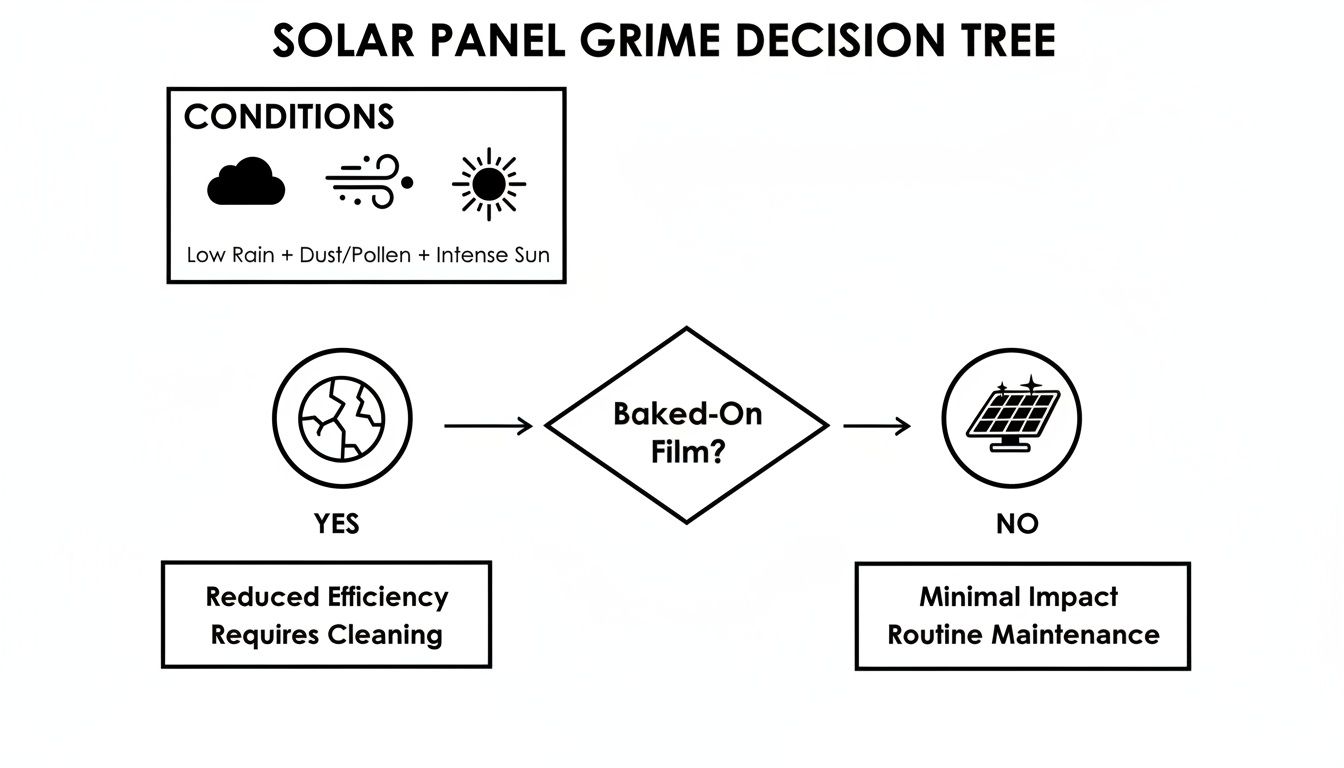
As you can see, a combination of factors can create a stubborn layer of grime that requires a lot more than a quick rinse to remove effectively.
Spotting Soiling Loss in Your System
This gradual drop in energy production caused by dirt has a name: soiling loss. It's the number one thief of your solar system’s efficiency, quietly chipping away at your energy savings day after day. While you can often just look up and see a dirty panel, the most accurate way to spot soiling loss is by keeping an eye on your system's energy output.
If you notice a consistent dip in your daily or weekly energy production that can’t be explained by cloudy weather, it’s a huge red flag that soiling is the culprit. Think of it as your system telling you it’s time for a cleaning.
By paying attention to your system’s performance data and considering your local environment, you can build a cleaning schedule that’s perfectly suited to your home. Taking this proactive approach is the best way to make sure you're always getting the maximum return on your solar investment.
The Real Financial Impact of Dirty Solar Panels
It's one thing to know that dust and bird droppings make your panels dirty. It's another to understand what that grime is actually costing you. The big question for most homeowners is simple: is paying for a professional cleaning worth it?
The best way to think about this isn't as an expense, but as a way to stop losing money.
When you let your panels stay dirty, you’re basically agreeing to a lower return on your investment. Every single day that layer of dust sits on your panels, it's blocking sunlight and choking your system's energy production. That lost energy is power you have to buy from the utility company—power your panels should have been generating for free.
A Simple Cost-Benefit Breakdown
Let’s break it down with some real-world numbers. Say your solar system's performance has dropped by 15% because of built-up grime, which is a pretty common scenario here in the Phoenix area. If your panels normally save you $200 a month on your electric bill, that 15% drop is costing you $30 in lost savings every single month.
Now, let's factor in a professional cleaning service, which might cost around $150.
- Monthly Loss Without Cleaning: $30
- Cost of One Professional Cleaning: $150
- Break-Even Point: 5 months ($150 / $30 per month)
In this example, the cleaning pays for itself in just five months. For the other seven months of the year, that recovered $30 per month is pure savings going straight back into your wallet. When you look at it this way, skipping a cleaning is really just choosing to give more money to the electric company.
A professional cleaning isn't just a maintenance chore; it's a smart financial move. The cost is almost always recovered through the restored energy savings, making it one of the easiest ways to protect your solar investment.
Optimizing Your Cleaning Schedule for Maximum ROI
So, how often should you do it? Finding the sweet spot is a balancing act between cost and performance. Researchers have even created formulas to pinpoint the most cost-effective cleaning schedule, weighing the price of a service against the daily efficiency loss from soiling. This kind of data is especially important in a place like Arizona, where intense sun and constant dust are major parts of the equation.
If you’re interested in the nitty-gritty, you can explore the detailed research on scirp.org to see the math behind it.
This shows that regular cleaning isn't about keeping up appearances. It's a core part of making sure you get every dollar of savings you expected from your solar array. To get a better handle on your system's output, check out our guide to maximize solar efficiency with regular panel cleaning. When you actually run the numbers, the choice is clear: a clean solar panel is a more profitable solar panel.
DIY Cleaning vs. Professional Service: Which Is Right for You?
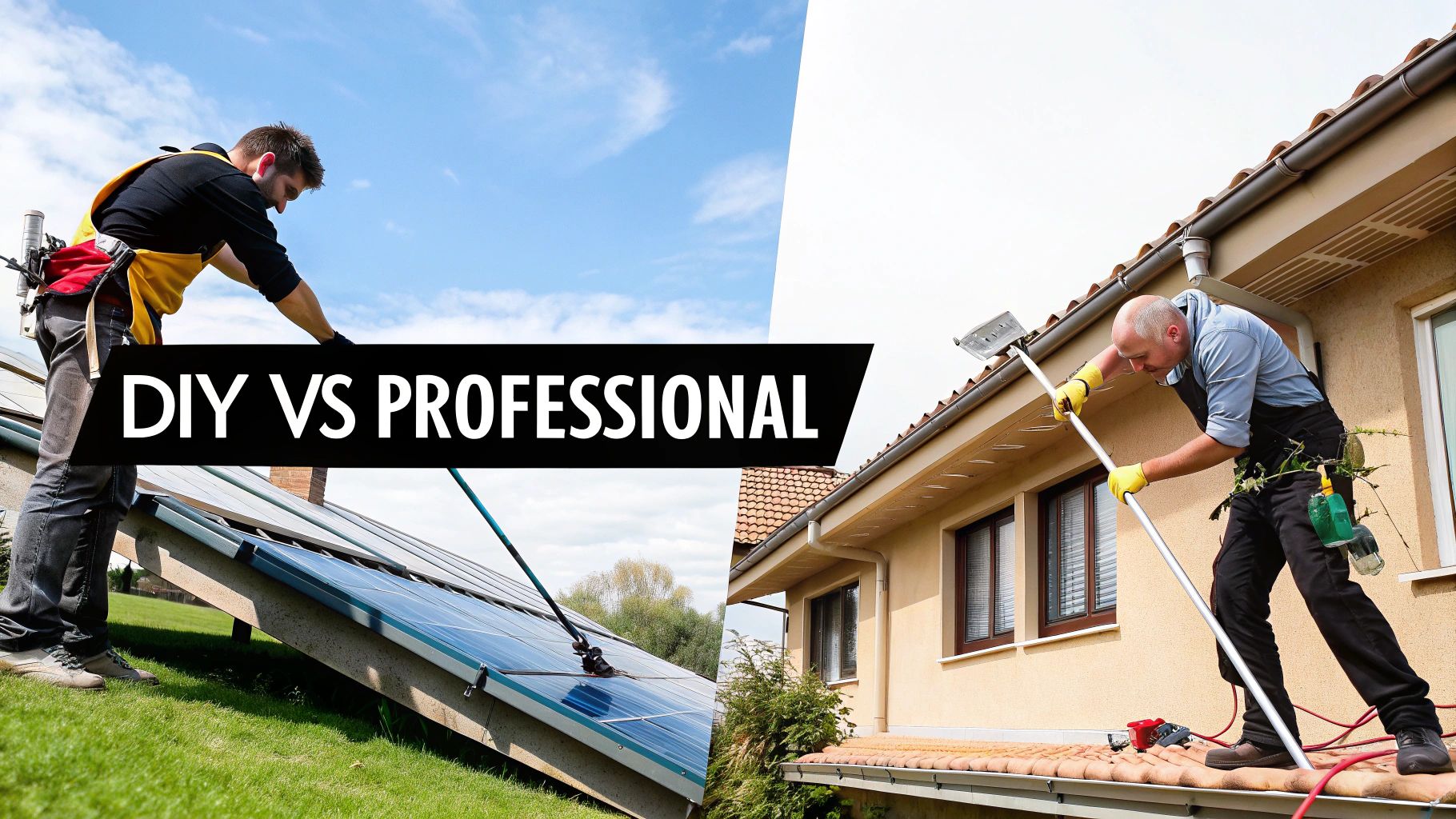
Okay, so you've figured out how often your panels need a good scrub. Now comes the big question: who's actually going to do the work? This is the classic homeowner's dilemma—do you roll up your sleeves and do it yourself, or do you call in the pros? It really boils down to trading a little cash for safety, quality, and your own peace of mind.
Let's be honest, the DIY route is tempting. You save a few bucks, and it seems straightforward enough. But before you dust off that old ladder, it's critical to understand what you're getting into.
First and foremost is your own safety. Getting up on a roof, especially a sloped or two-story one, is risky business. A slip or fall can be devastating. Beyond that, there's a real danger of damaging your very expensive solar panels. Using a regular hose, a pressure washer, or the wrong kind of brush can scratch the glass or strip away the vital anti-reflective coating.
What’s worse? An improper cleaning job could even void your system's warranty. Suddenly, that simple chore has turned into a massive, expensive headache. If you're still considering it, we've put together some crucial things you need to know about DIY solar cleaning to help you weigh the risks.
The Professional Advantage
This is where hiring an experienced, insured team really pays off. They handle all the risks for you. Professionals show up with the right safety harnesses and specialized tools, like water-fed poles with soft-bristle brushes made specifically for solar glass. They know how to navigate a roof safely and can get the job done in a fraction of the time it would take you.
The secret weapon for a top-notch clean is their use of deionized water systems. This is a game-changer. Tap water is full of minerals that leave behind spots and a hazy film, which blocks sunlight. Purified, deionized water dries perfectly clean, leaving a streak-free surface that lets every possible ray of sun get through.
Ultimately, a professional service offers more than just a cleaning; it provides a guarantee that the job is done safely, correctly, and without compromising your warranty or your system's performance.
Making the Right Choice for Your Home
So, what's the right call? It really depends on your comfort level with heights, the tools you have, and what your time is worth to you.
Here in the Phoenix area, with all our dust and urban grime, a professional clean makes a noticeable difference. In fact, panels in polluted areas can lose 10-15% of their output in just six months if left uncleaned. For homeowners and property managers in places like Paradise Valley or Surprise, a twice-yearly professional cleaning isn't a luxury—it's a smart investment to keep your system running at its peak.
Common Questions About Solar Panel Cleaning
Even with a good grasp of why regular cleaning is important, it's normal to have more specific questions pop up. Homeowners often ask me about the nitty-gritty details, from whether rain does the job to the potential risks of cleaning them yourself. Let's walk through the most common questions to clear up any confusion and help you protect your solar investment.
My goal here is to give you direct, straightforward answers based on years of experience, so you can feel completely confident in your maintenance plan.
Can I Just Use a Hose to Clean My Solar Panels?
It’s tempting to just grab the garden hose for a quick spray-down, but here in Arizona, that can actually make things worse. Our tap water is famously "hard," which means it’s loaded with minerals like calcium and magnesium. When that water evaporates in the desert sun, it leaves behind a chalky, white film on the glass.
You've essentially just swapped one problem for another. You might rinse away some loose dust, but now you have a new layer of mineral buildup that also blocks sunlight and hurts your system's efficiency. This is exactly why professionals use purified, deionized water—it dries perfectly clean, leaving no spots behind and ensuring every possible ray of sunlight gets to the solar cells.
Will Rain Clean My Solar Panels Enough?
This is probably the biggest myth I hear about solar panel maintenance. Unfortunately, you can't count on rain to do the job for you. A light sprinkle often does more harm than good, turning dry dust into a thick, muddy paste that sticks to the panels even more stubbornly once the sun comes out.
Even a heavy monsoon downpour doesn't have the scrubbing power to remove baked-on grime, stubborn bird droppings, or oily residue from air pollution. Think of it like washing your car by just leaving it in a rainstorm. It might get the top layer of dust off, but it’s not going to touch the real road grime. A proper cleaning with the right tools is the only way to get your panels back to peak performance.
How Do I Know if My Solar Panels Need Cleaning?
There are two easy ways to figure out when it's time for a cleaning. The first is a simple visual inspection. If you can safely see your panels from the ground or a second-story window and they look hazy, dusty, or have bird droppings, they’re overdue for a wash. Don't underestimate what that thin layer of dirt can do—it's actively costing you money.
The second, more accurate method is to check your system's performance data.
- Check Your Monitoring App: Your solar company's app is your best friend here. It shows you exactly how much power you’re generating.
- Look for a Gradual Decline: If you see your daily or weekly energy output slowly dropping, and it isn't just because of cloudy days or the season changing, soiling is almost always the culprit.
- Compare Year-Over-Year Data: This is a great trick. Compare your production this month to the same month last year. A significant, unexplained dip is a huge red flag that your panels are dirty.
Using your system's data takes all the guesswork out of it and tells you precisely when it's time to act.
Does Cleaning Solar Panels Void Their Warranty?
This is a crucial question, and the answer is: it depends entirely on how they are cleaned. Using the wrong methods or tools can absolutely cause damage and void your manufacturer's warranty. This is one of the biggest risks of trying to do it yourself without the right know-how.
Actions that can void your warranty include using a high-pressure washer, harsh chemicals like Windex or other abrasive cleaners, or stiff-bristled brushes. These can easily scratch the panel’s delicate anti-reflective coating, which is essential for absorbing sunlight. Once that coating is damaged, the panel’s efficiency is permanently crippled.
Bringing in a reputable, insured professional service is the safest bet. They use industry-standard tools, like soft-bristle brushes and purified water systems, that clean your panels safely and effectively. This protects both your warranty and the long-term health of your entire solar array.
Ready to restore your solar panels to peak efficiency without the risk? The experienced team at Sparkle Tech Window Washing LLC uses specialized equipment and purified water systems to deliver a safe, streak-free clean every time. Get your free estimate today and see the difference a professional cleaning can make!