

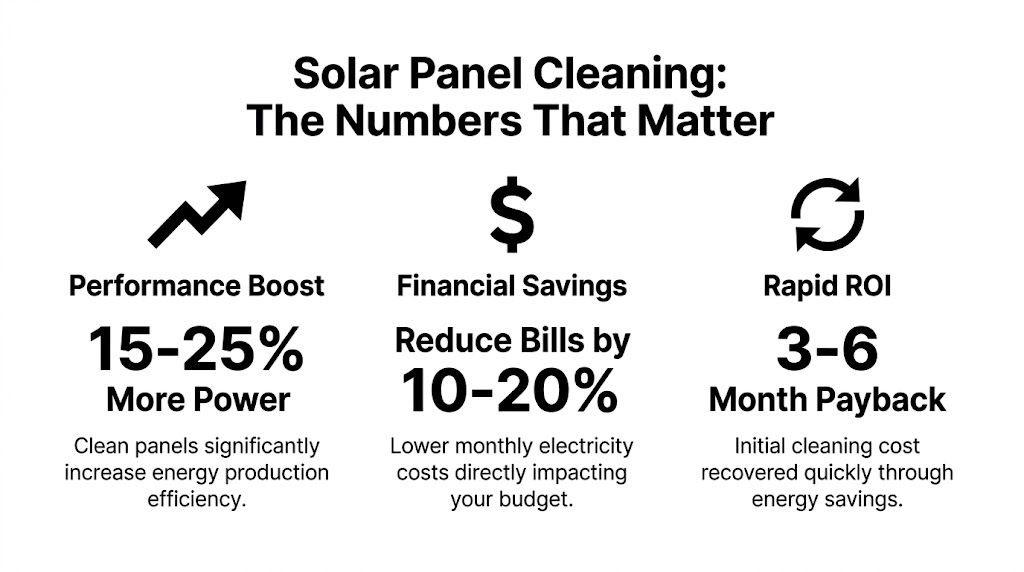
Phoenix homeowners usually assume their panels are working hardest in the months with the most sun. In practice, some of the strongest production losses happen during the same bright, dry stretches that make Arizona solar so appealing. In dusty climates, clean panels can boost output by as much as 30% compared to heavily soiled panels, and more typical gains still land in the 7% to 15% range, according to the NREL-based figures summarized here.
That single point changes the conversation. The benefits of solar panel cleaning aren't just cosmetic, and they aren't universal either. In Phoenix, Scottsdale, Peoria, and nearby communities, the main question is whether local dust, monsoon residue, bird droppings, and hard water deposits are stealing enough production to justify a cleaning now, later, or not yet.
A lot of online advice gets this wrong. Some articles treat every solar system like it sits in the same climate, at the same roof pitch, under the same conditions. That leads homeowners to overclean, underclean, or use the wrong methods entirely. Phoenix isn't Portland. A haboob doesn't behave like light suburban dust, and a summer rainstorm often leaves grime behind instead of rinsing panels clean.
Introduction Why Your Solar Panels Are Underperforming
If your utility bill has started creeping up even though your usage habits haven't changed much, your panels may be dealing with soiling loss. That's the industry term for production loss caused by dirt, dust, pollen, bird droppings, and other debris sitting between the sun and the photovoltaic cells.
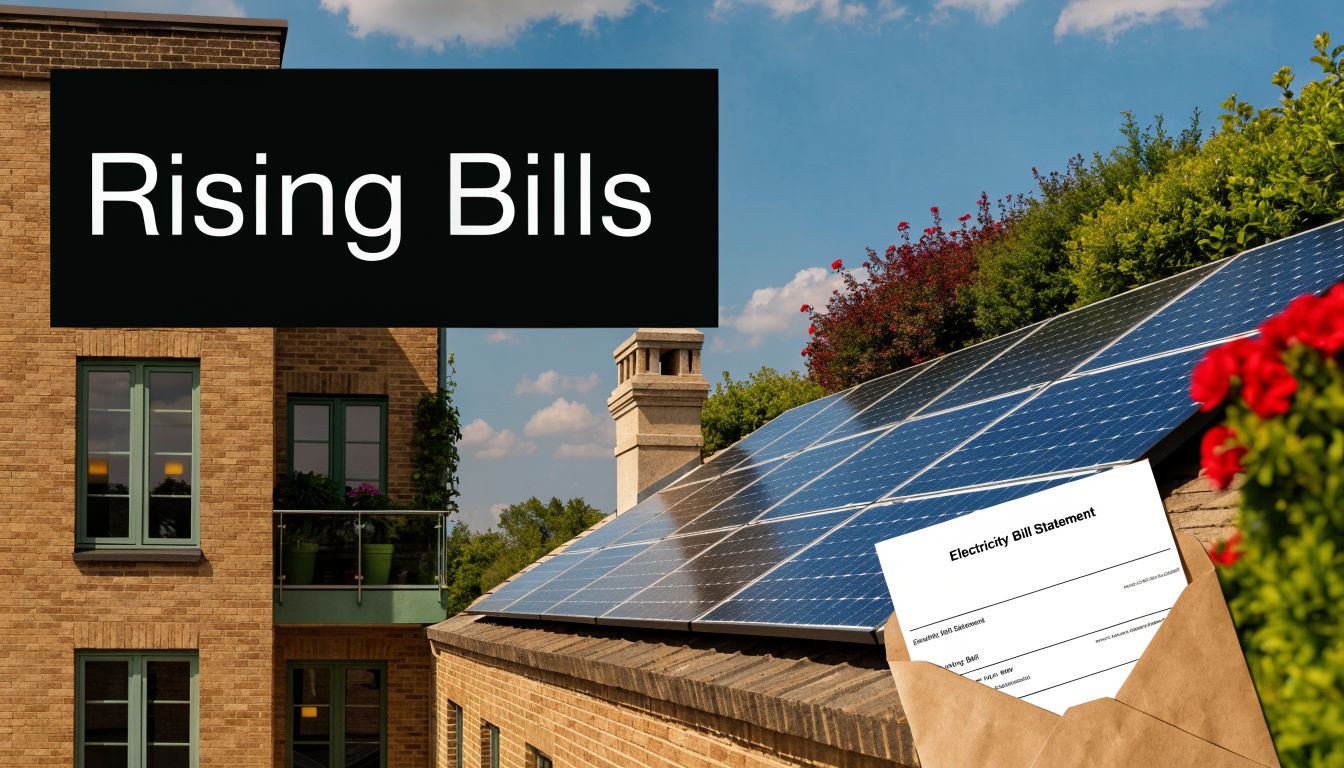
In the Phoenix area, that buildup happens faster than many homeowners expect. Fine desert dust settles gradually, then a wind event or monsoon pushes things further by leaving caked-on residue in corners and lower panel edges. Add hard water spotting from improper rinsing, and performance can slip without any obvious equipment failure.
What many solar owners notice first
The issue isn't typically identified by merely observing the roof. Instead, it becomes apparent in everyday life:
- Bills feel off: The solar system is still running, but monthly savings don't look as strong.
- Monitoring looks weaker: Production graphs flatten out compared with cleaner periods.
- Panels look dull: The glass loses that clear, reflective finish and starts looking hazy or patchy.
A helpful way to think about this is to compare panel performance with the broader effectiveness of solar panels in different climates and roof conditions. Panels can be highly effective, but only when sunlight reaches the cells efficiently.
Practical rule: If your system is producing less and nothing appears electrically wrong, surface contamination is one of the first things worth checking.
The fix isn't always "clean them immediately." Sometimes cleaning pays quickly. Sometimes it doesn't. What matters in Phoenix is timing, roof design, recent weather, and how the grime formed.
How Grime Robs Your Solar Panels of Power
A solar panel works like a clean window with electronics underneath. The glass layer has one job before anything else happens. It needs to let sunlight pass through cleanly. Once dust, pollen, dried mud, bird waste, and traffic film sit on that surface, less light reaches the photovoltaic cells.
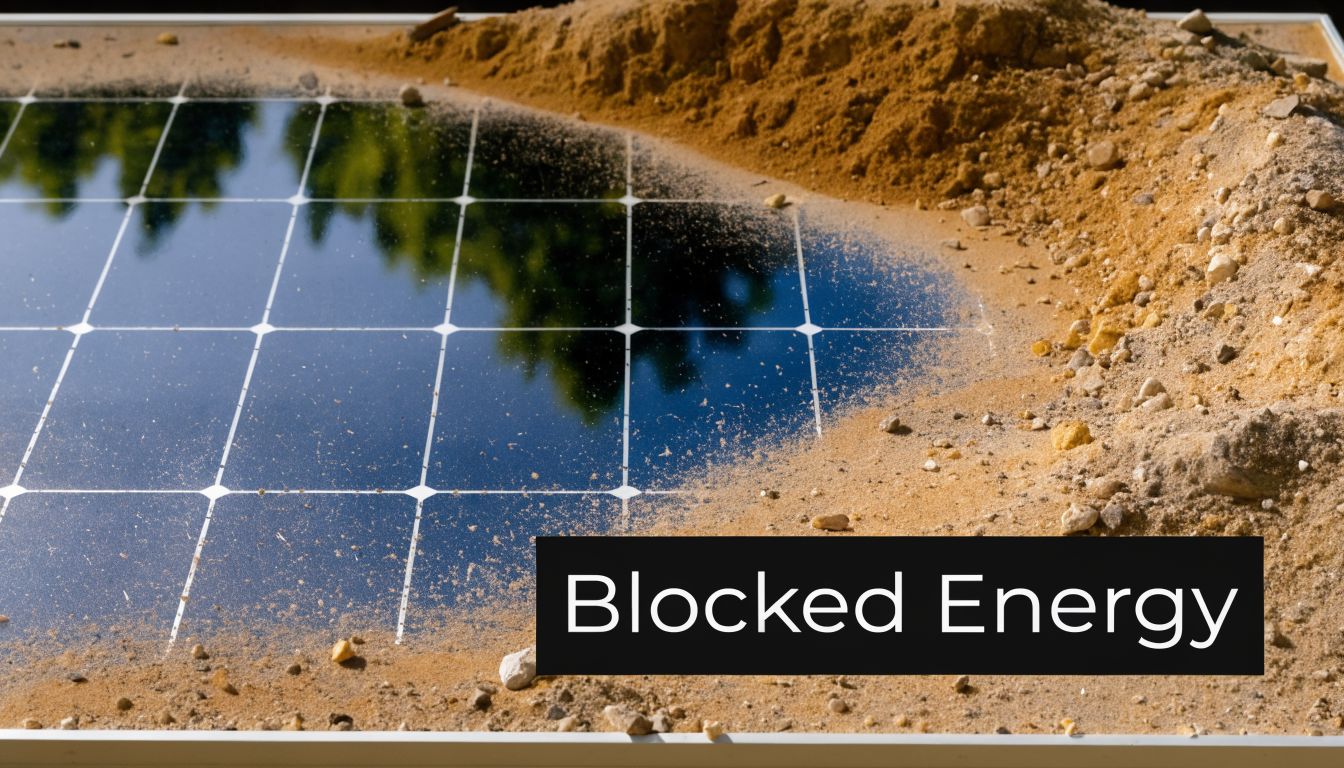
That sounds simple, but the effect adds up fast in Arizona. Fine dust creates a broad haze across the panel. Bird droppings create concentrated blockage. Pollen mixes with moisture and sticks. Pollution film adds a stubborn layer that doesn't rinse off easily. Each one reduces light transmission in a slightly different way.
What buildup looks like in Phoenix
The most common grime patterns on local residential systems are easy to recognize once you've seen a few hundred arrays.
- Fine desert dust: This is the everyday layer. It settles evenly and can make an entire array look slightly muted.
- Monsoon mud residue: Rain hits dusty panels and leaves a dried film once the water evaporates.
- Bird droppings and organic spots: These cause uneven shading and often need targeted removal.
- Hard water residue: This usually comes from poor cleaning technique, not weather alone, and it can leave mineral spotting behind.
The core mechanism doesn't change. Anything that blocks or scatters incoming sunlight lowers production. According to the PV dust accumulation research cited here, dust accumulation on photovoltaic panels can reduce solar panel efficiency by up to 25%. The same source notes that a residential 6-8 kW system losing 20% efficiency due to dust accumulation could lose approximately 4,000-6,000 kWh of annual production, representing about $500-$900 in unrealized energy savings annually.
Thin grime causes broad losses
Homeowners often wait for panels to look obviously filthy before taking cleaning seriously. That's understandable, but it misses how production loss works. A thin uniform film across every panel can hurt output even when the array doesn't look terrible from the ground.
If you can write your name in the dust on a panel frame, the glass is usually already dirty enough to affect production.
That matters because Arizona grime often arrives as a layer, not a dramatic mess. A panel doesn't have to be coated in visible sand to underperform. It just needs enough residue to cut light transmission across the surface.
This walkthrough shows the issue well in action:
Why rinsing alone often fails
Rain and casual hose rinsing remove loose dust. They usually don't remove the material that causes the most persistent underperformance. Dried minerals, adhered pollen, and bird waste need a gentler but more thorough cleaning method. Scrubbing too aggressively creates a different problem by risking scratches or coating damage.
In other words, grime doesn't just sit there. It changes how light reaches the cells, and in Phoenix that can turn a strong solar season into a weaker one without any inverter fault or hardware failure.
The Real Numbers Maximizing Your Energy Output and ROI
A dirty array does not need to be caked in mud to lose money. In Arizona, even moderate soiling can turn strong summer production into a weaker return on a system that already cost tens of thousands to install.
According to the National Renewable Energy Laboratory's research on photovoltaic soiling losses, energy losses from accumulated dirt can range from small but measurable levels to severe reductions when buildup is left in place for long periods. That wide range matters in Phoenix because ROI depends on conditions, not a one-size-fits-all cleaning schedule. A roof that picked up light dust last week is different from a roof that sat through a haboob, a spotty monsoon rinse, and a month of hard sun.
When better production turns into actual savings
The financial question is straightforward. How much power is the system failing to produce, and does that lost production exceed the cost of cleaning?
Analysts at EnergySage's guide to solar panel maintenance and cleaning note that dirt, pollen, leaves, and bird droppings can reduce output, especially in dry areas where rain does not regularly wash panels clean. For Phoenix homeowners, that means the savings case gets stronger after major dust events or long dry stretches, and weaker when panels only have a light film and production has not moved much.
On a larger system, small percentage losses add up faster. On a smaller system, the threshold for a worthwhile cleaning is higher. That is why I tell homeowners to stop asking for a universal schedule and start comparing likely recovery against actual service cost.
A Phoenix-specific way to judge ROI
The best time to pay for cleaning is when the panels are dirty enough that recovered production has a good chance of covering the visit.
A practical checklist helps:
- Look at recent weather: A haboob or windy week can justify cleaning sooner than a calm month.
- Check for broad residue: Uniform dust film, dried rain spots, and edge buildup matter more than one isolated bird mark.
- Consider system size: Bigger arrays lose more dollar value from the same percentage drop.
- Review your production trend: If output slipped without an equipment issue, soiling moves higher on the list.
- Price the service against likely recovery: This guide to solar panel cleaning service cost is useful for setting that comparison before you book anything.
This is maintenance economics, not aesthetics.
Where homeowners miscalculate
The common mistake is treating cleaning as an automatic money saver or a waste of money every time. Neither view holds up on Phoenix roofs.
If panels are only lightly dusty and production is stable, paying for service too early can eat into the return. If the array has been through dust, light rain, and weeks of heat, delaying service can mean buying more utility power than necessary while the system keeps underperforming. The smart move is condition-based cleaning tied to production value, weather history, and roof access difficulty.
That approach usually produces the best payback for Phoenix-area homeowners.
The Phoenix Factor Why Local Dust and Monsoons Matter
Generic solar advice falls apart fast in the Valley. Phoenix conditions create a different maintenance pattern than wetter regions because our dust isn't just frequent. It's fine, clingy, and often followed by weather that bakes residue onto the glass.
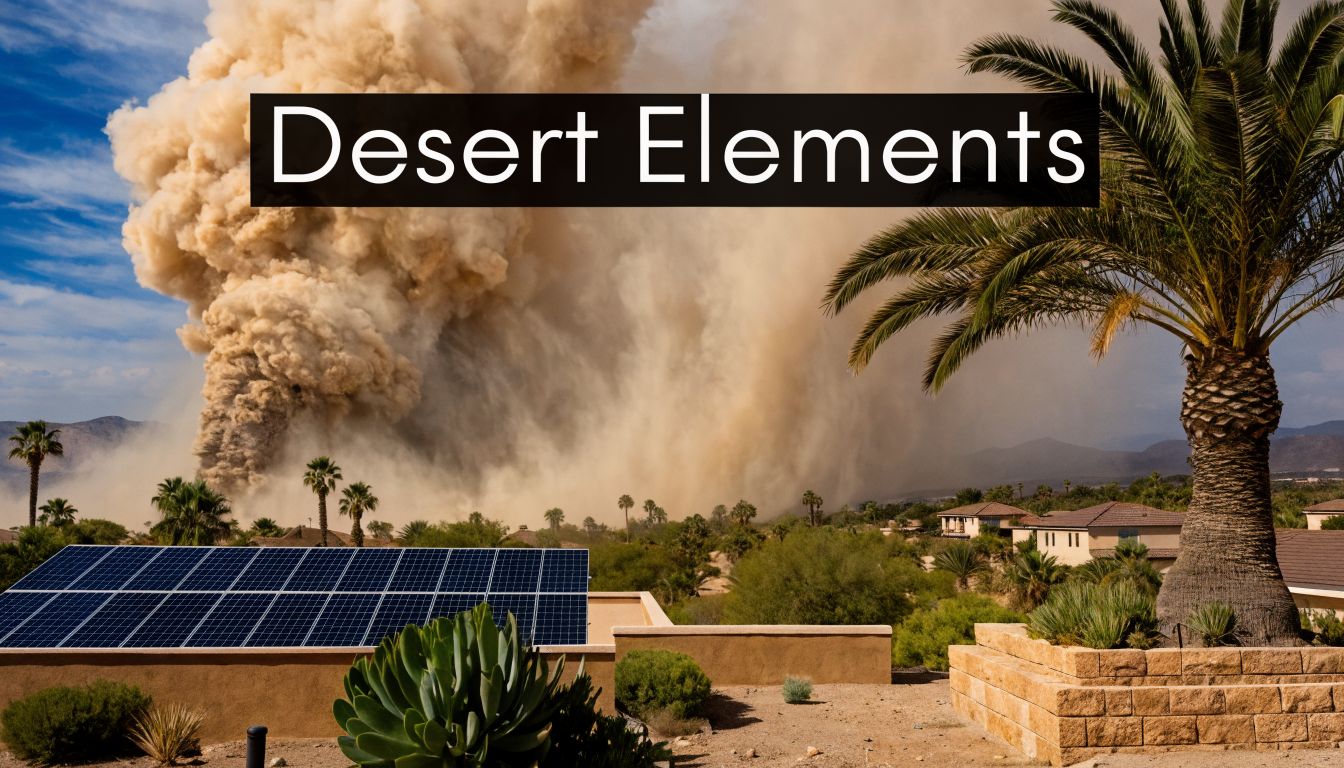
A haboob can coat a roof in material that looks light from the street but sits densely across the panel surface. Then monsoon rain hits. People assume that means a free rinse. Sometimes it helps. Often it leaves behind mud tracks, edge buildup, and dried spotting that a simple rain event won't remove.
Why rain isn't a reset button
In a rainy climate, regular showers can do some of the cleaning work. In Phoenix, rainfall often interacts with existing dust in a less helpful way. It moves the dirt around, then the heat dries it in place.
Three local troublemakers show up again and again:
- Haboob dust: Extremely fine and widespread, so it affects the whole array rather than one isolated section.
- Monsoon residue: Rain can turn loose dust into a bonded film instead of washing it off cleanly.
- Hard water spotting: Once mineral deposits dry on the glass, they can linger and keep reducing clarity.
This is why visual inspection matters more here than generic timing advice.
Why some homes see modest gains
Local conditions don't automatically mean every Phoenix homeowner should clean constantly. Roof pitch, panel tilt, surrounding trees, nearby roads, and recent weather all change the result.
The clearest reminder comes from the UC-related summary discussed here. It notes that cleaning tilted residential panels during a drought improved efficiency by 7.4%, representing just $20 in savings. That matters because many homes have tilted rooftop arrays, not flat commercial-style installations. It also reinforces a useful point for Phoenix owners: cleaning ROI depends heavily on recent dust storms and specific soiling, not just time passed.
What actually justifies a cleaning in Phoenix
A local homeowner usually gets the best value from cleaning when at least one of these is true:
- The panels took a clear dust-storm hit: You can see uniform buildup across most of the array.
- Rain made things worse: Instead of a clean surface, the panels show dried mud or patchy residue.
- There are stubborn deposits: Bird droppings or mineral spotting won't lift with natural weather.
- Monitoring and visual condition line up: Production is softer and the panels visibly look dirtier.
If your roof has moderate tilt, little recent storm activity, and only light dust, the gain may be real but small. If your neighborhood just went through a heavy wind event and the panels show a film across every row, the economics can shift quickly.
For homeowners trying to judge the condition of their own array before booking service, this guide on how to clean solar panels is useful as a visual reference for what surface buildup looks like and which residues usually need more than a rinse.
Local weather should drive the decision. The calendar should only be a reminder to look.
Protecting Your Warranty and Avoiding Costly Damage
Performance gets most of the attention, but protection is just as important. A residential solar system is a major asset. If cleaning is done improperly, you can lose more than production. You can create documentation problems, surface damage, or warranty headaches that cost far more than a routine service visit.
According to the manufacturer-focused guidance summarized by Chint Global, many solar panel manufacturers require regular cleaning as an explicit warranty condition. The same source states that failure to provide maintenance records can lead to warranty denial for a system that can cost over $15,000, while professional cleaning documentation helps protect that investment across its 25+ year lifespan.
What goes wrong with improper cleaning
Most damage doesn't come from the idea of cleaning. It comes from the method.
A few mistakes show up repeatedly on residential roofs:
- Abrasive tools: Dry wiping, stiff brushes, and rough pads can scratch the glass.
- Harsh chemicals: The wrong cleaners can affect coatings or leave residue behind.
- Hard water use: In Phoenix, mineral-heavy water can leave spotting that defeats the purpose of cleaning.
- Unsafe roof access: Sloped roofs, heat, and wet surfaces create obvious fall risk.
A scratched panel may still produce power, but the owner has introduced avoidable wear. A poorly documented DIY cleaning may also leave the homeowner with no clear proof that maintenance was performed according to manufacturer expectations.
Cleaning as risk management
Homeowners often think of solar panel cleaning as an efficiency service. It also functions as risk control. Proper maintenance helps preserve the physical condition of the panels and creates a record that the system was cared for appropriately.
That's especially relevant when an issue comes up later and the manufacturer, installer, or service company asks basic questions:
- Was the system maintained?
- Was it cleaned using approved methods?
- Is there any service history showing that care was documented?
If the answer to all three is unclear, the owner has less advantage.
Important distinction: A panel can survive a bad cleaning and still lose long-term value if the method creates scratches, residue, or warranty disputes.
Why Phoenix raises the stakes
Phoenix conditions make good technique more important. Heat dries water quickly. Mineral residue can bake onto the glass. Dust can turn into abrasive slurry if someone scrubs carelessly. Roof work in summer also carries obvious safety concerns.
That doesn't mean every homeowner must hire a professional every time. It does mean they should treat the task like panel maintenance, not like washing patio furniture. The benefits of solar panel cleaning only hold up when the cleaning itself doesn't create a more expensive problem.
DIY vs Professional Solar Cleaning The Definitive Comparison
National Renewable Energy Laboratory guidance has long noted that soiling can cut PV output, but the practical question for Phoenix homeowners is simpler. Will cleaning recover enough production to justify the cost and risk on this specific roof, in this specific climate?
That answer changes fast in the Valley. A lightly dusty, ground-mounted array after a normal dry spell is a different job from a two-story roof that took a haboob, then got baked with hard-water spotting after a monsoon rinse.
Side by side decision table
| Factor | DIY Cleaning | Professional Service |
|---|---|---|
| Cash outlay | Lower if you already have safe access, the right soft tools, and purified water | Higher upfront, but you are paying for labor, access, and technique |
| Safety exposure | You handle ladder setup, roof footing, and heat stress yourself | Crew handles roof access and work procedures |
| Cleaning quality | Can be fine for light dust on easy-to-reach panels | Usually better for baked-on residue, bird droppings, and spotting |
| Water risk | Phoenix tap water can leave mineral deposits if it dries on hot glass | Many pros use methods designed to avoid hard-water residue |
| Time | You spend part of a morning inspecting, cleaning, rinsing, and checking for streaks | Homeowner time is limited to scheduling and a quick post-job review |
| Documentation | Usually informal unless you keep your own records and photos | Service records are easier to retain for maintenance history |
| Best fit | Accessible arrays with mild soiling and an owner comfortable with the work | Roof-mounted systems, steeper pitches, stubborn grime, or owners who want lower hassle |
When DIY makes financial sense
DIY is reasonable when the system is easy to reach and the panels have light surface dust rather than stuck-on grime. In those cases, the actual savings come from avoiding a service call, not from some dramatic production jump. If the array is visible from the ground, the roof is low-risk, and you can clean without leaving mineral residue, doing it yourself can be a rational choice.
The trade-off is that DIY only stays cheap if the job stays simple.
For homeowners who want a realistic look at tools, safety limits, and where self-cleaning stops making sense, this guide to DIY solar panel cleaning covers the decision points well.
When hiring a professional is the better buy
Professional cleaning usually pencils out better on Phoenix roofs with one or more complicating factors. Common examples include second-story access, steep tile roofs, heavy dust after a storm, bird droppings near the lower edge of the array, or visible spotting from hard water.
I see one mistake often. Homeowners compare a cleaning quote only to the price of doing it themselves with a hose. That leaves out local variables, roof safety in high heat, the chance of leaving mineral film behind, and the time required to do the job carefully.
For a broader sense of how access and material sensitivity affect exterior maintenance pricing, this overview of professional residential and commercial cleaning services gives useful context.
Sparkle Tech Window Washing LLC offers solar panel cleaning in the Phoenix area as part of exterior maintenance work. That matters less as a brand point than as a local-service point. In Phoenix, method matters because dust, heat, and hard water create a different cleaning problem than homeowners in milder climates face.
A practical rule for Phoenix homeowners
Use DIY for light dust on safe, accessible systems. Hire out when access is difficult, residue is bonded to the glass, or the cost of one mistake is higher than the service price.
That is the key comparison. Not DIY versus professional in the abstract. Cost, access, water quality, roof risk, and actual soiling level on your home.
Your Solar Panel Questions Answered and Next Steps
Most homeowners don't need more theory at this point. They need direct answers.
Does rain clean solar panels
Not reliably in Phoenix. Light rain can remove loose dust, but monsoon moisture often mixes with existing grime and leaves residue behind once it dries. If the panels look streaked, patchy, or dull afterward, the rain didn't really solve the problem.
What's a clear sign that cleaning is worth considering
Look for two things at the same time. First, visible buildup such as general haze, dried residue, bird droppings, or spotting. Second, production that seems softer than expected for the season. When appearance and performance both point in the same direction, cleaning becomes a much stronger candidate.
Are all dirty panels losing the same amount of power
No. That's one of the biggest myths in this space. Some arrays lose very little from light dust on tilted roofs. Others take a meaningful hit after a dust storm or long dry stretch. The benefits of solar panel cleaning depend on actual soiling, not a blanket rule.
What cleaning products are safe
The safest approach is to follow your panel manufacturer's guidance exactly. In general, harsh chemicals, abrasive pads, and anything that can leave residue or scratch the surface should stay off the roof. In Phoenix, the water source matters too because mineral-heavy water can leave spots behind.
Is there a simple visual check I can do from the ground
Yes. Stand where the array catches angled morning or evening light. If the glass looks evenly glossy, that's a good sign. If it looks hazy, blotchy, or visibly spotted across multiple panels, surface contamination is probably affecting performance to some degree.
Should I clean right after a haboob
Usually, it makes sense to inspect first and act based on what landed on the array. Some dust events leave a light layer. Others leave broad, obvious buildup that warrants quick attention. The stronger the visible film across the array, the stronger the cleaning case.
What about hard water spots from a previous rinse
Those often need proper treatment and technique. They usually won't disappear with more tap water. Repeated rinsing with mineral-heavy water can make the finish worse, not better.
What to do next
For Phoenix-area homeowners, the smartest approach is simple:
- Inspect the panels after major dust or rain events.
- Compare the surface condition with your recent production trend.
- Avoid aggressive DIY methods if access is difficult or residue is stubborn.
- Keep records of maintenance, especially if warranty compliance matters.
If your panels are lightly dusty and easy to reach, you may decide to wait and monitor. If they're roof-mounted, visibly coated, or carrying mineral residue and bird waste, cleaning shifts from optional upkeep to sensible asset maintenance.
Solar cleaning isn't automatically urgent, but it also isn't fluff. In Phoenix, done at the right time and with the right method, it protects output, supports warranty compliance, and helps the system deliver the return you expected when you installed it.
If your solar panels in Scottsdale, Peoria, or the greater Phoenix area look dusty, streaked after monsoon weather, or just aren't producing like they should, Sparkle Tech Window Washing LLC offers solar panel cleaning using environmentally friendly, non-toxic cleaning agents, with licensed and insured service, documented maintenance support, and a 10-day service and rain guarantee. You can request a free, no-obligation quote to see whether a professional cleaning makes sense for your roof and current panel condition.