
Your utility bill says the solar array should be pulling harder than it is. The monitoring dashboard looks flat compared with the same stretch last season. Then you walk the roof in Phoenix and the answer is sitting there in plain view: a baked-on layer of dust, pollen, and grime that rain never really handled.
That's a common commercial property problem in the Valley. Panels don't have to look terrible from the parking lot to be underperforming. In Phoenix, a thin film is enough.
Protecting Your Solar Investment in the Valley of the Sun
Phoenix businesses install solar for a simple reason. They want predictable energy savings from a major capital asset. But in this market, heat, dust, and low rainfall work against that goal almost every day. If you treat cleaning as an occasional add-on, the system usually pays you back less than it should.
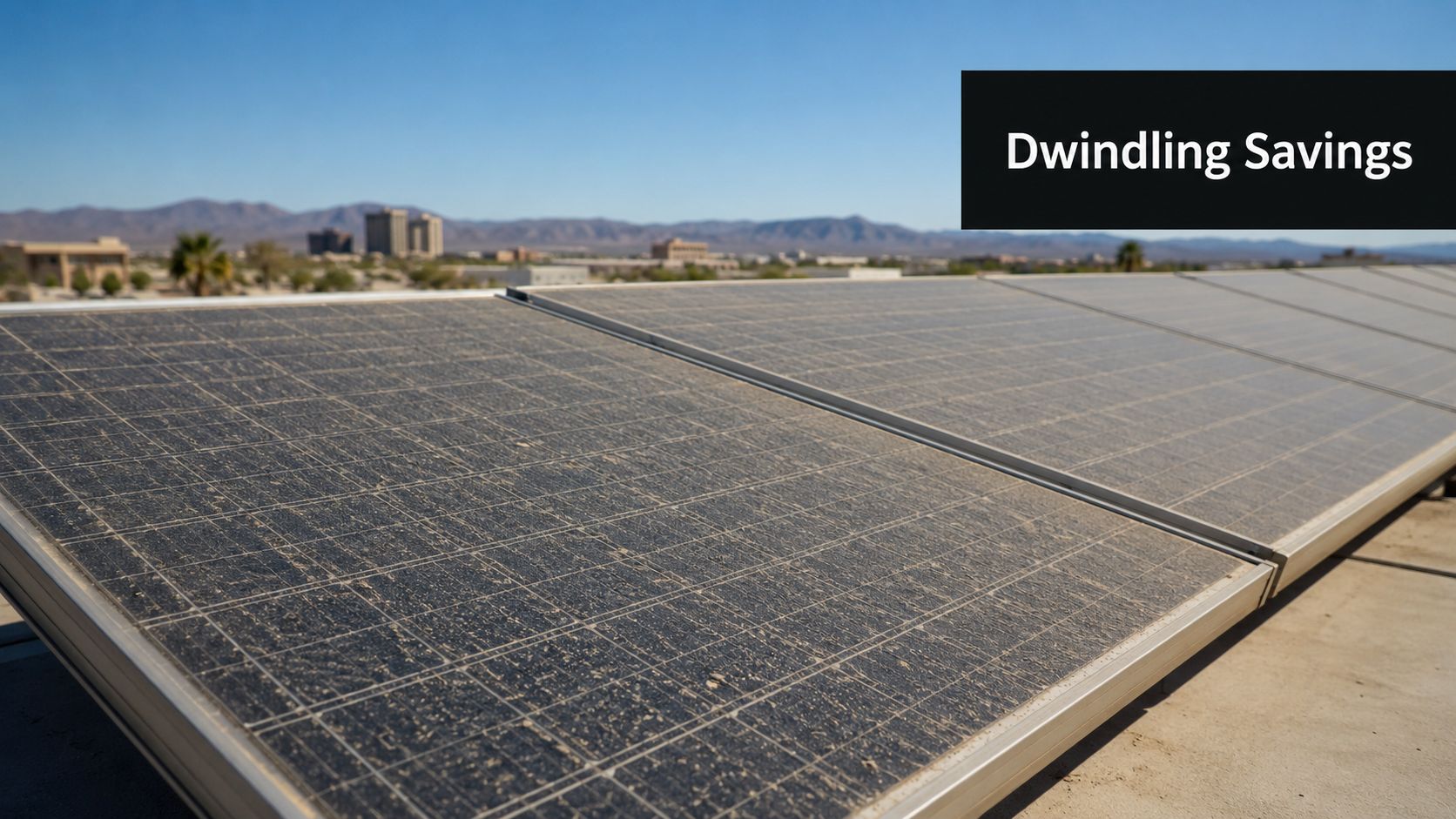
The industry has moved in that direction too. One market analysis valued the global solar panel cleaning market at USD 1.22 billion in 2025 and projected 3.5% CAGR from 2026 to 2035, reflecting how operators increasingly treat cleaning as part of routine O&M tied to efficiency and ROI, not a cosmetic service (market analysis on solar panel cleaning).
If you manage office, retail, industrial, HOA, or mixed-use property, you already know the primary challenge isn't buying panels. It's protecting output after installation. Sales teams talk a lot about system value up front, and VP of Sales' solar panel insights are useful for understanding how buyers evaluate solar decisions in the first place. On the maintenance side, the same logic applies. Performance expectations only matter if the array stays productive.
Why Phoenix changes the equation
In milder climates, a property manager can sometimes get away with a simple calendar reminder. Phoenix isn't that kind of market. Haboobs dump fine dust across entire roofs. Intense sun bakes bird droppings onto glass. Hard water leaves residue if the job is done poorly. Even when panels still “look okay,” light transmission can already be compromised.
Practical rule: In Phoenix, commercial solar panel cleaning is usually a revenue-protection decision, not a curb-appeal decision.
For a straightforward overview of local benefits, this guide on why solar panel cleaning matters in Phoenix is worth reviewing before you build out a maintenance budget.
The High Cost of Dirty Solar Panels in Phoenix
A dirty panel works like a dusty windshield pointed at the sun. The light is still there, but less of it reaches the surface cleanly. On a commercial array, that small reduction gets multiplied across every module, every hour of production, every billing cycle.
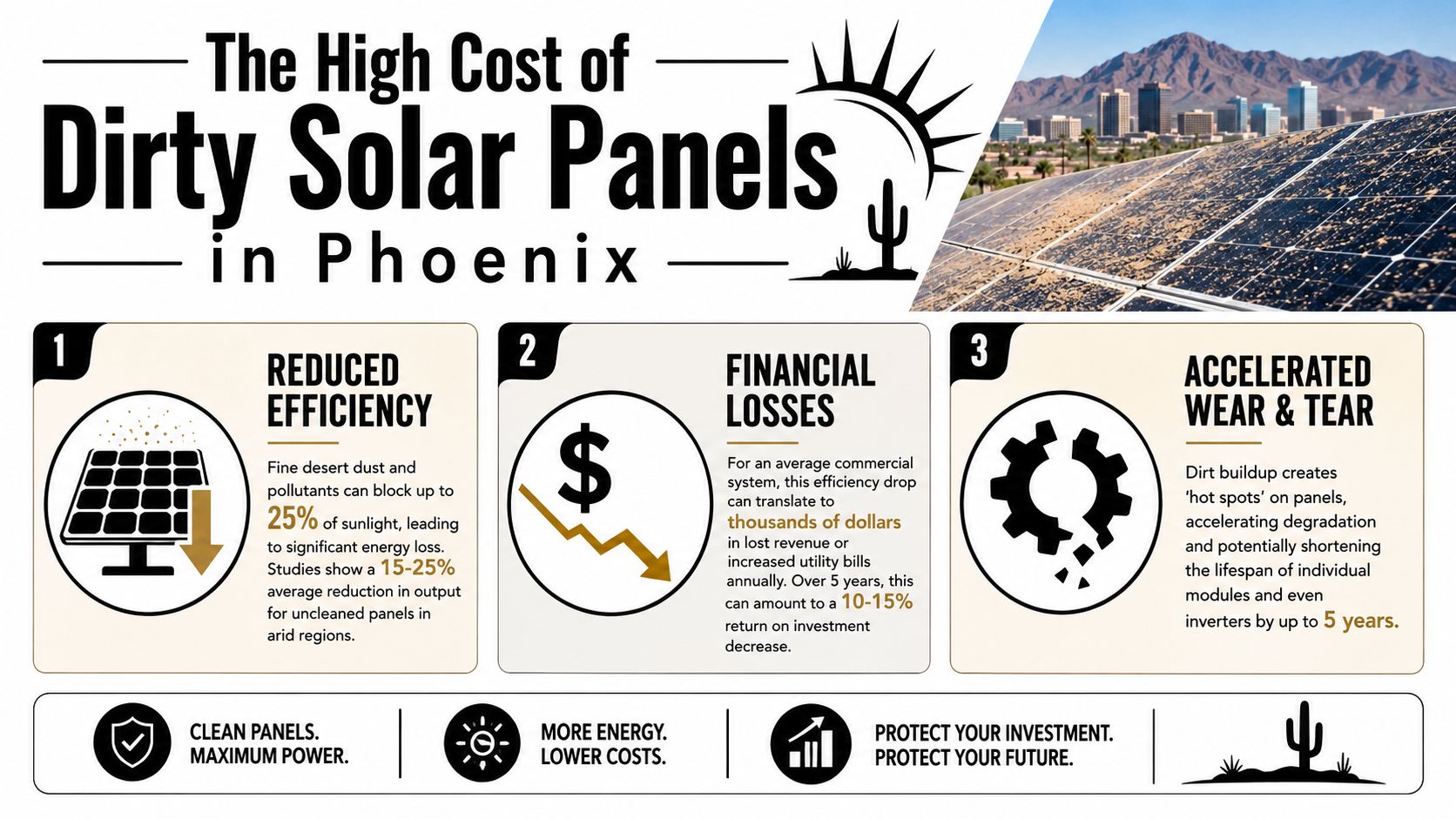
Phoenix makes soiling more aggressive than generic maintenance articles suggest. Fine desert dust settles after wind events. Spring pollen sticks in corners and along lower edges. Bird droppings harden quickly under intense sun. Rooftops near freeways, distribution corridors, and active development pick up an extra layer of airborne residue that doesn't rinse away on its own.
Industry coverage summarizes the performance stakes clearly. Dirty panels can lose 15% to 30% of efficiency, and in high-dust conditions, cleaning can improve efficiency by up to 35% (commercial solar panel cleaning benchmarks).
What that grime actually does on a Phoenix roof
There's a difference between loose dust and stubborn buildup.
- Loose surface dust can spread evenly across the array and reduce light transmission.
- Pollen and urban film tend to create a patchy haze that's easy to miss from ground level.
- Bird droppings are more concentrated and often become the biggest localized issue because the residue bakes onto the glass.
- Runoff patterns from parapets, HVAC discharge, and roof debris can create repeated dirty bands on specific rows.
Those patterns matter because they tell you whether a site needs ordinary preventive service or closer operational attention.
Why waiting for visible dirt is a mistake
Property managers sometimes wait until panels look obviously dirty from the ground. That's usually late. By then, the site has often been carrying avoidable production loss for weeks or months.
A Phoenix array can underperform long before it looks neglected. The panel surface only needs a light film to start costing you output.
The business impact also shows up unevenly. A clean office roof in North Scottsdale won't behave like a warehouse near construction in the West Valley. A shopping center near traffic and landscaping debris won't soil like a medical office with a steeper, cleaner roofline. That's why “we cleaned it last year” isn't a maintenance strategy. It's just a date.
Signs your site is losing output to soiling
Use a simple field check before you assume a technical fault:
- Production drift without an equipment alarm often points to surface buildup.
- Visible dirty edges or corners usually mean the center glass is carrying a lighter version of the same film.
- Spotting after a previous cleaning suggests the wrong water or method was used.
- Recurring bird activity almost always means certain sections need more attention than the rest of the roof.
If you're seeing those signs in Phoenix, commercial solar panel cleaning stops being optional maintenance and becomes a practical step to protect the economics of the system.
Your Phoenix Area Solar Cleaning Schedule
A fixed annual schedule sounds neat on paper. In Phoenix, it often fails in practice. Dust storms, dry months, roadside pollution, nearby construction, pollen bursts, and bird activity don't follow a tidy calendar. Good scheduling starts with site conditions, not habit.
Preventive guidance for commercial arrays usually lands at every 6 to 12 months in moderate environments, with service as often as monthly for locations near construction, farms, or heavily polluted areas (preventive cleaning guidance for commercial PV arrays).
How local conditions change frequency
In the Phoenix metro, location tells you a lot.
A mid-rise in central Phoenix with limited landscaping exposure may only need a modest preventive schedule. A property in Goodyear or Buckeye with open land nearby can collect dust fast after wind events. An office complex near major roadways can develop a constant film from traffic particulates. Rooftop arrays under frequent bird pressure almost never stay clean as long as owners expect.
The other variable is roof design. Low-slope commercial roofs hold onto dust differently than steeper installations. Drainage paths, parapet walls, and nearby mechanical units also affect where grime settles.
Recommended Phoenix Solar Cleaning Frequency
| Site Location/Type | Primary Soiling Factor | Recommended Frequency |
|---|---|---|
| Central Phoenix office or medical building | Urban dust and light pollution film | Every 6 to 12 months |
| Scottsdale or Paradise Valley property with landscaping and spring pollen | Pollen, organic residue, bird activity | About every 3 to 6 months |
| West Valley industrial or warehouse site near open land | Windblown desert dust and post-storm buildup | Quarterly |
| Property near active construction | Fine particulate dust and repeat settling | Monthly to quarterly |
| Site near agricultural edges or farmland | Soil dust, seasonal debris, airborne particulates | Monthly to quarterly |
| Retail or mixed-use roof with heavy bird presence | Bird droppings and uneven hotspot soiling | Every 3 months or based on inspection triggers |
A practical way to set the schedule
Don't start with “How often should any solar array be cleaned?” Start with these questions:
- What lands on the panels most often? Dust, pollen, bird waste, roadway film, or construction debris all behave differently.
- How quickly does the site get dirty again? Some roofs rebound fast after a wash. Others stay relatively stable.
- What does your monitoring show after storm periods? If output softens after known dust events, tie service to those patterns.
- How hard is roof access? If mobilization is complex, preventive scheduling matters even more.
The best Phoenix cleaning schedule is the one that matches how your roof gets dirty, not the one copied from a national checklist.
If you want a more localized planning reference, this article on how often to clean solar panels in Arizona conditions gives a useful starting point for comparing your site against common Valley scenarios.
Professional Cleaning Methods and Safety Protocols
The difference between a professional solar cleaning job and a risky shortcut usually comes down to three things: water quality, pressure control, and roof discipline. If any one of those is handled poorly, the array may look cleaner for a day and still be left with residue, scratches, or avoidable risk.
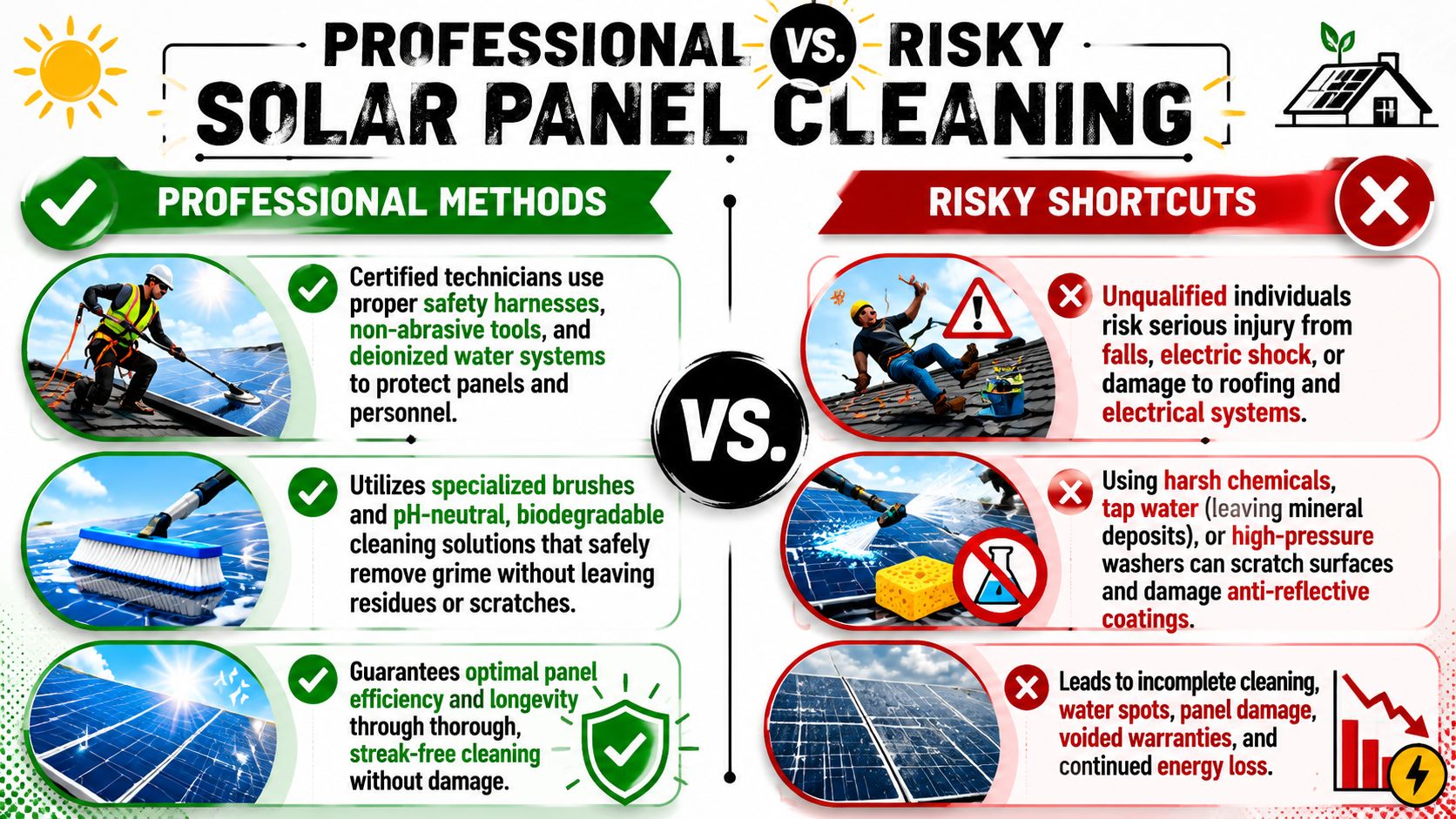
Technical guidance is clear on the basics. Use low-pressure water, keep spray pressure under 100 PSI, use non-abrasive tools, and use distilled or deionized water when possible to reduce mineral spotting and protect anti-reflective coatings (technical cleaning guidance for solar panels).
What professionals do differently
A trained crew doesn't show up with a pressure washer and a bottle of generic soap.
A proper commercial solar panel cleaning setup typically includes soft-bristle brushes, water-fed poles or controlled hose systems, purified water, and a methodical roof route that avoids dragging tools, hoses, or footwear across sensitive equipment. The point isn't to scrub aggressively. The point is to remove buildup without creating a second problem.
On Phoenix roofs, purified water matters more than many owners realize. Tap water can leave behind mineral residue, especially in heat. That spotting can dry fast and reduce the quality of the result.
One local option property managers may consider is Sparkle Tech Window Washing LLC's solar panel cleaning service, which includes solar panel cleaning as part of its commercial exterior service offering in the greater Phoenix area.
What doesn't work
The shortcuts are predictable:
- High-pressure washing can force water where it shouldn't go and can damage surfaces.
- Abrasive pads or steel wool can scratch coatings.
- Harsh detergents can leave residue or create compatibility issues with panel finishes.
- Untrained maintenance staff on the roof create liability well beyond the cleaning task itself.
If a contractor treats solar glass like concrete, storefront glass, or painted metal, they're using the wrong mindset for the job.
This video gives a useful visual reference for safe field technique and roof handling:
Safety isn't a side issue
On commercial sites, the cleaning method matters. So does the work environment. Crews need to understand rooftop movement, fall protection, electrical awareness, hose management, and how to work around mounting systems without stressing hardware or roof surfaces.
A cheap bid often leaves these details out. That's how property managers end up paying twice. Once for the bad cleaning. Again for damage control, access issues, or internal risk review after the fact.
When I look at a Phoenix commercial roof, I don't just think about getting glass clean. I think about the array, the roof membrane, the edge conditions, the water source, the weather window, and the people walking that roof. That's what separates maintenance from guesswork.
Decoding the Cost and ROI of Panel Cleaning
Most property managers ask the right question first: is cleaning worth the cost on this site, at this time, under these conditions? That's the correct framing. Commercial solar panel cleaning should be evaluated like any other maintenance line item. It has to protect revenue, reduce avoidable loss, or lower risk enough to justify the spend.
The pricing side is straightforward in concept and variable in practice. Contractors may quote by panel count, roof area, access complexity, or as a flat project price. The quote changes based on array size, roof height, roof pitch, obstruction density, water access, safety setup, and how severe the buildup is when the crew arrives.
What actually drives the price
Two sites with similar system sizes can price very differently.
A clean, accessible roof with simple hose runs and safe walking paths takes less labor than a congested roof with multiple setbacks, fragile surfaces, restricted access hours, and stubborn residue. That's why experienced estimators build around labor, access, and risk, not just square footage. If you want a useful comparison from the broader commercial cleaning world, how to price commercial cleaning explains why guessing creates bad bids and bad service.
For Phoenix properties specifically, this local guide to solar panel cleaning service cost can help frame what usually changes a quote.
The break-even question matters
Many cleaning pages, however, become too simplistic. Not every array benefits equally from routine washing on a fixed calendar.
UC San Diego engineers found that for some systems, especially those with steeper tilt, the energy gains from cleaning may not justify the cost. They also noted dirt losses are worse on very low-tilt panels, which means the business case depends heavily on site design and measured performance, not just a generic schedule (UC San Diego findings on cleaning economics).
That's especially relevant in Phoenix because many commercial rooftops use low-slope layouts. On those roofs, dust can linger longer and rain doesn't do much cleaning. But the point still isn't “clean everything constantly.” The point is to make a defensible decision.
A practical ROI framework for property managers
Use this framework when reviewing a cleaning proposal:
- Check monitoring data first. If output has drifted and no equipment issue is present, soiling becomes a stronger suspect.
- Look at tilt and drainage behavior. Lower-tilt roofs usually need closer attention than steep arrays.
- Map the dirt source. Dust storm exposure, nearby development, traffic corridors, and birds all change the payback case.
- Ask whether the bid reflects preventive service or recovery cleaning. Heavily neglected arrays often cost more to restore than to maintain.
Good contractors don't just sell frequency. They help you decide when the cleaning cycle actually makes financial sense.
That kind of conversation is what property managers should expect. If a vendor can't explain why your site needs the schedule they recommend, they're selling a calendar, not managing an asset.
How to Choose the Right Phoenix Cleaning Provider
Hiring for commercial solar panel cleaning in Phoenix isn't the same as hiring a basic exterior wash crew. You need a vendor that understands rooftop work, panel-safe methods, scheduling discipline, and the local dust conditions. Low price alone usually tells you very little.
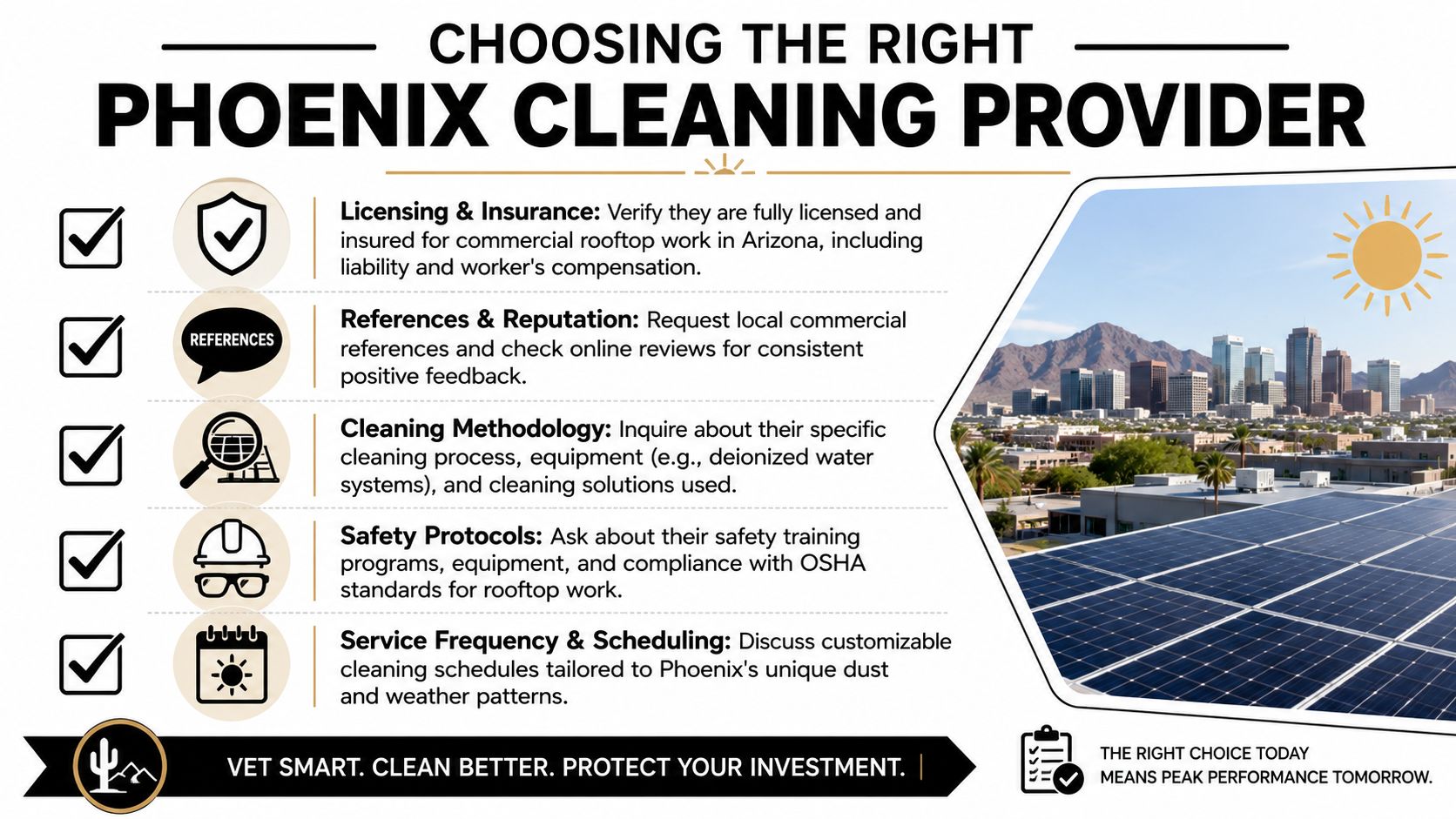
A solid vetting process should feel closer to contractor screening than commodity shopping. For a broader facility-management perspective, this piece on vetting cleaning service providers is a useful companion when you're comparing vendors.
The checklist that matters
Use a short list, but make it strict.
- Licensing and insurance. Verify the company is properly insured for commercial rooftop work, including liability and workers' compensation.
- Method clarity. Ask exactly what water, tools, and pressure levels they use.
- Commercial roof experience. A crew that mainly cleans storefront glass may not be prepared for larger arrays and access constraints.
- Safety process. Ask how they handle roof access, edge awareness, and work around energized equipment.
- Local references. Phoenix-area experience matters because the soil load here behaves differently than in wetter markets.
Questions worth asking before you sign
Don't ask only “What's your price?” Ask how they think.
Here are better questions:
- How do you clean without leaving mineral spotting on panels in Phoenix heat?
- What do you avoid using on panel surfaces?
- How do you handle bird droppings or baked-on residue?
- What changes your recommended frequency from one site to another?
- What documentation do you provide after service?
The answers tell you whether they understand the work or are improvising.
Watch for these red flags
Some warning signs show up fast:
- They recommend high-pressure washing
- They can't explain water type
- They treat every property the same
- They have no process for rooftop safety
- They underbid heavily without asking access questions
A serious provider asks detailed questions before quoting because the roof, the array, and the soil load all affect the job.
Service guarantees also deserve attention. A company willing to stand behind workmanship after the visit is usually more confident in its process than one that disappears once the invoice is paid. In Phoenix, where dust and weather can change conditions quickly, that matters.
Maximize Your Energy Output with Sparkle Tech
In Phoenix, solar performance gets shaped by local conditions more than generic maintenance advice admits. Dust storms, dry months, baked-on residue, and low-slope commercial roofs all make cleaning decisions more site-specific. That's why the best approach is practical, not automatic. Check the roof conditions, review production data, match the schedule to the site, and use a provider that cleans panels safely.
A professional job protects more than output. It protects the panel surface, the roof, your maintenance budget, and your liability profile. It also helps you avoid the two most expensive mistakes in this category: cleaning too casually and waiting too long.
If you manage commercial property in Phoenix, Scottsdale, Peoria, Paradise Valley, Goodyear, or the surrounding Valley, local experience matters. Sparkle Tech Window Washing LLC has over 15 years of experience serving the greater Phoenix area, is licensed and insured, and backs service with a 10-day service and rain guarantee, which makes it a practical fit for property managers who need dependable exterior maintenance support based on real local conditions.
If your building's solar production has started to slip, or you're trying to set a smarter preventive schedule before the next dust cycle, Sparkle Tech Window Washing LLC can help you evaluate the site, clean the array with panel-safe methods, and build a maintenance plan that fits Phoenix conditions instead of a generic national template.