


There’s nothing quite like a clear view of the desert landscape from your second-story window, but here in Phoenix, that view is often obscured by a stubborn layer of dust and hard water spots. Getting those upper windows clean might seem daunting, but it’s definitely doable. You really have three solid options: the old-school extension ladder and squeegee, a modern water-fed pole that lets you work from the ground, or simply calling in a professional window cleaning crew.
Deciding which route to take really comes down to your house, your comfort level with heights, and the equipment you have on hand.

Choosing Your Second Story Window Cleaning Method
Let's break down these methods to help you figure out the best fit. This isn't just about getting the glass clean; it’s about weighing the risks, costs, and the kind of results you're after. We've cleaned thousands of windows across Scottsdale, Peoria, and the rest of the Valley, so we know exactly what works—and what doesn't—in our unique desert environment.
The Traditional Ladder and Squeegee
This is the classic, hands-on approach. Climbing a ladder gives you direct access to the glass, which is great for tackling tough grime and getting that perfect, streak-free finish with a squeegee.
However, this is by far the riskiest method. Ladder safety is no joke, and it takes physical strength and confidence to manage your tools while perched 20 feet or more in the air. This is best left to those who are very experienced and comfortable working at height.
The Ground-Safe Water-Fed Pole System
A much safer—and increasingly popular—option is the water-fed pole. These are long, telescoping poles with a brush on the end that spray purified water. You can stand safely on the ground and scrub windows two or three stories up.
The real magic is the purified water. Because it has no minerals, it dries completely spot-free, which is a huge advantage against our notoriously hard water in Arizona. The main drawback? The initial investment for a quality system can be steep.
Hiring a Professional Window Cleaning Service
For many homeowners, this is the smartest choice. Bringing in a licensed and insured pro like Sparkle Tech takes all the risk and guesswork out of the equation. A professional crew arrives with commercial-grade equipment, specialized knowledge for dealing with things like sunscreens and mineral stains, and the job gets done efficiently and safely.
While it's the most expensive option per cleaning, it saves you time, eliminates the need to buy and store bulky equipment, and delivers guaranteed, flawless results.
Choosing Your Second Story Window Cleaning Method
To make the decision easier, here's a quick comparison of the three main approaches. Think about your home's specific needs, your budget, and what you're most comfortable with.
| Method | Best For | Pros | Cons |
|---|---|---|---|
| Ladder & Squeegee | Experienced DIYers who are comfortable with heights and already own a good extension ladder. | Allows for direct, detailed scrubbing. Lower initial cost if you own the equipment. | Highest risk of serious injury. Physically demanding and time-consuming. |
| Water-Fed Pole | Homeowners who prioritize safety above all else and want to avoid ladders completely. | Extremely safe since you stay on the ground. Great for reaching high or awkward windows. | High upfront cost for quality equipment. Can be unwieldy to handle without practice. |
| Professional Service | Anyone with a multi-story home, hard-to-reach windows, or who values safety and guaranteed results. | Zero personal risk and total peace of mind. Superior, streak-free finish. Saves you a ton of time and effort. | Highest cost per cleaning, but no need to buy or store your own tools. |
Ultimately, a small second-story window on a Scottsdale ranch-style home might be a manageable DIY project with a pole. But for a large two-story house in Paradise Valley with complex window designs, calling a pro is almost always the safer and more effective call.
Gathering Your Tools: What You'll Actually Need
Trying to clean second-story windows without the right gear is a recipe for frustration and, more importantly, a serious safety risk. Having the correct tools on hand isn't just about getting a streak-free shine; it's about making sure the job gets done safely and efficiently from start to finish.
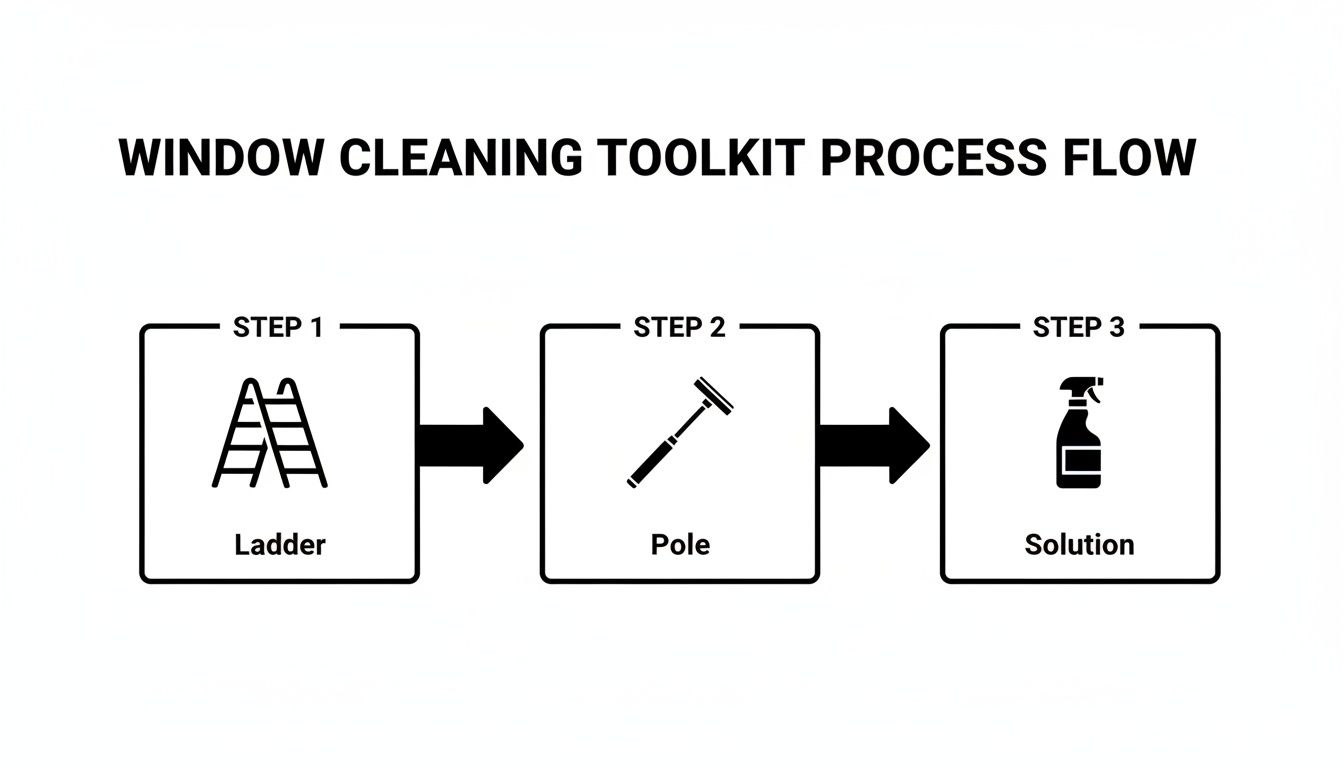
Before you get started, take a moment to gather your equipment. What you need will depend on how you plan to tackle the job—either with a traditional ladder or with a ground-based water-fed pole system. Let’s look at the essentials for both.
For the Traditional Ladder Approach
If you're comfortable working at height and going the hands-on route, your toolkit is all about stability. Every piece of equipment here plays a crucial role in keeping you safe.
- Extension Ladder: You'll need a solid aluminum or fiberglass ladder that can extend at least 3 feet above the sill of your highest window. That extra height is critical—it gives you something to hold onto and prevents dangerous overreaching.
- Ladder Stabilizer: I consider this a non-negotiable piece of safety equipment. This U-shaped attachment braces the top of the ladder against the house, creating a much wider, more stable point of contact. It stops the ladder from sliding sideways and protects your gutters and siding from damage.
- Proper Footwear: Wear sturdy, closed-toe shoes with great grip. Never climb a ladder in sandals or old sneakers with worn-out soles.
- Tool Belt or Bucket Hook: Keeping your hands free is essential for maintaining three points of contact on the ladder. A simple tool belt lets you carry your squeegee and scrubber securely, so your hands are free for climbing.
Always give your ladder a quick inspection before you use it. Check for any loose rivets, cracked rungs, or frayed ropes. A damaged ladder is an accident waiting to happen, and it's simply not worth the risk.
For the Modern Water-Fed Pole Method
For anyone who’d rather keep their feet on solid ground, the water-fed pole system is the way to go. It’s significantly safer and a lifesaver for reaching those awkward windows above landscaping or on sloped ground.
The star of the show here is the telescoping pole. For most two-story homes in the Peoria or Goodyear area, a pole that extends from 20 to 30 feet will do the trick. I recommend choosing one made from lightweight carbon fiber or aluminum to help reduce arm fatigue, especially on a warm day.
Attached to the pole is the brush head. You’ll want a brush with soft bristles specifically designed for windows to avoid scratching the glass. Many of these have built-in jets that spray purified water right where you're scrubbing, making the process incredibly efficient.
Setting Up a Safe Zone & Mixing Your Cleaner
No matter which method you choose, take a minute to secure your work area. A few orange cones or a simple sign can alert your family or neighbors that you're working, preventing someone from accidentally bumping your ladder or tripping over a water hose.
Now, for the cleaning solution itself. You don’t need harsh chemicals that can scorch your desert landscaping or pose a risk to pets. A simple, homemade mix works wonders.
Our Go-To Eco-Friendly Window Cleaner:
In a bucket, mix one part white vinegar with ten parts warm water. Then, add just a few drops of a biodegradable dish soap. The soap acts as a surfactant, breaking down the water's surface tension so it can lift dirt and grime right off the glass.
This vinegar solution is a fantastic natural degreaser and won't leave any harmful residue behind—a big plus for homeowners from Anthem to Paradise Valley who care about their yards.
Finally, you have your primary cleaning tools. You’ll use a strip washer (also known as a scrubber) to apply your cleaning solution and scrub away the built-up dust and dirt. Then, you'll follow up with a high-quality squeegee to whisk the water away, leaving nothing but a perfectly clear finish. If you want to dive deeper into what makes a professional-grade squeegee, check out our guide on how to find the best squeegee for washing windows.
The Traditional Ladder and Squeegee Method
If you’re comfortable working on a ladder and want that hands-on control, the classic ladder and squeegee method is hard to beat. This approach gets you right up close to the glass, letting you put some real muscle into scrubbing away the stubborn grime and dust that a pole from the ground might not touch. There's a reason the pros have used it for decades—when you get it right, the results are flawless.
But let’s be clear: this is not a job to rush. Safety is everything here. It all comes down to setting up your ladder correctly and moving with intention.
Securing Your Ladder The Right Way
Before you take a single step up, your ladder's placement is your number one safety priority. You have to find a patch of firm, level ground for the base. Stay off soft, squishy grass, mulch beds, or any slanted surfaces where the ladder's feet could suddenly shift.
Next, you need to get the angle just right. The industry-standard is the 4-to-1 rule: for every four feet of ladder height, the base should be one foot away from the wall. So, if your window is 16 feet up, the feet of the ladder need to be exactly four feet out from the house. This angle gives you the perfect balance of stability, so the ladder won't tip backward or slide out from under you.
A non-negotiable safety rule: make sure your extension ladder reaches at least three feet above the windowsill or roofline you’re working on. That extra length gives you something firm to hold onto as you get on or off the ladder, which is where most accidents happen.
Mastering The Squeegee For A Streak-Free Finish
Once your ladder is secure, it's time to make those windows shine. The professional technique is a specific sequence that lifts away every speck of dirt, leaving nothing but crystal-clear glass.
First, dip your strip washer (you'll also hear it called a scrubber) into your bucket of cleaning solution. Wring it out well—you want it damp, not dripping wet. Scrub the entire window, giving a little extra attention to the corners and edges where dust and cobwebs love to hide. This loosens up all the grime so the squeegee can do its job.
Now for the squeegee. To get a truly streak-free finish, pros always start by "cutting the edge." Just take a dry, clean cloth and wipe a narrow, one-inch strip down the side of the glass. This creates a dry starting point for your squeegee and stops water from seeping back in from the frame.
Place your squeegee at the top of the window, angled slightly, and pull it down in one smooth, unbroken motion. After every single pass, wipe the rubber blade clean with your cloth. This is crucial—a dirty blade is the number one cause of streaks. On your next pull, just overlap the last stroke by about an inch to avoid leaving any little lines of water.
If you really want to perfect your technique, check out our complete guide on how to get streak-free windows.
Tackling The Interior Of Second Story Windows
Getting to the inside of those upper-story windows can be tricky, especially over a staircase or in a two-story great room. You obviously can’t prop a giant extension ladder in your foyer.
Here are a few ways to handle it safely from the inside:
- Tilt-In Windows: Check to see if you have modern tilt-in windows. Look for small latches on the top or sides of the window sash. These allow the window to fold inward, giving you easy access to clean the exterior glass from the safety of your room.
- Small Step Ladders: For those windows that are just out of arm's reach, a sturdy A-frame stepladder is often all you need. Just be sure it’s on a solid, flat floor.
- Interior Poles: A smaller, handheld extension pole with a scrubber and squeegee attachment works wonders for high-up interior glass, like in a vaulted entryway. It saves you from trying to set up scaffolding or a ladder in an awkward spot.
Deciding to DIY this project is a trade-off between your time and your tolerance for risk. Keep in mind that cleaning second-story windows can easily take 50% longer than ground-floor ones. Professionally, this often adds $3 to $5 per window in labor costs. With ladder-related injuries in the U.S. hitting over 81,000 annually, hiring an insured professional is often the smartest and safest investment.
Using a Water-Fed Pole System for Ground-Level Safety
Let's be honest, not everyone is comfortable spending their weekend perched on a 20-foot ladder. If you're looking for a way to clean your second-story windows with both feet planted firmly on the ground, a water-fed pole system is the answer. It’s hands-down the safest and most effective way for a homeowner to get professional-looking results without the risk.
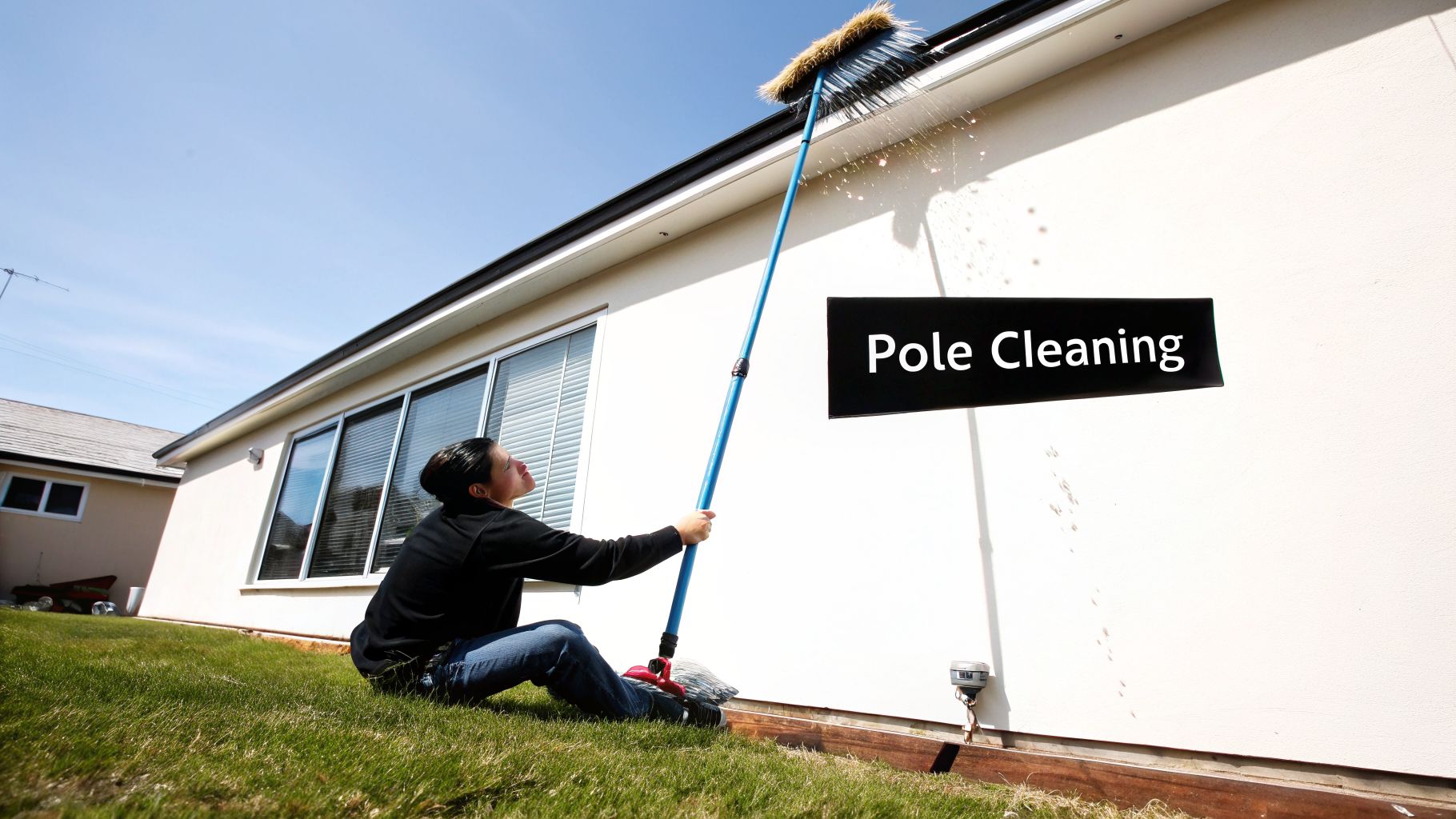
These systems use a long, lightweight telescoping pole fitted with a soft-bristled brush. Water flows through the pole and out of jets in the brush head, letting you scrub and rinse from the safety of your lawn or patio. But the real genius behind this method isn't the pole—it's the water itself.
Why Purified Water Is the Secret Ingredient
A true water-fed pole system isn't just about squirting water; it connects to a deionization (DI) or reverse osmosis (RO) filtration unit. This tank is the key. It strips every last mineral and impurity—what we call total dissolved solids (TDS)—from your tap water.
Here in hard-water hotspots like Phoenix and Mesa, this is a total game-changer.
When you use regular tap water, it evaporates and leaves behind all those minerals, creating the very spots and streaks you were trying to clean. Purified water, on the other hand, has a TDS of 0 parts per million. It’s so pure that when it evaporates, it leaves absolutely nothing behind. This means you scrub, rinse, and just let it air dry. No squeegee needed.
A water-fed pole solves the two biggest headaches of window cleaning: the danger of ladders and the tricky art of using a squeegee on a pole. It transforms a high-risk job into a simple, manageable task.
The need for effective cleaning is especially high in our climate. It's a known fact that urban areas like Phoenix require 2-4 times more window cleaning than rural spots. Here in the Valley, from Scottsdale to Glendale, we see desert dust and monsoon grime build up 40% faster on upper-level windows. It's why many of our clients opt for quarterly service. You can read more about what drives commercial cleaning frequency and its drivers.
Setting Up Your Water-Fed Pole
Getting your system ready to go is surprisingly straightforward. You're basically just connecting a few hoses.
- Connect to Your Spigot: Start by running a garden hose from your outdoor tap to the "inlet" on the water purification tank. Make sure it's screwed on tight.
- Connect the Pole: Next, attach the hose that came with your pole from the "outlet" on the purification tank to the base of the pole itself. This line feeds the pure water up to the brush.
- Extend and Get Started: Turn on the water. You'll see it start flowing through the filter and up to the brush head. Just extend the pole sections to reach your highest window, and you're ready to clean.
Mastering the Pole Cleaning Technique
Using a long pole feels a bit awkward at first, but you'll get the hang of it quickly. The trick is to be methodical and let the pure water do the heavy lifting for you.
The Scrubbing Motion
Begin at a top corner of the window. Use a gentle side-to-side motion, almost like you're drawing a lazy 'S' pattern as you work your way down the glass. Make sure to scrub the window frames and sills—that’s where most of the dirt, pollen, and cobwebs hide. The constant stream of water will help flush all that gunk away.
The All-Important Final Rinse
This is the step that guarantees a spot-free finish, so don't rush it. After scrubbing the glass and frame, lift the brush head a few inches away from the window. Start at the very top of the frame and let a solid sheet of pure water flow down the entire pane. This final rinse washes away any lingering dirt particles.
Once you’re done, simply move on to the next window. The one you just cleaned will air dry to a perfect, streak-free shine all on its own.
When to Call in the Pros for Window Cleaning
Let's be honest, sometimes a DIY project isn't the smart move. While cleaning your own windows can be satisfying, there are absolutely times when tackling those second-story panes yourself is a bad—and unsafe—idea.
Knowing your limits isn't about giving up; it’s about making a smart call for your home and your own safety. When a job's complexity and risk start to pile up, calling a professional is the wisest decision you can make.
Red Flags: When to Pick Up the Phone
Some situations are an immediate signal to leave it to the experts. If your home checks any of these boxes, hiring a professional crew is almost always the right move.
- Three Stories or More: The moment you go beyond a typical two-story home, the game changes. The ladders and poles you can buy at a home improvement store just won't cut it, and the risks of working at that height increase exponentially.
- Tricky Architecture: Do you have windows set over a steeply pitched roof? Or maybe some are tucked into a dormer that’s impossible to reach from the ground or a ladder? These are the jobs that require specialized equipment and know-how to access safely without damaging your siding or roof.
- Serious Hard Water Stains: If your glass is covered in that milky, chalky film that a vinegar solution won’t even dent, you're looking at advanced mineral deposits. Pros have access to specific, professional-grade compounds and polishing techniques to restore the glass without etching or scratching it.
- You're Just Not Comfortable with Heights: This one is simple. If the idea of being two stories up on a ladder makes your stomach churn, listen to that instinct. No amount of money saved is worth the anxiety or the very real risk of a fall.
The cost of a professional service is an investment in both safety and a job well done. Keep in mind that second- and third-story windows can cost an extra $3-$5 per pane because of the specialized gear and risk involved. For a standard two-story house here in Phoenix, that can bring a professional cleaning to a base of around $375. You can see a more detailed breakdown in this excellent window cleaning pricing guide.
The Real Value of Hiring an Expert
Bringing in a professional crew is about more than just dodging a weekend chore. You're buying a level of quality and safety that's incredibly difficult to achieve on your own. It's the difference between a "good enough" job and a truly sparkling, long-lasting result.
The true value isn't just the clean glass. It’s the peace of mind you get from knowing the job was handled safely and correctly by licensed and insured experts who do this every single day.
Professionals show up with equipment that's worlds beyond typical homeowner tools. We're talking about water-fed pole systems that use ultra-purified water for a guaranteed spot-free finish, plus a whole truck full of specialized squeegees, scrapers, and solutions for any situation.
Most importantly, you're hiring licensed and insured technicians. This is a huge deal. It completely protects you from liability if an accident or property damage were to happen. If you have a mishap while doing it yourself, that risk is 100% on you.
It’s More Than Just the Glass
Another key difference is the sheer thoroughness of a professional service. A DIY job usually just focuses on the glass itself, but a pro service is a complete top-to-bottom cleaning of the entire window unit.
A comprehensive service includes so much more:
- Detailed Track and Sill Cleaning: Technicians get in there and clean out all the caked-on dust, bugs, and debris from your window tracks so they operate smoothly.
- Screen Washing: What good are clean windows if you're looking through dirty, pollen-caked screens? Pros wash them properly, and many services (like ours at Sparkle Tech) can even do minor screen repairs on the spot.
- Frame and Sill Wiping: The entire window frame and sill get wiped down, leaving the whole unit looking brand new.
When you add up the time you save, the elimination of personal risk, and the superior finish that lasts longer, the value becomes pretty clear. For many homeowners in Scottsdale and the Greater Phoenix area, investing in our residential window cleaning services is a simple, practical decision that protects their biggest investment and their own well-being.
Answering Your Top Questions About High Window Cleaning
Even after laying out the steps, I know you probably still have some questions. Tackling second-story windows for the first time brings up a lot of "what ifs." Over the years, I've heard just about all of them, so let's walk through the most common ones I get from homeowners around Phoenix.
How Often Should I Clean My Second Story Windows in Arizona?
Out here in Scottsdale and the greater Phoenix valley, I always tell people to aim for a quarterly cleaning. It might sound like a lot, but our unique climate—with its monsoon dust storms, desert winds, and city pollution—cakes grime onto upper-level windows incredibly fast.
Think of it as preventative maintenance for your glass. A quarterly schedule is your best defense against stubborn buildup and, more importantly, the hard water etching that is a huge problem here. Waiting six months or more just allows those mineral deposits to bake onto the glass in the sun, making them exponentially harder to remove and ruining that beautiful Arizona view.
Are Water-Fed Poles Really Better Than a Squeegee?
For a homeowner cleaning their own second-story windows, the answer is a definite yes. The single biggest advantage is safety. A water-fed pole keeps your feet firmly on the ground, completely removing the risks that come with climbing and repositioning a ladder. For that reason alone, it's the superior choice for any DIYer.
But it’s not just about safety; it's also about the results. The purified water used in these systems dries 100% spot-free all on its own. While a seasoned pro can get a perfect finish with a squeegee on a long pole, that’s a skill that takes years to master. For most people, the water-fed pole is far easier and delivers a more consistent, streak-free shine on high windows.
Can a DIY Solution Remove Stubborn Hard Water Spots?
This is where things get tricky. For heavy, baked-on hard water stains, a standard DIY mix of vinegar or dish soap just won't cut it. Those chalky white spots are mineral deposits (calcium and magnesium) that have chemically bonded with the glass.
Removing them requires more aggressive, specialized methods. We sometimes use super-fine grade #0000 steel wool, which is the only grade that won't scratch glass, or professional polishing compounds. This is delicate work; using the wrong material or applying too much pressure can permanently scratch and ruin the window. If you're seeing significant mineral buildup that won’t budge with a normal scrub, it's a clear sign you need a professional to safely restore the glass.
Is It Worth Paying More for a Professional?
Here's how I see it: while you can do it yourself, hiring a pro for high, hard-to-reach windows eliminates the very real safety risks involved. That’s the biggest piece of the puzzle.
Beyond that, a professional service brings commercial-grade equipment and the experience to deliver a flawless, longer-lasting clean. When you add up the cost of buying or renting the right gear, the value of your own time and effort, and the potential for injury or property damage, bringing in a licensed and insured pro often provides far more value and total peace of mind.
Don't let dirty windows spoil your view or risk your safety. For a guaranteed streak-free shine without the hassle, trust the experts at Sparkle Tech Window Washing LLC. Contact us today for a free, no-obligation quote.