

A lot of Phoenix-area homeowners reach the same point. The basement is sitting there underused, and the idea of turning it into a cooler guest room, office, gym, or media space starts to look smart, especially during long stretches of desert heat.
That is when the egress question shows up.
Many people think of an egress window as a permit checkbox. In practice, it is one of the most important life-safety features in a finished basement. If someone has to get out fast, or if firefighters need to get in, the opening has to work without hesitation, without tools, and without tight squeezes. That is why basement egress window requirements deserve careful attention before anyone starts cutting concrete, ordering windows, or framing new walls.
Why Egress Windows Are a Non-Negotiable Safety Feature
A finished basement feels separate from the rest of the house. That is part of the appeal. It is quieter, cooler, and easy to turn into a private living area. It can also become the hardest place to escape from if there is smoke, fire, or a blocked stair path.
That is why egress windows are essential.
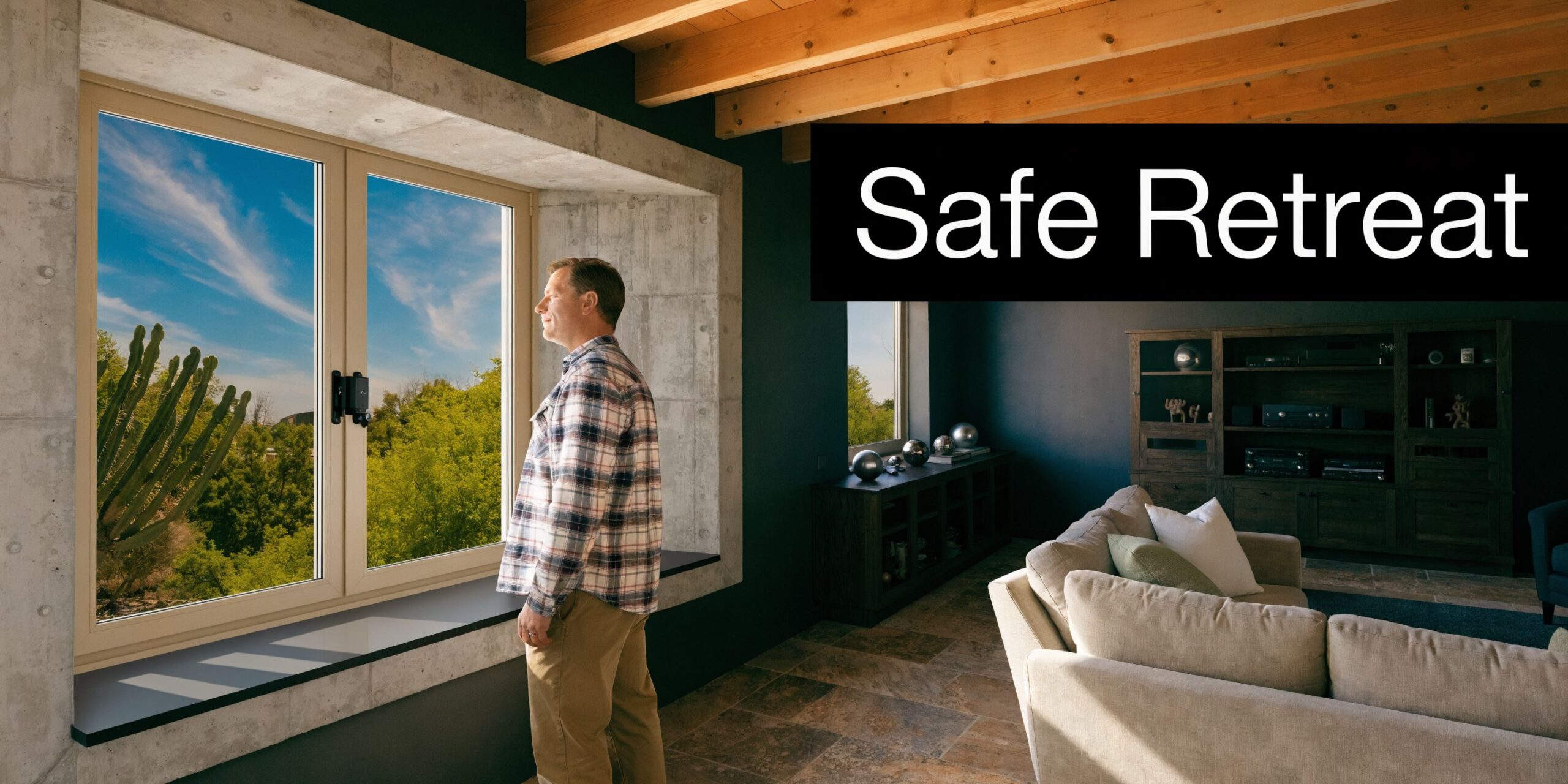
Safety first, permits second
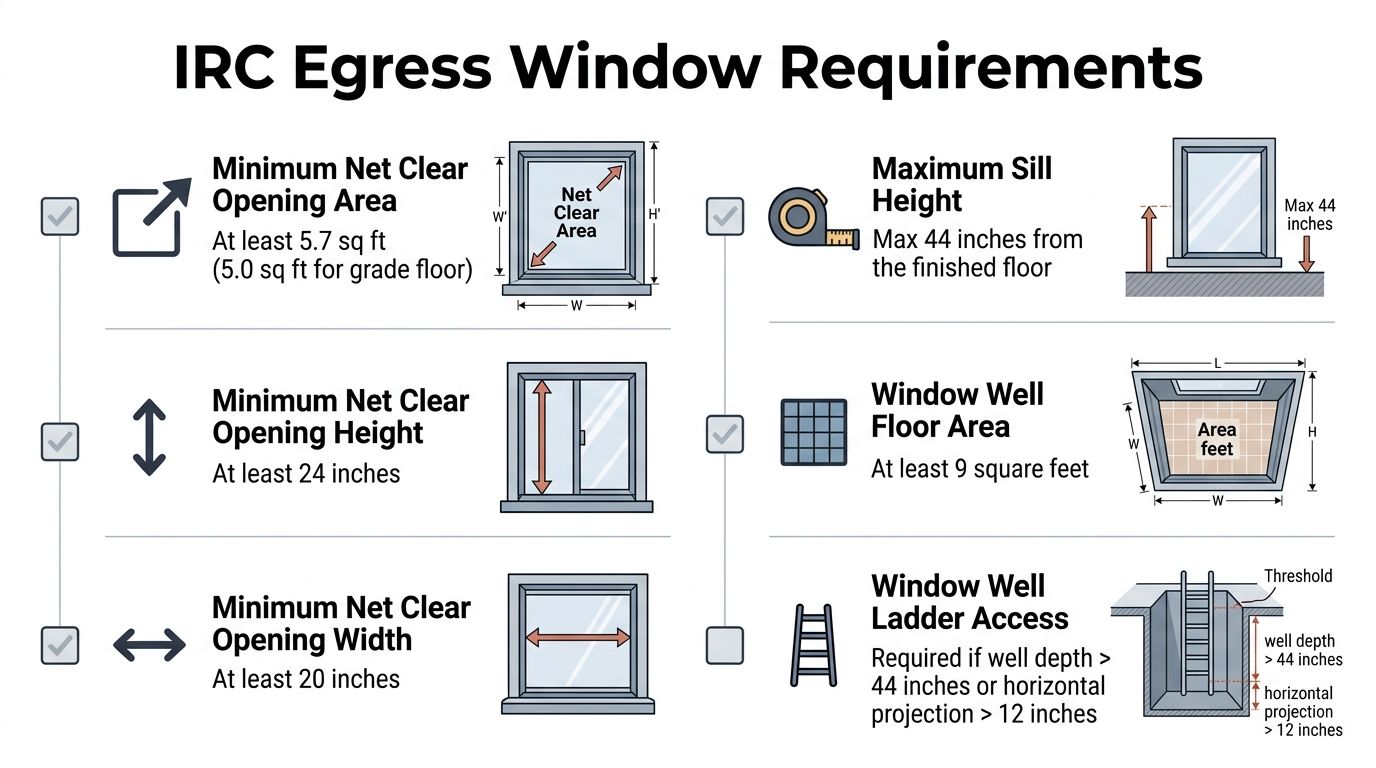
The International Residential Code sets the baseline for basement egress window requirements across most U.S. jurisdictions. It requires a minimum net clear opening of 5.7 square feet for basement windows and 5.0 square feet for ground-level openings, along with a minimum opening height of 24 inches, minimum width of 20 inches, and maximum sill height of 44 inches from the floor, as outlined in this summary of IRC egress window requirements.
Those measurements are not random. They are meant to give occupants a realistic path out and emergency personnel a realistic path in.
If the basement window is below grade, the rules expand beyond the window itself. The same IRC summary notes that the window well must provide at least 9 square feet of area with at least 36 inches of horizontal projection, and permanent ladders or steps are required when the well depth exceeds 44 inches.
What homeowners often miss
The key mistake is treating the window like a normal light-opening window. An egress window is different. It is part of a full escape system.
That system includes:
- The opening itself: It must provide actual pass-through space when fully open.
- The sill height: People need to reach it without climbing over furniture or built-ins.
- The outside exit path: A deep, cramped, or flooded well defeats the whole purpose.
A basement is not finished until someone can get out of it safely in an emergency.
In Phoenix and across Arizona, code compliance matters during remodeling, inspections, and resale. But even before that, the practical question is simple. If the stairs are blocked, can a child, adult, guest, or firefighter use that window under stress? If the answer is uncertain, the design is wrong.
Decoding the National Egress Window Size and Placement Rules
The hardest part for many homeowners is the phrase net clear opening. People measure the glass, or the frame, or the rough opening in the wall. Code does not care about those dimensions by themselves. It cares about the actual clear space available when the window is fully open.
That distinction changes everything.
What the opening has to achieve
The IRC requires a minimum net clear opening of 5.7 square feet for basement windows and 5.0 square feet for grade-floor openings, plus a minimum clear opening height of 24 inches, minimum clear opening width of 20 inches, and maximum sill height of 44 inches above the finished floor, according to this code-focused breakdown of egress sizing and requirements.
That same source explains the reason behind the sizing. The opening is engineered around the practical need for emergency escape and for a fully geared firefighter to enter.
If a window looks large but the sash or frame blocks too much of the path, it can still fail as an egress opening.
The four measurements that matter most
A homeowner comparing windows should focus on these four items first:
| Requirement | What it means in practice |
|---|---|
| 5.7 square feet | The fully open window must create enough real passage space for escape from a basement room. |
| 24-inch minimum height | The opening cannot be too short to crawl through effectively. |
| 20-inch minimum width | The opening cannot be too narrow, even if the total area seems large enough. |
| 44-inch maximum sill height | The bottom of the opening cannot sit too high above the finished floor. |
Many installations go wrong at this stage. A homeowner sees a manufacturer’s listed size and assumes it will pass. But listed size and net clear opening are not the same thing.
Why window style affects compliance
Casement windows are often easier to size for egress because they open more fully. The same code source notes that a standard 30×48-inch casement window can achieve 5.7 square feet when fully open, while double-hung windows may need larger sizes such as 30×52 inches because the sash obstructs part of the opening.
That is a useful real-world trade-off.
- Casement windows: Better when wall space is limited and every inch matters.
- Double-hung windows: Can work, but they may need a larger unit to create the same usable opening.
- Slider units: Can look convenient, but they need close review because only part of the frame opens.
A lot of costly mistakes happen at the ordering stage. The wrong style can force a larger excavation, more concrete cutting, and a redesign of the well outside.
Placement matters as much as size
The 44-inch maximum sill height sounds straightforward, but finish details can push a passing design into a failing one. Flooring build-up, interior trim choices, built-in benches, or a raised platform can change the effective height from the floor to the sill.
That is why good contractors verify dimensions after the finished floor assembly is known, not just at rough framing.
Below-grade openings have a second set of requirements
The same source also states that window wells must provide at least 9 square feet of area with 36 by 36 inches of projection and width, and that wells deeper than 44 inches require ladders or steps with listed dimensional requirements.
For homeowners, the practical lesson is simple. A code-compliant window can still fail if the exterior well is too tight for the sash to open or for a person to climb through.
What does not work
The following problems show up again and again:
- Buying by frame size only: The unit looks big enough on paper but does not produce the required clear opening.
- Choosing the wrong sash style: A double-hung replacement may look clean but lose too much opening area.
- Ignoring finish-floor height: A passing rough opening becomes a noncompliant final installation.
- Treating the well as landscaping: Decorative stone, covers, or plantings can interfere with emergency use.
The safest way to approach basement egress window requirements is to measure the escape path, not just the product.
Essential Specifications for Window Wells and Ladders
A below-grade egress window is only as good as the space outside it. If the well is cramped, too deep, hard to climb, or prone to collecting water, the window stops functioning as a reliable exit.
That is why the exterior details deserve as much attention as the unit in the wall.
The well must leave room to move
The code standard covered earlier requires a well with enough floor area and projection for the window to open fully and for a person to maneuver through the opening. In practical terms, the well cannot just be a narrow excavation lined with metal.
A good egress well needs to do three jobs at once:
- Allow the sash to operate fully
- Give a person room to turn and climb out
- Stay clear enough to function during an emergency
Layout decisions matter in this situation. A larger casement window may save interior wall space but swing into the well. If the projection is too tight, the opening can be compromised even if the window itself is compliant.
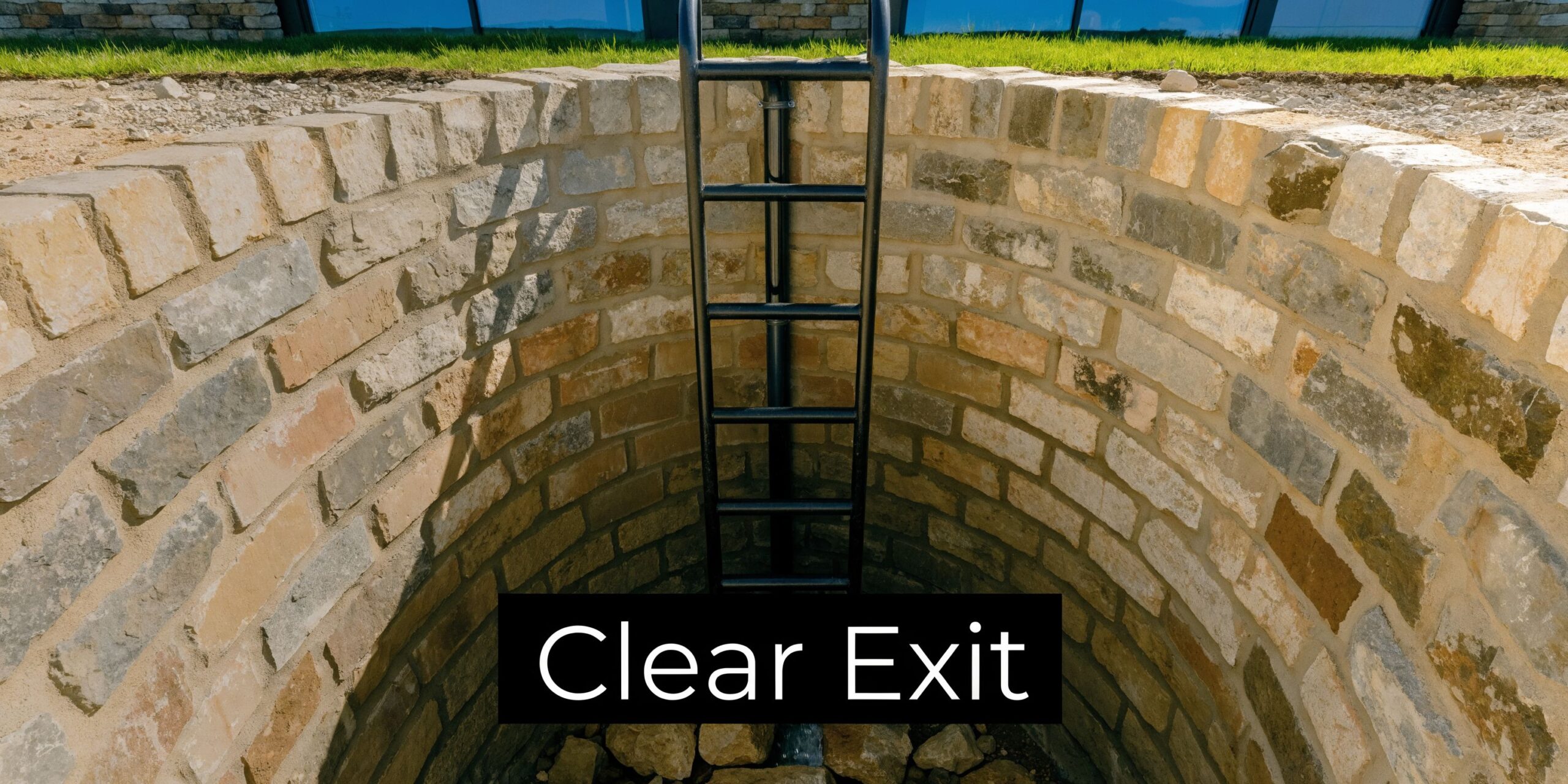
When a ladder becomes mandatory
Once the well depth goes beyond the threshold covered under the code rules above, a permanent ladder or steps becomes part of the required system.
That requirement exists for a reason. People do not exit neatly in an emergency. They climb fast, often in poor visibility, and they may be helping a child, elderly family member, or pet. A slippery wall and loose decorative block are not a substitute for fixed access.
A proper ladder should be easy to spot, rigid, and positioned so it does not block the window from opening.
If someone has to improvise their way out of the well, the installation is not doing its job.
Drainage is the Arizona issue people underestimate
Phoenix does not deal with the same basement volume as colder regions, but local weather still creates a real problem. A below-grade well can collect runoff during monsoon conditions if drainage is poorly designed or if the grading pushes water toward the house.
The most common failures are practical, not theoretical:
- Clogged drains
- Improper slope around the well
- Yard rock or debris blocking water flow
- A well cover that traps debris and still lets water in
In Arizona, soil conditions can make this worse. Hard-packed ground may shed water quickly at the surface. If the drainage plan is weak, the well can fill fast and push water against the window assembly.
What works better in the field
Contractors get better long-term results when they think beyond the code minimum.
That means:
- Planning drainage before excavation is finished
- Keeping the well clear of decorative obstructions
- Checking that the ladder remains usable after landscaping
- Making sure the window can open fully without rubbing the well wall or cover
Homeowners tend to focus on how the well looks from the yard. That matters, but function comes first. A neat-looking well that traps water or blocks access is a liability.
Navigating Phoenix and Arizona Egress Window Rules
Phoenix homeowners start by searching for national code dimensions. That is a good first step, but local execution is where projects succeed or fail.
Most Arizona municipalities use IRC-based residential standards. In practical terms, that means the national egress principles discussed above are the right starting point for homes in Phoenix, Scottsdale, Peoria, Glendale, Mesa, Gilbert, Surprise, and surrounding communities. The local building department still controls plan review, permit issuance, inspections, and any city-specific requirements.
Local code adoption is only part of the job
The code tells you what the finished opening must achieve. It does not tell you how difficult it may be to build that opening in an Arizona yard.
For homeowners in the Valley, local review centers on issues like:
- Structural work at the foundation wall
- Drainage planning for the well
- Site access for excavation equipment
- Final inspection of the installed opening and exterior escape path
A clean set of plans helps. So does early contact with your city’s planning or development department. Before ordering materials, check the permit portal or call the local counter staff for the city where the house sits. Phoenix, Scottsdale, and Peoria each have their own submission workflow, even when the underlying residential code concepts are similar.
Arizona soil can change the budget fast
The local challenge many homeowners do not see coming is excavation difficulty.
In parts of greater Phoenix, crews encounter hard desert soil and caliche. That can slow digging, affect equipment choice, and complicate shaping the well to the required dimensions. It can also make drainage work more demanding because the soil may not behave the way homeowners expect once the area is opened up.
A few field realities matter here:
- Tight side-yard access can limit machinery options.
- Hard soil conditions can extend excavation time.
- Existing irrigation, hardscape, or utility routing can complicate placement.
- Improper backfill and grading can create future water problems around the well.
None of that changes the code target. It changes how carefully the job needs to be planned.
Practical steps before construction starts
A smart Arizona homeowner does four things early:
- Confirm the room’s intended use so the permit application matches reality.
- Verify the exact property jurisdiction because mailing address and city jurisdiction are not always the same.
- Ask about structural plan requirements before demolition begins.
- Walk the exterior site to look at access, grade, hardscape, and drainage paths.
In Arizona, the code dimensions are only half the story. The site conditions drive the schedule, method, and final cost.
This is especially important in older neighborhoods and custom-home areas where retaining walls, mature landscaping, and unusual lot grading can make a straightforward design much harder to execute.
Egress Rules for Basements Without Bedrooms
One of the most expensive assumptions in basement remodeling is this: if the room is not a bedroom, egress does not matter.
That assumption causes permit problems, inspection failures, and awkward resale conversations.
Habitable space still needs emergency escape
IRC-based codes generally require an emergency escape opening for regularly used finished basement living space, not just rooms labeled as bedrooms. That point is emphasized in this discussion of basement egress requirements for finished spaces, which notes that the rule can apply to spaces such as offices, gyms, playrooms, and family rooms, with the same core benchmarks of 5.7 square feet of clear opening, 20-inch minimum width, 24-inch minimum height, and 44-inch maximum sill height, plus a well and ladder when the installation is below grade.
For Phoenix-area homes, that matters more than many people realize.
A basement office may not have a closet. A workout room may not have a bed. A playroom may only be used during the day. None of those labels removes the basic safety concern. If people regularly occupy the space, they need a dependable way out.
Why this gets missed often
Homeowners think in real-estate labels. Code officials think in habitable use.
That creates confusion when someone says:
- “It’s only a home office.”
- “We’re calling it a bonus room.”
- “It won’t be used as a bedroom.”
Those descriptions do not automatically eliminate the need for egress. If the space is finished and intended for regular occupancy, the life-safety issue remains the same.
A room name on a floor plan does not change the risk of smoke, fire, or a blocked stairway.
The Phoenix use case
In greater Phoenix, finished basement spaces end up as flexible rooms. One month it is a home office. Later it becomes a guest room, teen hangout, or workout area. That is exactly why this issue needs attention during the remodel stage, not years later during a sale.
For homeowners, agents, and property managers, the practical takeaway is simple. Do not design around a loophole that may not hold up under permit review or buyer scrutiny.
If the basement is becoming usable living space, evaluate it as habitable space from the beginning. That approach avoids redesigns, surprise corrections, and the far more expensive option of retrofitting after finishes are complete.
Your Guide to the Permit and Inspection Process
Most egress window projects trigger permits because the work involves structural changes, excavation, and code review. If the plan includes cutting a new opening in a foundation wall, assume the city wants to see it before the work starts.
That is not red tape for its own sake. Inspectors are looking at life safety, structural support, and water management.
What the typical process looks like
The permit path follows a straightforward order:
Define the room use
Be honest about whether the basement will be habitable space. That affects how the city reviews the work.Prepare plans
The city may require drawings showing the new opening, structural support above it, well layout, and drainage details.Submit through the local building department
In the Phoenix area, this happens through the municipality where the property is located.Wait for plan review comments
If the city asks for revisions, handle those before demolition or cutting begins.Schedule inspections during construction
Structural and final inspections are the common checkpoints.
What inspectors care about
At rough inspection, they focus on whether the opening was built the way the approved plans showed it. That can include the structural header, framing details, and the relationship between the cut opening and surrounding wall.
At final inspection, the practical questions become more visible:
- Does the window open fully and easily?
- Is the sill height acceptable from the finished floor?
- Is the window well accessible and unobstructed?
- If required, is the ladder fixed in place and usable?
- Does the drainage approach appear complete and functional?
A project can look clean and still fail if the final dimensions or operation do not match what was approved.
Why skipping permits is a bad bet
Unpermitted egress work can create several problems at once:
- Stop-work orders during construction
- Trouble when selling the house
- Questions from appraisers or buyers
- Forced corrections after finishes are installed
The cleanup after a structural project matters too. Dust, slurry, and debris from concrete cutting travel farther than many homeowners expect. If you are planning the project schedule, it helps to review a practical guide to cleaning after construction in Phoenix so the basement and surrounding rooms can be returned to usable condition quickly.
Good permit work is cheaper than bad correction work.
If the city asks for engineering or revised plans, that is the time to solve the problem. Not after drywall, trim, and flooring are already in place.
When to Hire a Professional for Egress Window Installation
Homeowners ask whether this can be a DIY project. In most cases, the answer is no, or at least not if the goal is a safe, durable, code-compliant result.
An egress window installation is not the same as swapping an old window unit for a new one. It involves cutting concrete, changing structural loads, excavating below grade, managing water, and passing inspection.

The work is more complex than it looks
A typical project may include:
- Foundation cutting
- Structural reinforcement
- Excavation for the well
- Drainage installation
- Waterproofing
- Window setting and sealing
- Final grading and site repair
Every one of those steps can go wrong in a different way.
A poor cut can damage the surrounding wall. Weak structural support can create long-term problems above the opening. Bad waterproofing can lead to chronic leaks. Sloppy well drainage can turn a code-required safety feature into a water entry point.
Budgeting for professional installation
According to Angi’s overview of egress window laws and installation costs, the average cost to install egress windows in basements ranges from $2,500 to $5,300, with a national average of about $3,900 per installation. That same source explains that pricing is shaped by location, number of windows, and window type, and that the cost reflects more than the window itself because the project includes excavation, drainage system installation, waterproofing, and structural reinforcement.
For Arizona homeowners, that budget framework is useful because site conditions can shift the labor approach quickly.
A cheaper bid is not always cheaper in the end. If the contractor misses drainage details, underestimates the excavation, or treats the structural work casually, the correction cost can easily outweigh the original savings.
A short video can help you visualize the scope before talking to contractors.
What to ask before you hire
Do not stop at price. Ask how the contractor handles the critical risk points.
Look for clear answers on:
- Structural approach: Who determines the header or support details?
- Drainage plan: Where does water go if the well fills during a storm?
- Permit handling: Who submits plans and schedules inspections?
- Site protection: How will the crew protect hardscape, finishes, and access paths?
It also helps to understand the difference between contractor protections before signing an agreement. This breakdown of bonded vs insured is useful background for homeowners reviewing companies.
This is one of those projects where skilled installation is part of the safety system, not just part of the finish quality.
If the basement will become habitable space, a professional installation is the safer decision.
Egress Window Maintenance A Simple Safety Checklist
Once the installation is complete, the job is not over. An egress window is life-safety equipment. It has to keep working year after year.
That means homeowners should treat maintenance as routine, not optional.
A simple checklist that matters
Use this as a regular review list:
- Open the window fully: Make sure it moves without sticking, dragging, or binding.
- Keep the well clear: Remove leaves, dirt, trash, rocks, and anything that blocks the opening.
- Check the ladder or steps: Confirm they are secure, reachable, and not obstructed.
- Look for water issues: Watch for standing water, clogged drains, staining, or dampness near the opening.
- Keep the interior path open: Do not place furniture, storage bins, or gym equipment where they block fast access.
The small problems that become big ones
Most egress failures begin with ordinary neglect. Dirt packs into the track. Hardware corrodes. A well slowly fills with debris. Someone places a desk, sofa, or shelving unit in front of the opening because the room layout looks better that way.
Then the emergency comes, and the window no longer works as intended.
A compliant egress window that does not open quickly is no longer doing the job you installed it to do.
Seasonal exterior upkeep helps with this. Homeowners who want a broader maintenance rhythm can use this exterior home maintenance checklist to keep windows, drainage areas, and exterior access points in better shape throughout the year.
A well-designed basement is valuable. A well-maintained egress system makes it safe.
If you want help keeping basement windows, window wells, and exterior glass in clear working condition, Sparkle Tech Window Washing LLC serves Scottsdale, Peoria, Phoenix, and surrounding areas with professional window cleaning and exterior maintenance support. Clean glass and clear access points make it easier to spot drainage issues, hardware problems, and obstructions before they turn into bigger repair or safety concerns.