


You’re probably looking at a rug you still like, but don’t love the way it looks right now.
Maybe it sits under the coffee table and used to pull the whole room together. Then life happened. Shoes across the edge. Dog traffic. A drink spill that seemed minor at the time. Now the color looks flatter, the fibers feel rougher, and every quote you request seems to come back with a different number.
That’s where most homeowners get stuck. Not because they don’t want the rug cleaned, but because they don’t want to overpay, under-clean it, or damage something that still has value to the room. A good rug can affect how a home shows and feels, especially when you’re trying to freshen things up before a move or a sale. If home presentation is already on your mind, this guide on how to increase home value before selling ties into the same decision: spend carefully where buyers and guests notice it.
The hard part is that area rug cleaning prices aren’t simple flat fees. Two rugs with the same size can land in very different price ranges based on material, construction, soiling, and whether the cleaner handles it in your home or off-site.
Homeowners often assume they’re paying for soap and a machine. In reality, they’re paying for correct identification, safe cleaning, controlled drying, stain treatment judgment, and the labor needed to avoid turning a dirty rug into a damaged one.
The True Cost of a Dirty Rug
A dirty rug costs more than the cleaning bill.
It changes how the whole room feels. A rug that looks gray, matted, or blotchy makes clean floors and tidy furniture look unfinished. Homeowners usually notice it slowly. First the rug looks a little dull. Then they start fluffing corners, shifting furniture, or layering decor around it to distract from the wear.
What homeowners usually wrestle with
Homeowners usually wrestle with this core decision, which isn't just, “What does rug cleaning cost?”
It’s more like this:
- Emotional value: It was picked for the room carefully, inherited, or bought on a trip.
- Practical value: Replacing it means shopping again, matching the space again, and spending money anyway.
- Risk tolerance: If the rug is wool, silk, or handwoven, one bad cleaning attempt can create a bigger problem than the dirt.
A rug doesn’t need to be antique to be worth cleaning. It only has to be worth keeping.
That’s why area rug cleaning prices feel frustrating at first. Homeowners expect a quick menu price. What they need is a way to judge whether the quote makes sense for that specific rug.
Dirt changes the cleaning decision
Not every dirty rug needs the same level of work.
Dry soil sits in the pile and backing. Oils cling to fibers. Pet contamination changes the treatment plan. Some rugs can handle a straightforward process. Others need slower handling and more testing. When a rug cleaner builds a quote, they’re not just charging for visible dirt. They’re pricing the risk, time, and method needed to clean it without setting stains, bleeding dyes, or leaving moisture behind.
That’s why the cheapest quote isn’t automatically the best value. If the process is wrong, the low price disappears the moment the rug shrinks, smells worse, or dries stiff.
Typical Area Rug Cleaning Prices in 2026
Most homeowners want a baseline first. Here it is.
Professional area rug cleaning prices in 2026 range from $50 to $300+, with most companies charging $2 to $10 per square foot depending on rug size, material, condition, and cleaning method. The average cost is about $175 to $180, and most homeowners spend $80 to $400 per rug, according to this 2026 rug cleaning cost guide.
2026 Area Rug Cleaning Price Estimates
| Rug Size | Synthetic (Nylon, Polyester) | Wool | Silk / Handwoven Oriental |
|---|---|---|---|
| 3×5 | $40 to $80 | Usually higher than basic synthetic pricing | Often priced at premium specialty rates |
| 5×8 | $80 to $200 | $120 to $300 | $150 to $600 |
| 8×10 | $150 to $400 | $120 to $300+ depending on condition and method | $150 to $600 |
The same source notes that standard synthetic or blended area rugs usually cost $80 to $200, wool rugs range from $120 to $300, silk rugs from $200 to $600, and handwoven Persian or Oriental rugs from $150 to $500.
Why quotes use two different pricing models
Most cleaners price rugs in one of two ways.
Per square foot
This is the more transparent model for medium and large rugs. The cleaner measures length and width, calculates the square footage, then applies a rate based on material and method.
It works well because size matters. A bigger rug takes more labor, more wash volume, more drying capacity, and more handling.
Per rug
This is common for smaller rugs or standard service packages.
A company may quote a small accent rug at a flat rate because the handling, setup, and minimum labor still exist even when the rug itself is compact. Flat pricing can also simplify things for homeowners, but it’s worth asking what’s included.
Method changes price just as much as size
The same 2026 pricing guide shows how much cleaning method affects the bill. Steam cleaning runs $1 to $4 per square foot, dry cleaning runs $2 to $5 per square foot, and hand washing is the highest at $5 to $8 per square foot.
That’s why one 8×12 rug can price very differently depending on what the cleaner decides it needs. Method isn’t a small add-on. It’s one of the biggest cost drivers in the quote.
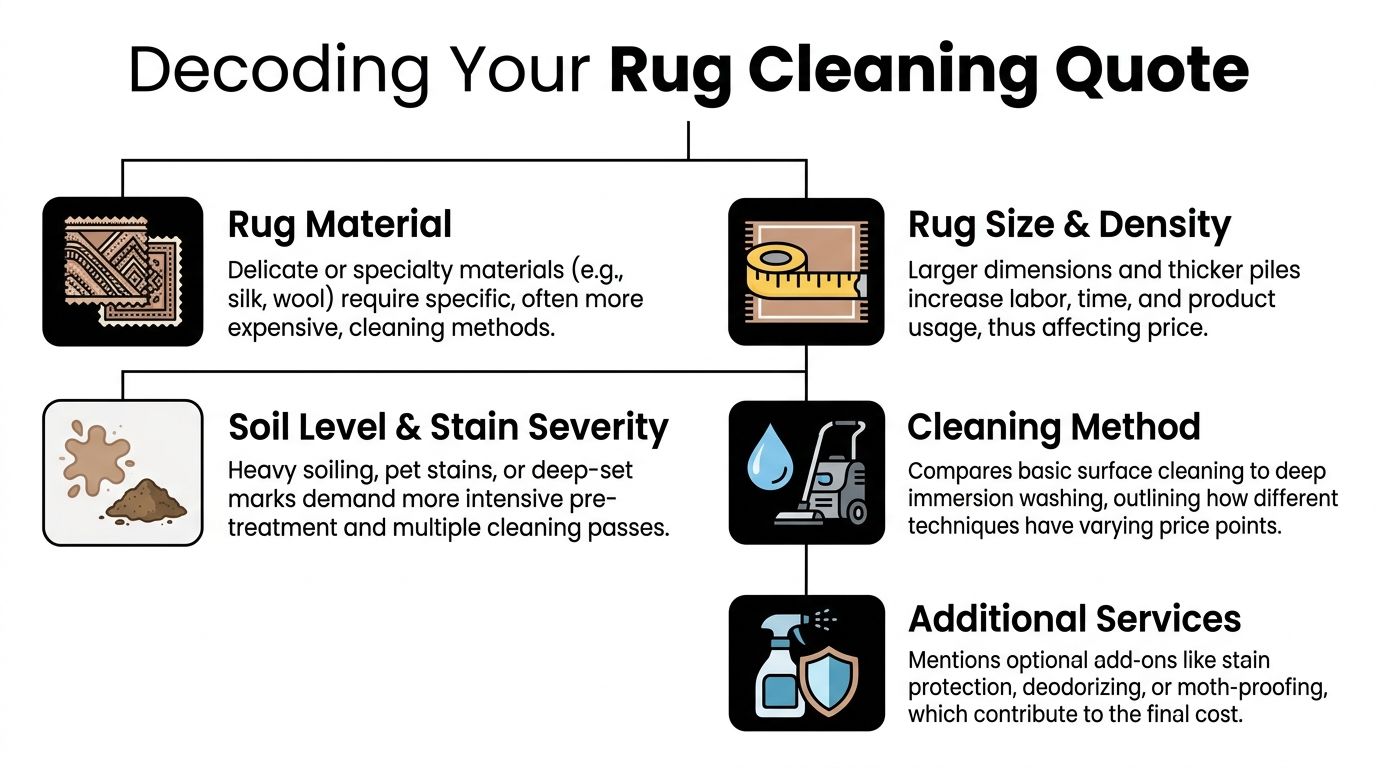
Decoding Your Quote The 5 Key Cost Drivers
A rug cleaning quote works like a repair estimate. The number only makes sense once you know what’s driving it.
Rug material
Material sets the rules.
Synthetic rugs are usually the most forgiving. Wool needs a more controlled approach. Silk and many handwoven pieces leave almost no room for error. The cleaner has to think about dye stability, fiber sensitivity, and how the rug will behave during drying, not just during washing.
If a company gives the same casual quote for polyester, wool, and silk, that’s a warning sign.
Rug size and construction
A thick machine-made rug and a thin handwoven rug of the same dimensions don’t behave the same way.
Size affects labor, but so does density. Heavy rugs are harder to move, dust, rinse, and dry. Fringe, backing type, and pile thickness all affect handling time. That’s one reason quotes vary more than homeowners expect.
Soil level and stain severity
Light maintenance cleaning is one thing. Pet accidents, oily traffic lanes, and set-in spots are another.
A quote often rises when the cleaner expects extra pre-treatment, repeated flushing, or odor work. That doesn’t mean the company is padding the bill. It often means they’re telling you the rug needs more than a surface pass.
Practical rule: If the rug has pet urine, ask whether the quote includes treatment or whether that’s priced separately.
Cleaning method
For machine-made synthetic area rugs, professional steam cleaning costs $1 to $4 per square foot, or $40 to $160 total for a typical 5×8 synthetic rug, and this method can remove embedded dirt, allergens, and oils more effectively than dry methods for that rug type, according to Angi’s professional rug cleaning cost guide.
That matters because the “right” method isn’t always the cheapest one.
Steam cleaning makes sense for many synthetic rugs. Dry cleaning may fit situations where lower moisture is preferred. Hand washing costs more because it takes more labor and more caution. If you want a broader baseline for household service estimates, this breakdown of cleaning service cost helps explain why labor-heavy specialty work rarely has bargain pricing.
Additional services and logistics
Quotes also change based on what surrounds the cleaning itself.
A company may include pickup and delivery, fringe attention, deodorizing, or protectant options. Another company may strip those out and present a lower base number. That’s why comparing “price only” can mislead you.
Ask for the out-the-door price. That’s the number that matters.
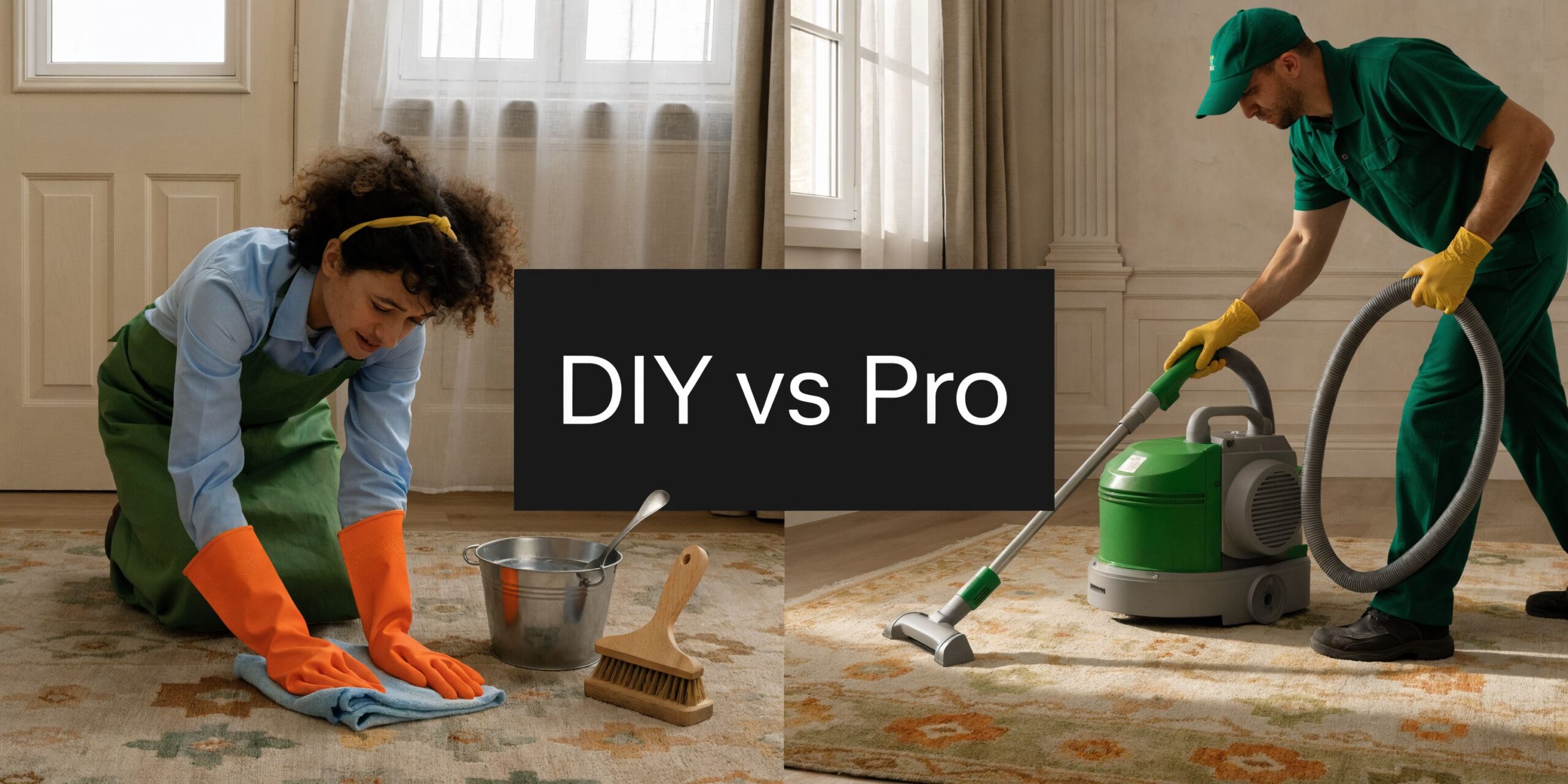
DIY vs Professional Cleaning A Cost-Benefit Analysis
Homeowners usually ask the right question first. Can I clean this rug myself and save the money?
Sometimes, yes. Often, not really.
When DIY is reasonable
DIY works best when the rug is durable, machine-made, and only needs minor attention.
That usually means routine vacuuming, quick blotting after a fresh spill, and cautious spot cleaning in a small area. If the rug is inexpensive synthetic material and you’re dealing with light surface soil, a homeowner can often improve it enough for day-to-day use.
DIY makes sense if all of these are true
- The rug is synthetic: Nylon and polyester generally tolerate more aggressive cleaning than delicate natural fibers.
- The problem is small: One fresh spot is different from overall dinginess or odor.
- You can dry it fast: Lingering moisture creates its own problems.
Where DIY starts getting expensive
The cost problem with DIY isn’t always the product you buy. It’s what happens if the result is poor.
Homeowners commonly over-wet rugs, push stains deeper, scrub pile distortion into one area, or leave residues that attract more soil later. Wool and silk rugs are especially unforgiving. Even a good-faith attempt can create color movement, shrinkage, texture changes, or a musty smell if drying isn’t controlled.
If you’re already worried about damaging the rug, that’s usually your answer.
Professional cleaning has gained ground for a reason. The global area rug cleaning services market was valued at about $1.2 billion in 2023 and is projected to reach around $2.0 billion by 2032, with a 5.5% CAGR, according to DataIntelo’s area rug cleaning services market report. Homeowners and businesses are clearly putting more value on professional care for hygiene and maintenance.
Better result versus lower upfront spend
Professional service costs more upfront, but it buys expertise and the right process.
A good cleaner identifies the rug, chooses a method that fits the fiber, treats spots with restraint, and dries the rug correctly. That’s what homeowners are paying for. Not just equipment, but judgment.
A quick visual on the difference in process helps:
A practical way to decide
Choose DIY when the rug is low-risk and the issue is minor.
Choose a professional when any of these apply:
- The rug is wool, silk, or handwoven
- The whole rug looks dull, not just one spot
- There’s pet odor or repeated accidents
- You care more about preserving the rug than just improving it a little
That’s the ultimate cost-benefit test.
The Phoenix Factor How Local Conditions Affect Your Price
Phoenix-area rugs live a harder life than rugs in many other markets.
The dirt here is finer. Dust moves in constantly. Sun exposure is tougher on fibers. Homeowners in Scottsdale, Peoria, and nearby communities also deal with practical conditions that change how cleaners have to handle rugs safely.

Why Phoenix rugs often need more work
In dry desert conditions, fine particulate soil settles deep into rug fibers and backing.
That matters because embedded dry soil doesn’t just make a rug look dusty. It can act like grit inside the pile. A cleaner may need more intensive dust removal before any wet cleaning starts. If they skip that step, they can turn dry soil into muddy residue during washing.
Hard water can also complicate the process locally. Homeowners may notice residue issues after home spot cleaning or previous DIY efforts. A professional has to work around what’s already sitting in the fiber, not just the latest dirt.
What that does to area rug cleaning prices
Geographic location can materially change pricing. For homeowners in the greater Phoenix region, premiums of 20% to 30% over national averages can show up because of desert dust and higher local labor costs, and an 8×10 rug that costs $160 to $640 nationally could cost $200 to $800 in Scottsdale or Peoria, according to Ayoub’s analysis of area rug cleaning cost factors.
That local premium isn’t just “because Phoenix is expensive.”
It often reflects more dusting, more careful flushing, and more labor to get fine particulate soil out of the rug properly.
In the desert, a rug can look only mildly dirty on top and still hold a surprising amount of dry soil underneath.
A smarter local mindset
For Phoenix homeowners, the best question isn’t “What’s the cheapest rug cleaning?”
It’s “Who understands what desert conditions do to rugs?” A quote that accounts for local dust load, previous residue, and safe drying is usually more useful than a generic national price pulled from a search result.
Smart Savings Tips to Lower Your Cleaning Bill
The best way to save money on rug cleaning is to avoid turning routine maintenance into restoration work.
That doesn’t mean babying the rug. It means preventing avoidable buildup and asking better questions before you book.
Where homeowners usually save the most
- Vacuum consistently: Regular dry soil removal helps stop grit from packing into the base of the pile.
- Blot spills fast: Press with clean towels. Don’t scrub. Scrubbing spreads the problem and roughs up fibers.
- Be honest when requesting a quote: If there’s pet contamination, old spotting, or heavy traffic soil, say so upfront. Accurate quoting helps avoid surprise add-ons later.
- Ask about drop-off versus full-service handling: Some cleaners price differently depending on logistics and handling.
- Bundle work when it makes sense: If a company offers multiple cleaning services, one visit can sometimes be more efficient than separate appointments.
What doesn’t save money
Cheap over-the-counter treatments often create a second cleanup problem.
They may leave sticky residue, bleach color, or lock a spot in place by overheating or oversaturating it. Homeowners also waste money waiting too long. A fresh spill is usually simpler than a set stain that has had time to bond with the fiber.
Worth remembering: Maintenance is cheaper than rescue work.
How to compare “savings” offers
If a company advertises a low base rate, ask what that includes.
A lower starting number may exclude pickup, stain treatment, deodorizing, or specialty handling. Real savings come from a clear quote, not a teaser price. The cheapest headline often turns into the most expensive invoice once the rug is already in their hands.
Hiring the Right Pro A Simple Checklist
A solid rug cleaning company should make the process clearer, not foggier.
If the quote feels vague, rushed, or oddly simple for a rug with obvious complexity, slow down and ask better questions.
Essential Requirements
Insurance and professionalism
Confirm the company is properly insured before they touch the rug.
If you want a quick refresher on why that matters, this guide on bonded vs insured gives homeowners a useful way to think about service-provider risk.
Material-specific process
Ask how they would clean your rug, not rugs in general.
A good cleaner should be able to explain the likely process for synthetic, wool, silk, or handwoven construction in plain language. If the answer sounds one-size-fits-all, move on.
Clear pricing
Get the full quote in writing when possible.
Look for whether the estimate includes pickup, delivery, stain treatment, odor treatment, drying, and any optional protector. Hidden charges usually show up where scope wasn’t clearly discussed.
Questions worth asking before you book
- What cleaning method do you recommend for this rug, and why?
- Are pet urine treatment or odor treatment included, or extra?
- Do you clean this type of rug on-site or off-site?
- What results are realistic, and what might remain?
- What happens if the rug has dye instability or prior damage?
What honest answers sound like
The right pro won’t promise miracles.
They’ll usually talk in terms of improvement, risk management, and fiber-safe methods. That’s a good sign. Rug cleaning is skilled work, but not every stain is fully reversible, and trustworthy companies say that upfront.
A careful cleaner would rather set realistic expectations now than disappoint you later.
Red flags that should slow you down
| Red flag | Why it matters |
|---|---|
| Same price for every rug | Suggests they’re not accounting for material or method |
| Guaranteed stain removal | Some stains are permanent |
| No questions about fiber, age, or condition | Indicates a generic process |
| Vague language about extra charges | Creates room for surprise fees |
Frequently Asked Questions About Rug Cleaning Costs
Is pet urine treatment always extra
Not always, but it often is.
Pet contamination usually requires more than standard cleaning. The cleaner may need separate treatment steps to address odor and residue in the pile and backing. That’s why many companies treat it as a different service level instead of standard maintenance cleaning.
How often should I have my rug professionally cleaned
That depends on traffic, pets, and how the rug is used.
A rug in a formal room can often go longer than one in a family room, entry area, or home with pets. In Phoenix, rugs also collect fine dust faster than many homeowners realize, so appearance alone doesn’t tell the whole story.
Will professional cleaning remove every stain and odor
No. Good cleaning improves many rugs substantially, but not every stain is fully removable.
Old spills, dye damage, previous DIY residue, and deep contamination can leave some trace behind. A reputable cleaner should tell you what looks promising, what’s uncertain, and what may be permanent.
Is it worth cleaning a cheaper rug
Sometimes yes, sometimes no.
The better question is whether the rug is worth keeping. If replacing it would cost more in time, money, or hassle than cleaning it, professional cleaning can still make sense. If the rug is low quality and heavily damaged, replacement may be the smarter move.
If you’re in Scottsdale, Peoria, or the greater Phoenix area and want straightforward advice from a local service company that values clear communication and professional care, Sparkle Tech Window Washing LLC is a trusted option. While they’re known for window cleaning, screen care, and solar panel cleaning, their approach reflects what homeowners want from any home service provider: responsive scheduling, transparent pricing, insured work, and respect for your property.