


The sun hits those second-story windows at the worst possible time. What looked “not too bad” at breakfast suddenly shows every streak, every dust trail, and every sprinkler spot by late morning. In Phoenix, that problem gets amplified fast. Fine dust settles overnight, hard water leaves mineral marks that plain soap won’t fix, and heat dries glass before most homeowners can finish a full pane.
That’s usually when people start shopping for the best window cleaning tools for high windows. Some buy a pole and do fine. Some buy the wrong setup, fight streaks for two hours, and still end up calling for help. Some climb a ladder where they shouldn’t have been off the ground in the first place.
After years cleaning homes and commercial glass around Phoenix, Scottsdale, and Peoria, the pattern is predictable. The right tool depends less on the word “high” and more on access, sun exposure, hard water buildup, landscaping, and whether you can keep both feet safely where they belong. A tool that works well on a straightforward second-story bedroom window can be the wrong choice for glass over tile roofing, a pool deck, or thorny shrubs.
Your Guide to Tackling Hard-to-Reach Windows
A lot of homeowners stand in the driveway and make the same first calculation. The windows aren’t that dirty. They’re only on the second story. A long pole should handle it.
Sometimes that’s true. If the glass has light dust, decent access from flat ground, and no heavy mineral staining, a basic high-window setup can get the job done. Consumer Reports notes that telescoping cleaning pole kits that reach second-floor windows start at about $100 at home improvement stores, while water-fed systems that connect to a garden hose begin at about $140 in their high-window cleaning guide. That’s a real improvement in accessibility for homeowners who want to work from the ground.
But Phoenix changes the equation. Hard water is common. Dust sticks to frames and tracks. Heat makes ordinary cleaning solution flash off the glass too quickly. A tool that’s fine in mild weather can leave a mess here if you use it at the wrong hour or with the wrong technique.
High windows don’t just test your reach. They expose every weak part of your process.
The good news is that there are solid options. Telescoping poles, professional squeegees, scrubbers, microfiber towels, scrapers, and water-fed pole systems all have a place. The hard part is knowing which setup fits your house, and when the “savings” of DIY starts turning into extra cost, wasted time, or avoidable risk.
First Assess Your High Window Situation
Before you buy anything, look at the job like a technician, not a shopper. “High windows” covers a lot of different situations, and the wrong assessment is what causes most failed DIY attempts.

Check height and working angle
Start by identifying what you’re trying to reach. A second-story window over open, flat ground is one thing. A window above a sloped side yard, stacked stone, or a narrow walkway between homes is completely different.
Look for these access issues first:
- Flat working ground: If the surface is uneven, soft, wet, or sloped, your setup gets harder immediately.
- Obstacles below the glass: Bushes, bougainvillea, decorative rock, AC units, pool equipment, and outdoor lighting all interfere with pole control.
- Roofline interference: Some windows look reachable until the eave or overhang forces you to work at an awkward angle.
- Tight property lines: In many Phoenix-area neighborhoods, side yards leave almost no room to maneuver a long pole.
If you can’t stand square to the glass and keep the tool under control, the job is already telling you something.
Identify what’s on the glass
Not all dirt responds the same way. Light dust and normal buildup usually come off with standard washing. Mineral spots from sprinklers are another story. In the desert, many homeowners confuse “dirty windows” with stained windows. Dirt can often be washed away. Mineral etching needs a different approach and more care.
A quick field check helps:
- If the glass looks filmy or dusty, standard wash tools may be enough.
- If you see white spotting or drip patterns, hard water is likely involved.
- If debris is stuck near the edges, you may need detail towels and possibly a scraper used carefully.
- If screens are packed with dust, washing the glass without cleaning the screen first won’t solve much.
Practical rule: If the stain looks bonded to the glass instead of sitting on top of it, don’t assume a stronger soap will fix it.
Time the work around Phoenix heat
This matters more than is often realized. In direct desert sun, glass heats up fast. When the pane is hot, cleaning solution dries before you can control it, especially on upper windows where your hand speed is slower because you’re working on a pole.
The result is familiar. Soap lines dry early. Water spots reappear. You keep going over the same pane and make it worse.
A better plan is simple:
- Work early when possible: Cooler glass gives you more control.
- Avoid the hottest part of the day: Midday sun can ruin an otherwise good technique.
- Watch wind: Even light gusts make high-pole work less accurate and harder on your shoulders.
- Test one window first: Don’t commit to the whole house until you know the process is working.
Decide whether it’s a cleaning problem or a liability problem
Homeowners often focus on whether they can reach the window. The better question is whether they can reach it safely, repeatedly, and without creating a bigger problem. If the route to the window involves awkward footing, a tall ladder, or leaning around roof sections, it’s no longer a simple maintenance task.
That distinction matters before you spend money on equipment. The smartest tool choice starts with an honest assessment, not optimism.
Choosing Your Core Window Cleaning Tools
Most high-window jobs come down to a small group of tools. The trick is matching them to the glass, not buying whatever has the longest handle on the shelf.
The tools that actually matter
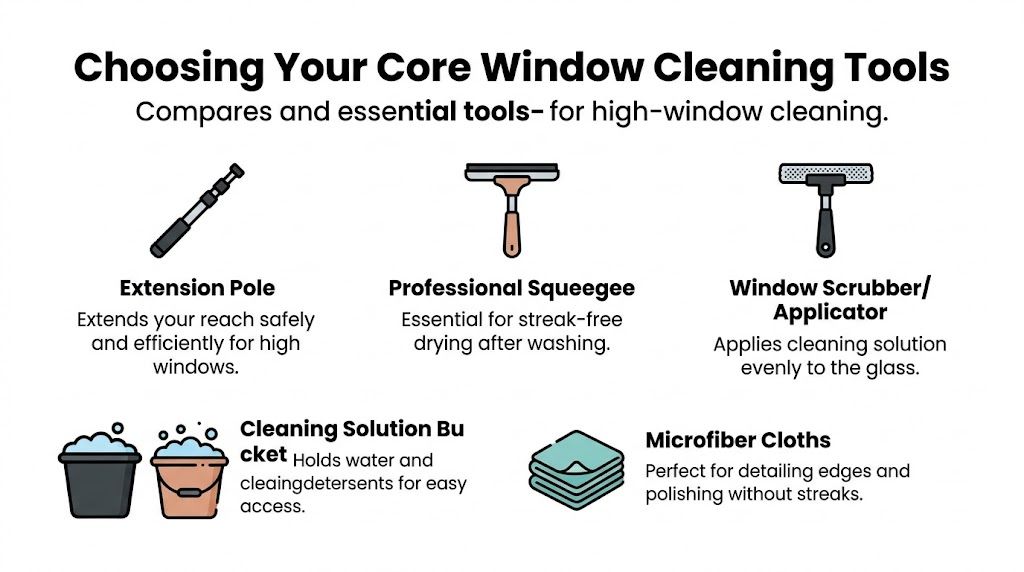
A telescoping pole is usually the first buy for exterior high windows. It keeps you on the ground, reaches second-story glass, and accepts different attachments. It’s the most practical starting point for many homeowners.
A professional squeegee is still the tool that separates clean glass from glass that only looks clean from across the yard. Detroit Sponge’s professional tool guide notes that professional-grade squeegees use replaceable rubber blades and ergonomic handles, and experienced pros recommend setups like the 14-inch Moerman squeegee with Ettore Master rubber blades, reporting they use that combination for 95% of their daily work. Proper technique can allow one pull per pane, which is why pros can move quickly without leaving chatter or streaks.
You’ll also want:
- A scrubber or applicator: To loosen dust and soil before you pull water off the glass.
- Microfiber towels: For detailing edges and catching drips at the frame.
- A scraper with replaceable blades: Useful for stubborn debris, but only if used carefully on appropriate glass.
- A bucket: Basic, but it needs to fit your washer and let you work without sloshing solution everywhere.
For a closer look at what makes a squeegee worth buying, this breakdown of the best squeegee for washing windows is a useful reference.
Ladder versus pole
Ladders still have a place. They’re not obsolete. They’re just overused by people trying to avoid buying better reach tools.
Here’s the practical trade-off. If the window is accessible from stable ground and can be cleaned effectively with a pole, the pole is usually the smarter choice. If the angle, screen removal, or detailed handwork makes a ladder necessary, then the ladder may be the only way to do the window correctly. That doesn’t make it the safer choice for every homeowner.
| Tool Type | Best For | Pros | Cons |
|---|---|---|---|
| Telescoping pole | Second-story windows with open ground access | Ground-level work, versatile attachments, good reach | Harder to control at full extension, technique matters |
| Professional squeegee | Final drying and streak-free finish | Precise results, replaceable rubber, fast in skilled hands | Less forgiving without technique |
| Extension ladder | Direct access to difficult windows | Close control, useful for screen handling and detail work | Higher risk, setup takes space, easy to misuse |
| A-frame ladder | Lower exterior work and some interior high glass | Stable on flat surfaces, simple to position | Limited height, not a solution for many exterior high windows |
| Scraper | Stuck-on debris | Removes stubborn contamination | Can scratch if used improperly |
| Microfiber towels | Edge detailing and cleanup | Great for corners and frames | Won’t replace proper washing on large panes |
What works and what doesn’t
What works is a matched system. Pole, scrubber, squeegee, towel. Each piece supports the next.
What doesn’t work is trying to do everything with one gadget. Combo tools sold as all-in-one miracle solutions usually struggle with control, especially in heat. The pad gets dirty fast, the blade drags, and the user ends up making repeated passes that leave more marks than they remove.
Good equipment helps. Good technique decides whether the glass actually finishes clean.
For most homeowners searching for the best window cleaning tools for high windows, the smartest basic kit is a quality telescoping pole, a real professional squeegee, a washer, microfiber towels, and patience. If the glass is heavily spotted or the house layout is complicated, a more advanced system makes a lot more sense.
Using a Water-Fed Pole System for a Spotless Rinse
When standard pole-and-squeegee work starts hitting its limits, a water-fed pole system is the next step. This is the setup many people notice on professional jobs because it allows high-window cleaning from the ground without dragging ladders around the property.
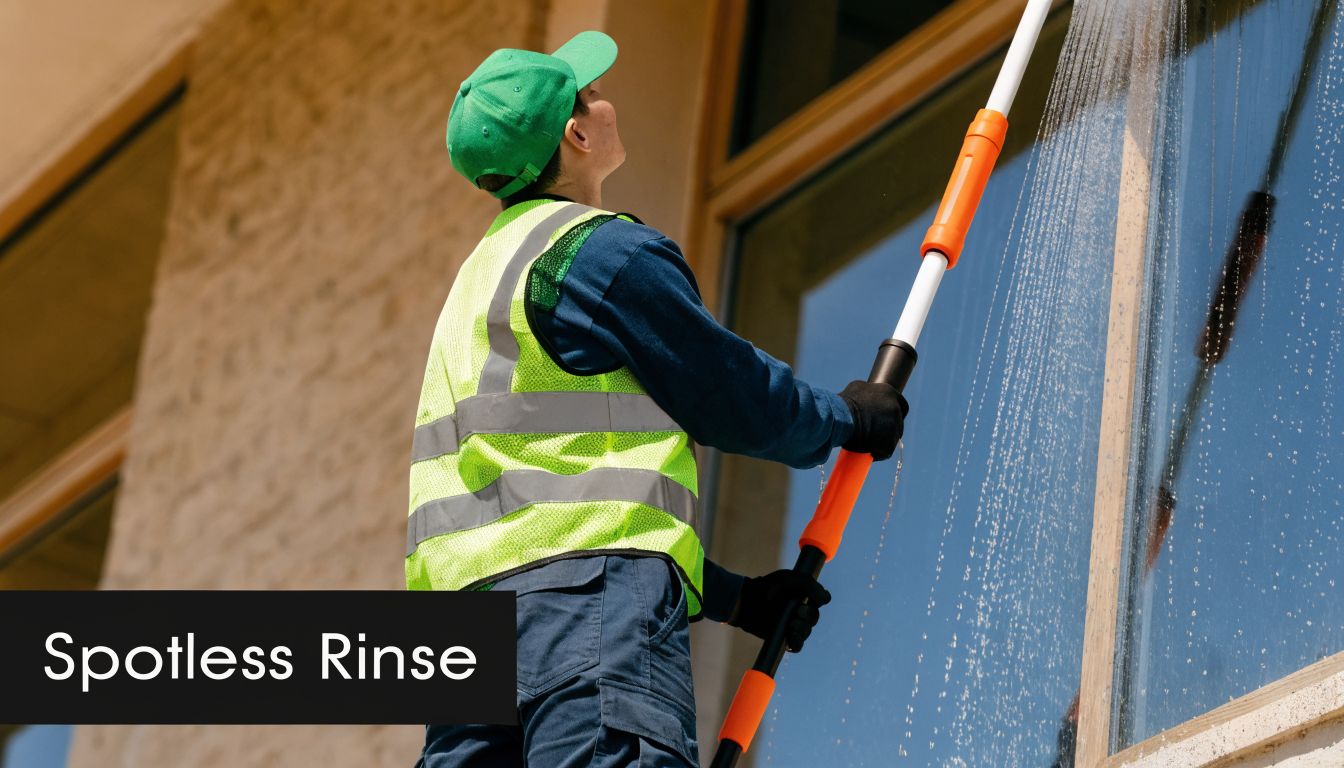
The reason it works is the water. These systems use deionized or purified water instead of ordinary tap water. Homesmiles explains in its water-fed pole overview that these systems use telescoping poles up to 60 feet, allow ground-level cleaning, and reduce fall risks by over 80% compared to traditional methods. The same source notes that consumer-grade kits start at around $140. That makes them far more accessible than they used to be.
In Phoenix, purified water matters because hard water is the enemy of a clean finish. If your rinse water leaves minerals behind, the sun will reveal every spot.
How the process should look
A water-fed setup isn’t complicated, but it does need a method.
- Set up the filtration system first. The quality of your water decides the quality of your final result.
- Brush the glass, don’t just mist it. The brush head is there to agitate dust and loosen grime.
- Rinse thoroughly with purified water. The rinse is what carries away loosened contamination and dries without spotting.
Homesmiles also notes a useful benchmark for technique. Their process calls for pre-wetting the glass, then agitating with the brush for 10 to 15 seconds, followed by a final pure-water rinse that evaporates streak-free.
For homeowners working on second-story glass, this can be a very practical middle ground between simple pole tools and climbing a ladder. If you want a general walkthrough for upper exterior glass, this guide on how to clean second-story windows gives a good overview of the workflow.
Where people go wrong with water-fed poles
Most bad results come from one of three mistakes.
- Using untreated water: If the water isn’t purified, the system becomes a long-handled hose. That won’t solve spotting.
- Rushing the brush work: Dust, pollen, and desert residue need agitation. A quick swipe usually isn’t enough.
- Trying to use it on the wrong contamination: Mineral staining, paint, heavy debris, and baked-on residue may need something beyond pure-water maintenance cleaning.
A water-fed pole shines on routine cleaning and high access. It’s less impressive when the glass already has years of neglected buildup.
The video below gives a visual sense of how a water-fed pole system is handled in the field.
Why it fits desert conditions so well
A water-fed system is one of the few high-window methods that lines up naturally with Phoenix conditions. You stay on the ground. You reduce direct ladder exposure. You use purified water instead of relying on local tap water to dry clean. And you can cover a lot of upper glass efficiently when the windows are maintained regularly.
Sparkle Tech Window Washing LLC uses water-fed poles on appropriate residential and commercial work where ground-level access and pure-water rinsing make sense.
That said, don’t treat it like magic. If the pane has etched hard water damage or debris fused to the surface, pure water alone won’t undo that history. It’s a maintenance and access tool, not a cure-all.
Your Non-Negotiable Safety Checklist
A high-window job is never routine once your balance, reach, or footing gets compromised. Clean glass isn’t worth a trip to urgent care, and it definitely isn’t worth a fall.

The checklist that matters before you start
Run through this every time, even if the job looks simple.
- Inspect your equipment: Check poles for cracks, locking mechanisms for slippage, ladder feet for wear, and squeegee channels for damage.
- Look at the ground first: Decorative rock, wet concrete, loose soil, and pool decking all change footing.
- Control the work area: Keep kids, pets, and foot traffic away from hoses, buckets, and ladder zones.
- Don’t work in bad conditions: Wind, glaring sun, and overheated glass make you less accurate and less stable.
- Keep your body centered: If you have to lean, twist, or stretch to reach the edge, reposition the tool or stop.
Ladder caution isn’t optional
Plenty of homeowners are comfortable on ladders until the task requires one hand for balance and one hand for cleaning. That’s the exact point where confidence turns into risk.
If you use a ladder at all:
- Set it on firm, level footing.
- Make sure it’s fully stable before climbing.
- Keep three points of contact whenever possible.
- Never overreach sideways to “save time.”
- Get down and move the ladder instead.
If the ladder has to do the job of a scaffold, it’s the wrong setup.
Ground-level systems need safety discipline too. Water-fed poles bring hoses, wet surfaces, and long, flexible equipment into the picture. Those are trip hazards, especially around walkways and landscaping. Coil hoses neatly, keep the route visible, and don’t let the work area turn into an obstacle course.
Stop when the job starts fighting back
This is the judgment call many people miss. If the tool feels unstable, the glass is drying too fast, the angle is awkward, or your shoulders are burning from controlling a long pole, stop. Fatigue creates sloppy movements, and sloppy movements create accidents.
The best safety habit in window cleaning is knowing when not to continue.
When to Call a Phoenix Window Cleaning Professional
At a certain point, this stops being a question about tools and becomes a question about exposure. Not just fall risk, but time, equipment cost, property risk, and personal liability.
The issue homeowners often miss is that a DIY high-window project can create liability that may not be covered the way they assume. GorillaDesk notes in its discussion of window cleaning tool choices and homeowner risk that homeowners often underestimate their personal liability during high-risk maintenance, and that tall-pole or ladder work may create exposure a homeowner’s insurance policy might not cover. Hiring a licensed, insured professional shifts that risk, which matters a lot on multi-story homes in places like Scottsdale and Paradise Valley.
The real cost isn’t just the tool purchase
A telescoping kit or water-fed starter system may seem affordable up front. But the full cost picture includes more than the sticker price.
Think about what you’re buying into:
- Equipment: Pole, attachments, towels, scrubber, filtration, replacement parts.
- Time: Setup, learning curve, repeated attempts, cleanup.
- Result risk: Streaks, missed spots, scratched glass, damaged screens, water mess on stucco or interior sills.
- Personal risk: Falls, strain, and liability if something goes wrong.
That doesn’t mean every homeowner should outsource every upper window. It means the cheaper option on paper isn’t always the lower-cost option in practice.
Jobs that usually belong in professional hands
Some scenarios push beyond sensible DIY.
Third-story glass is an obvious one. So are windows above pools, steep landscaping, tile roofs, or narrow side yards where you can’t set up square to the pane. Homes with complicated architecture also create problems fast. Arched windows, divided panes, deep recessed frames, and windows tucked behind decorative exterior features all take more control than most retail tool kits allow.
Another category is neglected glass with serious mineral buildup. If the issue isn’t ordinary soil but hard water spotting baked on by desert sun, the work shifts from maintenance cleaning to restoration judgment. That’s where inexperience can turn a simple window into a costly mistake.
If you’re weighing whether to handle it yourself or hand it off, comparing local residential window cleaning services near me can help you see what’s involved.
The practical dividing line
Here’s the simplest rule I can give after years in the trade. If you can reach the window safely from the ground, control the tool comfortably, and identify the contamination correctly, DIY may be reasonable. If access is awkward, the glass is heavily stained, or the process depends on a ladder and hope, it’s time to call a pro.
You’re not only paying for cleaner windows. You’re paying to transfer risk, avoid damage, and get the job done without turning your Saturday into a safety problem.
Frequently Asked Questions
What cleaning solution works best on high windows in Phoenix
For routine glass cleaning, keep it simple. The bigger issue in Phoenix usually isn’t a fancy soap. It’s the water quality and the glass temperature. If you’re using a water-fed system, purified water is the key. If you’re using a traditional washer and squeegee, don’t work on hot glass and don’t expect ordinary tap-water rinsing to hide hard-water problems.
Should I use vinegar on hard water spots
Be careful with internet shortcuts. Homeowners often reach for vinegar because it sounds safe and cheap, but hard-water buildup can range from light mineral residue to more stubborn staining. On upper windows especially, experimenting at full extension usually leads to uneven results and a lot of rework.
How often should high windows be cleaned in the Phoenix area
That depends on dust exposure, nearby landscaping, sprinklers, traffic, and how visible the glass is from inside the home. Homes near active construction, heavy road dust, or frequent irrigation usually need attention more often than homes in more protected settings. A regular maintenance schedule is usually easier and cheaper than letting upper glass build up for too long.
Can the same tools clean screens too
Some can help, but glass tools aren’t automatically screen tools. Screens hold fine desert dust differently than glass does. If the screen is dirty, clean it as its own task. Otherwise, you can wash the window and still end up looking through a dusty filter.
Are water-fed poles worth it for homeowners
They can be, especially if you have accessible second-story windows and want to stay on the ground. They make the most sense when the windows are maintained consistently and the user understands that purified water, not just reach, is what creates the clean finish.
If your high windows have hard-water spotting, difficult access, or you’d rather not take on the liability yourself, Sparkle Tech Window Washing LLC handles residential and commercial window cleaning across the Phoenix area with licensed and insured service.