

If you're in Phoenix and your AC seems to run all day but one bedroom still feels stuffy, you're not imagining it. A lot of homeowners chase the thermostat, replace filters, and even service the equipment, only to keep getting the same result. High summer bills. Uneven cooling. Dust that keeps coming back.
One of the most overlooked reasons is leaky ductwork. The system may be producing cooled air, but part of that air never reaches the rooms you paid to cool. It escapes into the attic, wall cavities, or other unconditioned spaces before it gets where it belongs.
That’s why aeroseal duct sealing cost gets attention. Homeowners want to know what it costs, but the better question is what they’re buying. In Phoenix, the price can vary a lot. Some quotes look reasonable. Others seem inflated. The difference often comes down to system count, duct layout, leak severity, and what the contractor includes in the job.
Why Your AC Bill Is So High and One Room Is Always Hot
A common Phoenix pattern goes like this. The living room is tolerable. The back bedroom stays warm. The upstairs or far end of the house never catches up until late at night. Meanwhile, the AC keeps cycling, and the electric bill lands with a thud.

The comfort problem usually starts behind the ceiling
Most homeowners first suspect the thermostat, the insulation, or the AC unit itself. Sometimes those are part of it. But in many homes, the duct system is where significant waste happens.
When ducts leak, conditioned air spills out before it reaches the supply vents. That leaves some rooms undercooled, especially the ones furthest from the air handler. In Phoenix heat, that shortfall shows up quickly.
The comfort clues are often practical, not technical:
- One room stays warm: The system runs, but the airflow in that room feels weak.
- Dust builds up quickly: Leaks can pull in dirty air from spaces you don’t want mixed into your living area.
- The AC runs longer than expected: The equipment keeps trying to satisfy the thermostat while some cooled air never makes it into the house.
A good home energy audit checklist helps narrow down whether the problem is insulation, windows, duct leakage, or a combination of all three.
Why this gets worse in Phoenix summers
In a mild climate, leaky ducts are annoying. In Phoenix, they get expensive.
Every bit of lost cooled air forces the AC to run longer during the hottest part of the year. That increases wear on the equipment and drags out the time it takes to cool the house evenly. The result isn’t just a higher bill. It’s a house that never feels quite settled.
Practical rule: If one or two rooms are consistently hotter and the AC itself checks out, don’t assume the equipment is undersized. Check the duct system before spending money on a bigger unit.
Aeroseal comes into the conversation because it targets hidden duct leaks that manual sealing often can’t reach with ease. For homeowners dealing with uneven temperatures, noisy runtime, and stubborn summer bills, that’s often the first time the problem makes sense.
What Exactly Is Aeroseal Duct Sealing
Aeroseal seals ductwork from the inside out. Instead of hunting for every leak by hand, the process pressurizes the duct system and sends suspended sealant particles to the spots where air is escaping.
That difference matters in Phoenix homes, where much of the duct system is buried in attics, soffits, or other areas that are hard to access without opening things up.
How the process works
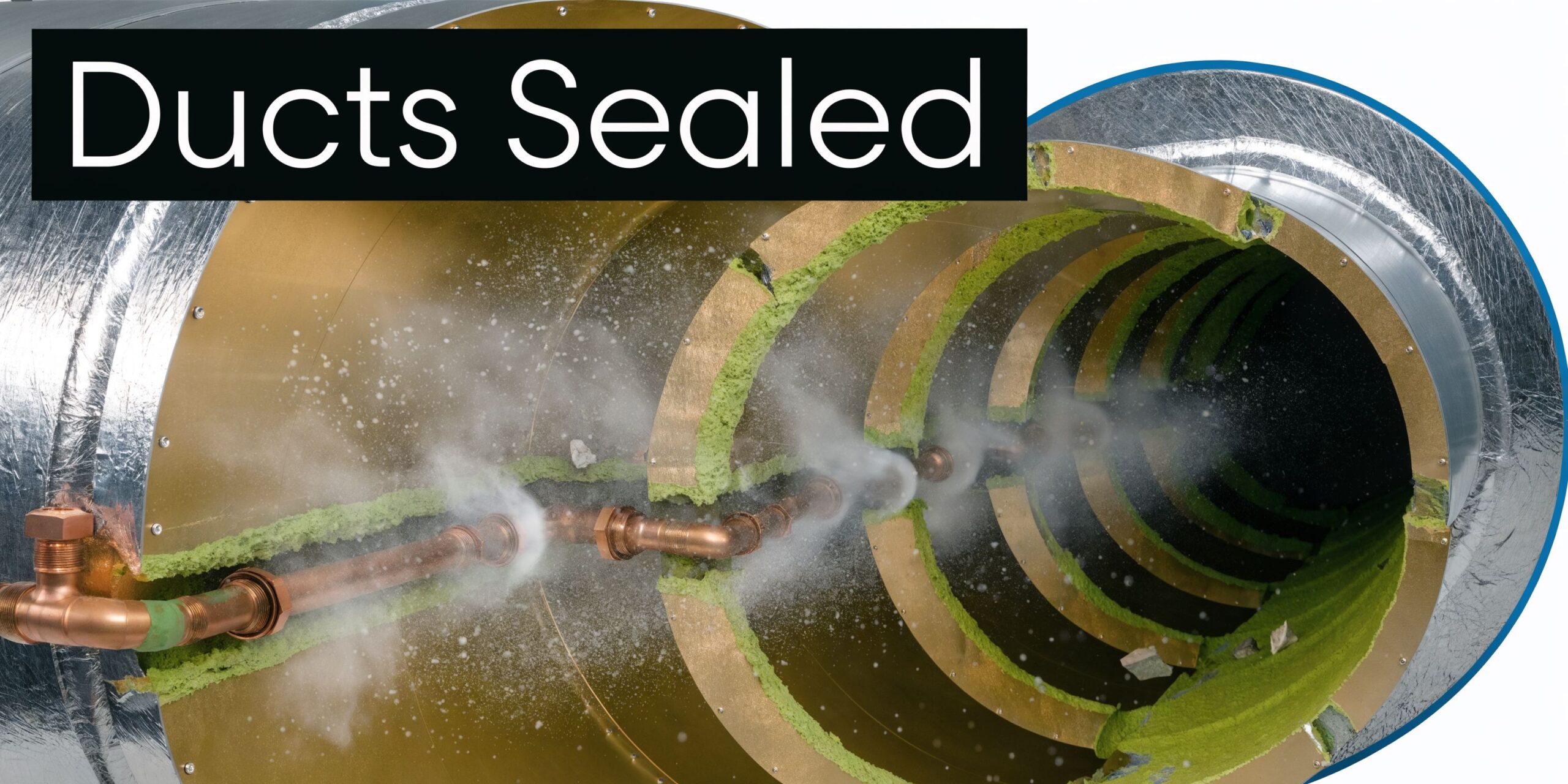
The contractor temporarily seals the supply and return openings, connects testing equipment, and pressurizes the ducts. Then a computer-controlled mist is introduced into the system. The particles stay suspended until escaping air carries them to leak points, where they collect along the edges and build up a seal.
In practical terms, Aeroseal is built for the leaks technicians cannot easily reach with mastic and tape. That often means joints, takeoffs, boots, elbows, and connections hidden behind finished surfaces or deep in attic runs.
A proper job also measures leakage before and after sealing. Homeowners should not have to guess whether anything improved.
What homeowners usually see during the appointment
Aeroseal is more controlled than a basic spot-seal visit. The appointment often follows a clear sequence:
System prep
Registers and vents are sealed off so the duct system can be tested accurately.Baseline leakage test
The equipment measures how much air the ducts are losing before any sealant is applied.Sealant injection
The aerosol mist moves through the ductwork and collects at active leak sites.Final verification
The software shows how much leakage was reduced and generates a before-and-after report.
Here’s a look at the process in action:
Why it’s different from manual sealing
Manual sealing still makes sense in some situations. If the ductwork is fully exposed and the leaks are easy to reach, mastic can be a solid lower-cost fix.
But that is not the setup in many Phoenix-area homes.
Aeroseal is often considered because the expensive leaks are often the hidden ones. A technician can manually seal what they can see. Aeroseal can address leakage across the full system and verify the result with testing. That testing is a big reason quotes vary so much from one house to another. You are not just paying for sealant. You are paying for diagnostics, controlled application, and proof of improvement.
For homeowners trying to make sense of quotes that range from about $1,500 to well over $4,000, this is the first pricing point to understand. The method is different, the equipment is different, and the final bill depends significantly on how complex the duct system is to test and seal.
Aeroseal Duct Sealing Cost in Phoenix
A Phoenix homeowner usually starts looking at duct sealing after a familiar pattern shows up. The AC runs for hours, the electric bill climbs, and one bedroom still feels five degrees warmer than the rest of the house. Then the quotes come in, and the price spread looks all over the map.
That spread is normal.
In Phoenix, Aeroseal often falls somewhere between $1,500 and $4,000 or more, depending on how many systems the home has, how the ductwork is laid out, and how much leakage the contractor finds during testing. The reason the range feels confusing is simple. Contractors are not all pricing the same scope of work.
Why one quote is $1,500 and another is over $4,000
The biggest pricing divider is the number of AC systems.
A smaller home with one system and a fairly straightforward duct layout may come in near the lower end. A larger Scottsdale or North Peoria home with two systems, longer duct runs, or separate zones can move considerably higher quickly. That does not automatically mean the higher quote is inflated. It often means there is more duct system to isolate, test, seal, and verify.
Access also affects price, even with Aeroseal. The process handles hidden leaks well, but the crew still has to set up the system correctly, protect registers, connect the equipment, and work through the home's layout. Homes with awkward attic access, split systems, or older duct modifications often take more labor.
How Phoenix contractors commonly price the job
Quote formats vary, which is why apples-to-apples comparisons are harder than they should be.
| Pricing approach | What it often means for the homeowner |
|---|---|
| Per AC unit | Common in the Phoenix market. Helps explain why two-system homes cost much more than single-system homes. |
| Per square foot | Useful for rough budgeting, but it can miss duct layout and system complexity. |
| Bundled package | May include testing, setup, reporting, cleanup, and sometimes related duct services. Review the scope closely. |
The practical question is not which quote is cheapest today. It is which quote is most likely to fix the high-bill, uneven-cooling problem you have.
A low number can still be a bad value if it leaves major leakage untouched or skips the verification that shows whether the work made a significant difference.
What a fair Aeroseal quote should make clear
A solid quote should explain whether pricing is based on one system or multiple systems. It should also spell out what is included in the job instead of hiding the complete scope inside a package price.
Look for clarity on:
- Number of systems being sealed
- Whether pre- and post-sealing testing is included
- Whether the contractor is pricing the full duct system or only part of it
- Any separate charges for access, prep work, or related duct repairs
That context matters more than the sticker price by itself.
For Phoenix-area homeowners, the safest budgeting mindset is to estimate Aeroseal by system first, then adjust for layout and complexity. That is often the fastest way to tell whether a quote is fair, incomplete, or padded.
Key Factors That Influence Your Final Price
One house gets a straightforward Aeroseal quote. Another house of similar square footage gets a much higher number. This often comes down to the duct system itself, not just the house size printed on the listing.
According to Rite Way’s analysis of whether Aeroseal is worth it, cost variability of $1,500-$2,500 per AC system is driven by home size, duct inaccessibility, and local HVAC factors. The same source states that leaky ducts are common in over 80% of homes, can cause 20-30% energy efficiency loss, and that Phoenix providers often offer rebates that can support a 2-5 year payback through up to 30% energy cuts from a 90% leakage reduction.
Home size matters, but layout matters more
Bigger homes often have more ductwork. That part is obvious.
What surprises homeowners is that two homes with similar square footage can have very different duct layouts. Long branch runs, awkward routing, multiple returns, and segmented attic pathways can all increase complexity. The contractor isn’t sealing a number of square feet. They’re dealing with how the air distribution system is built.
Number of HVAC systems changes the math fast
This is common in Phoenix-area homes, especially larger ones. A two-system home can’t be viewed like a one-system home with extra rooms.
Each system adds more than equipment count. It adds separate duct networks, separate testing considerations, and more total sealing work. If a homeowner compares a one-system quote to a two-system quote without realizing the difference, the price will look inflated when it may just be apples to oranges.
Duct accessibility still matters, even with Aeroseal
Aeroseal reduces the need for invasive manual access. It doesn’t remove all inherent challenges of the job.
The contractor still has to prep the system, evaluate conditions, and work around the existing installation. In slab homes and tight layouts, conditions can affect whether the process is suitable and how smoothly the work proceeds.
A few common factors that raise or lower the final number:
- Leak severity: More leakage typically means a more involved job.
- Duct condition: Clean, dry, sealable ducts are better candidates.
- Local contractor setup: Pricing often reflects labor structure, service area, and whether testing and reporting are built in.
A quote should make sense when you compare it to the system you have, not the house down the street.
Rebates affect net cost, not quote quality
A rebate can make the project more attractive. It doesn’t make a weak quote better.
Ask whether the contractor helps identify available rebate options and whether the quote already assumes one. Some homeowners hear a lower “final” number, then find out later that the rebate still requires paperwork or qualification steps.
A solid quote should separate these clearly:
| Quote item | What to check |
|---|---|
| Base service | Does it include testing, sealing, and verification? |
| Add-ons | Is duct cleaning separate or bundled? |
| Rebate assumption | Is the rebate guaranteed, estimated, or homeowner-filed? |
That level of detail is what turns a quote from a mystery into a decision.
Aeroseal vs Traditional Sealing A Cost and ROI Breakdown
A lot of Phoenix homeowners compare Aeroseal to manual duct sealing as if the job is the same and only the price changes. It is not the same job.
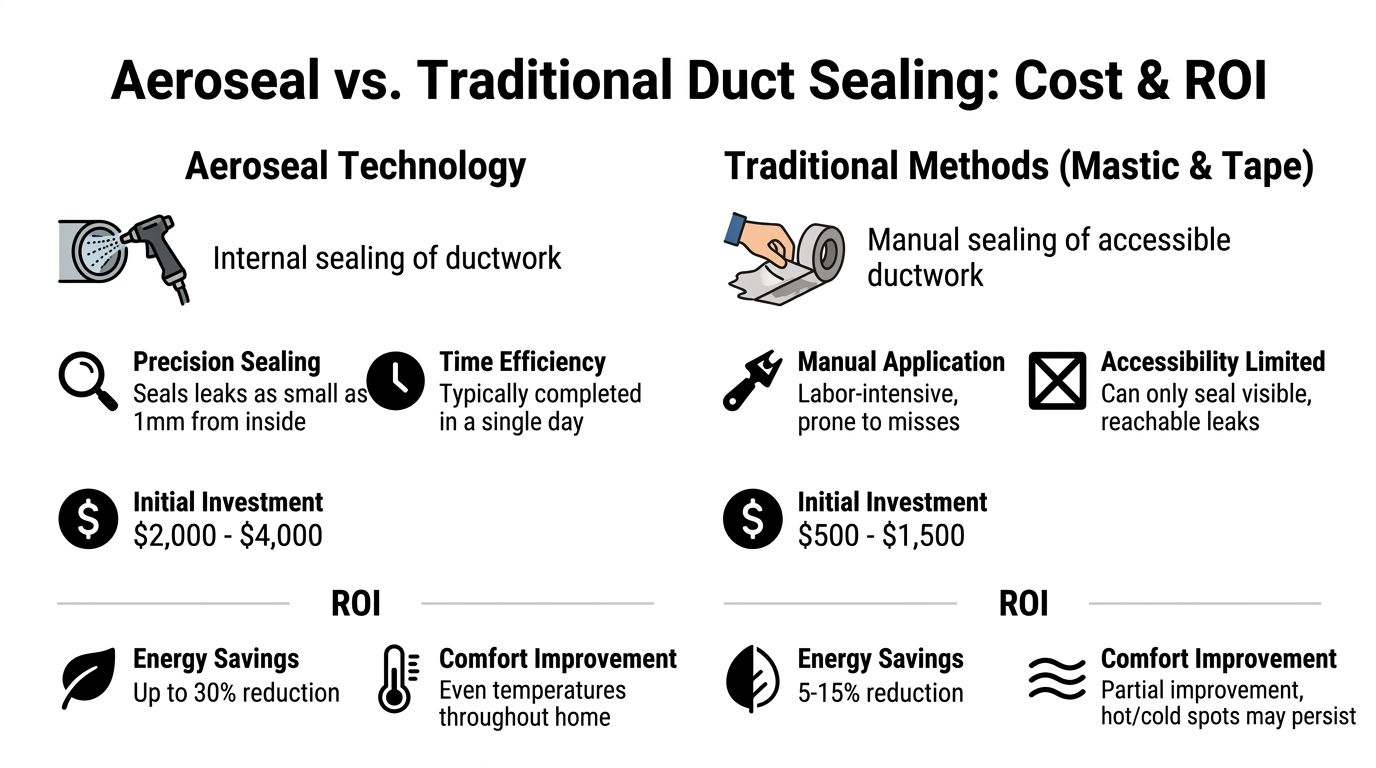
The fundamental question is what you are paying to fix. Manual sealing is often the lower starting-cost option because a crew can seal visible joints, boots, and connections they can reach. Aeroseal typically costs more because it includes whole-system testing, pressurization, the sealing process itself, and verification at the end. That price difference makes more sense once you look at access.
If duct leaks are out in the open, manual sealing can be a smart value. If the leaks are buried in attic runs, behind finished areas, or scattered through a system with multiple problem points, manual sealing can leave a lot of waste behind. That is why Aeroseal pricing ranges so widely. You are not just buying sealant. You are paying for a method that can reach leaks a hand-applied repair may miss.
Upfront price matters, but coverage matters more
Traditional sealing often makes the most sense on exposed duct systems where the technician can see the leakage points and seal them directly. In those cases, paying Aeroseal pricing may not pencil out.
Aeroseal earns its higher cost when the system has hidden leakage, uneven room temperatures, or long AC runtimes that point to losses deeper in the ductwork. In Phoenix, that matters. Every bit of cooled air that leaks into an attic or wall cavity is air you already paid to cool, and your system has to run longer to make up for it.
A cheaper repair can still be the more expensive decision if it only fixes the visible part of the problem.
ROI depends on the house, not just the method
I would not tell every homeowner to choose Aeroseal. I would tell them to match the method to the duct layout and the symptoms.
Use manual sealing when:
- Ducts are exposed and accessible
- Leak points are visible
- The comfort issue is limited and localized
- The goal is a targeted repair, not a full-system correction
Use Aeroseal when:
- Rooms stay hot even with long AC runtimes
- Ductwork is hard to reach
- Testing shows meaningful system leakage
- You want measured before-and-after verification
That verification piece matters more than many homeowners realize. Manual sealing is often judged by what looks sealed. Aeroseal is judged by what the system leakage test shows after the work is done.
Side-by-side practical differences
| Decision point | Aeroseal | Traditional manual sealing |
|—|—|
| Best use case | Hidden leaks and hard-to-reach duct sections | Exposed, accessible ducts |
| Application method | Internal aerosol sealing | Hand-applied mastic or foil tape |
| Verification | Measured before-and-after report | Often visual and access-based |
| Likelihood of missed leaks | Lower in concealed systems | Higher when ducts are inaccessible |
Where Phoenix homeowners usually see the difference
In this market, ROI is tied to summer performance. A house with duct leakage can show up as one back bedroom that never catches up, an AC that runs deep into the evening, and utility bills that stay stubbornly high even after a thermostat setback. If the leaks are hidden, Aeroseal has a better chance of producing a whole-house improvement instead of a partial repair.
That does not mean manual sealing is inferior. It means it is more limited by access.
For homeowners planning to sell, lower operating costs and more even comfort can also support buyer appeal alongside other updates that increase home value before selling.
What usually pays off
- Choosing the method based on duct access, not sales pitch
- Asking for leakage testing before and after the work
- Paying attention to comfort improvement and runtime reduction, not just invoice total
- Using manual sealing for visible problems and Aeroseal for hidden system-wide leakage
What usually wastes money
- Choosing the lowest bid without confirming scope
- Assuming a visible patch job fixed the full system
- Paying for whole-system sealing when the issue is small and fully accessible
- Comparing methods by price alone without asking what each one can reach
A fair comparison comes down to this: manual sealing is often a repair. Aeroseal is often a measured system correction. That is the main reason one quote may be hundreds lower and another lands in the $1,500 to $4,000-plus range.
How to Get an Accurate Aeroseal Quote in Scottsdale and Peoria
The biggest pricing mistake homeowners make is assuming all Aeroseal quotes refer to the same service. They don’t.
Verified pricing data shows Aeroseal can range from $1,500 to over $6,000, with one Phoenix contractor charging $4,200 per system, according to HomeGuide’s air duct sealing cost breakdown. That same source points to market fragmentation and price opacity, especially when quotes bundle or separate items like duct cleaning and testing.
Ask for the scope before you react to the number
A quote that looks high may include testing, reporting, cleanup, or duct cleaning. A quote that looks cheap may leave those out.
Ask every contractor to explain exactly what’s included. Not in sales language. In line items.
Use this checklist during the estimate:
Pre- and post-seal testing
Ask whether the quote includes a documented leakage test before the job and a verification report after the job.Per-system pricing
Confirm whether the price is for one AC system or the whole home.Duct cleaning status
Ask if cleaning is included, optional, or required before sealing.Rebate help
Find out whether the contractor helps with rebate paperwork or only mentions rebates in conversation.Authorization and training
Ask whether the contractor is an authorized Aeroseal provider and who will perform the work.
Red flags that should slow you down
A bad quote isn’t always the highest one. It’s often the least clear one.
Watch for these warning signs:
No verification report promised
Aeroseal is a measured process. If there’s no before-and-after proof, you’re missing one of its biggest advantages.A vague bundled price
If the contractor can’t explain whether testing or cleaning is included, comparison shopping becomes impossible.Pressure to commit immediately
Home performance work should be explained, not rushed.No proof of insurance
Any company working in your home should be properly covered. If you want a quick refresher on the difference, this guide on bonded vs insured is useful.
Don’t compare quotes by total alone. Compare them by system count, included testing, cleaning requirements, and final documentation.
How to judge whether a high quote is fair
A higher quote may be justified if the house has multiple systems, a more complex duct layout, or bundled services you’d otherwise pay for separately.
The contractor should be able to explain that clearly. If the answer sounds slippery, the price probably is too.
A practical decision filter:
| Question | Why it matters |
|---|---|
| What exactly is included? | Prevents false comparisons |
| How many systems are covered? | Clarifies whether the quote is partial or whole-home |
| Will I get printed or emailed results? | Confirms accountability |
| What conditions could change the price? | Helps avoid surprise charges |
The best quote is rarely the lowest. It’s the one you can understand, verify, and defend after the work is done.
Is Aeroseal Worth It for Your Phoenix Area Home
For the right house, yes.
Not every home needs Aeroseal. But if your AC runs continuously, certain rooms stay hot, and you suspect your system is losing cooled air before it gets to the vents, Aeroseal is one of the few upgrades that directly targets that waste.
It makes the most sense when comfort and cost problems show up together
The strongest candidates often have a combination of issues:
- Uneven cooling
- High summer utility bills
- Persistent dust concerns
- Ductwork that isn’t easy to access manually
If that sounds familiar, the investment often makes more sense than continuing to tweak the thermostat or chase minor fixes around the house.
The value goes beyond the duct system itself
A tighter HVAC distribution system helps the whole home perform better. In Phoenix, that matters because cooling demand affects everything else. If your house needs less wasted cooling, every efficiency improvement around it works harder.
That includes insulation, window performance, and even solar. Clean solar panels perform optimally when the house itself isn’t wasting energy on the cooling side. A better-sealed duct system lowers the load your AC has to carry in the first place.
If your house has a comfort problem and a bill problem at the same time, duct leakage deserves serious attention.
The practical decision
Aeroseal is worth serious consideration if you want:
- More even temperatures
- Less wasted cooling
- Measured proof of improvement
- A solution for hidden leaks, not just visible ones
It’s less compelling if your ducts are fully exposed, the leakage problem is minor, and a manual seal can address the obvious trouble spots. That’s why an evaluation matters.
The smartest next step isn’t guessing. It’s getting a detailed quote that includes testing, scope, and verification so you can see whether the aeroseal duct sealing cost matches the problem you’re trying to solve.
If you're already investing in home efficiency, don’t overlook the parts of your property that affect appearance, comfort, and energy performance together. Sparkle Tech Window Washing LLC serves Scottsdale, Peoria, and the greater Phoenix area with professional window cleaning, screen cleaning and repair, and solar panel cleaning that helps homeowners keep their homes brighter, cleaner, and more efficient.