

The sun is hitting the west side of the house hard, the room is heating up fast, and the blind you count on every afternoon suddenly will not drop. Or it drops halfway and sticks. Or one side hangs lower than the other, leaving a bright strip of Arizona sun cutting across the floor.
That is a normal Phoenix problem, not a random one. Heat, dust, and constant UV exposure punish window coverings here in ways that generic national advice often ignores. A blind that worked fine in a milder climate can start binding, fading, warping, or collecting enough grit in the headrail to fail sooner in the Valley.
Homeowners usually start with one question. Repair it, or replace it? Right behind that come a few more. What type of blind works best in this climate? Is this a simple fix or a mechanism issue? If new blinds are going in, what separates a clean installation from one that starts giving trouble a few months later? Keeping blinds in shape also goes hand in hand with keeping them clean, and a practical cleaning routine matters. If you want a maintenance baseline, this guide on the best way to wash blinds is a useful companion.
Your Guide to Flawless Phoenix Window Blinds
In Phoenix, a blind is not just a décor item. It is part of how you control glare, protect flooring and furniture, and keep a room usable during the hottest part of the day. When one fails, you feel it immediately.
A common local scenario goes like this. A bedroom mini-blind starts sticking for a week or two. Someone tugs it a little harder each day. Then one afternoon the cord lock jams, the blind will not stay up, and the room becomes either a cave or a greenhouse. In many homes, the problem is not dramatic damage. It is accumulated dust in the mechanism, sun stress on plastic parts, or a previous installation that was off and has been wearing itself down.
Phoenix homes also have a mix of window setups that change the repair decision. Some have older aluminum mini-blinds in secondary rooms. Others have faux wood blinds in main living areas, vertical blinds on patio sliders, or insulated cellular shades where afternoon heat is strongest. In Scottsdale and Peoria, it is also common to see tall entry windows, stairwell windows, and hard-to-reach openings where access matters as much as the blind itself.
Practical takeaway: The first problem you see is not always the first problem that started. A crooked blind often points back to bracket alignment, mounting issues, or grit inside the headrail.
Blind installation and repair works well when you treat it as part diagnosis, part fit-and-finish work. The details matter. The blind type matters. The wall surface matters. In Phoenix, the environment matters more than most homeowners realize.
Understanding Your Blind Types and Components
Choosing blinds is a little like choosing a vehicle. A compact sedan, a pickup, and an SUV all get you where you need to go, but not under the same conditions and not with the same strengths. Window blinds work the same way. A product that fits a shaded guest room may be the wrong choice for a west-facing family room in Phoenix.
The global blinds and shades market represents a substantial industry, with residential applications making up a majority share and retrofit installations accounting for a significant portion of revenue. This trend aligns with what contractors observe in older Phoenix-area neighborhoods where homeowners improve existing windows rather than replace the full assembly (Grand View Research on the blinds and shades market).
Blind types that make sense in Phoenix
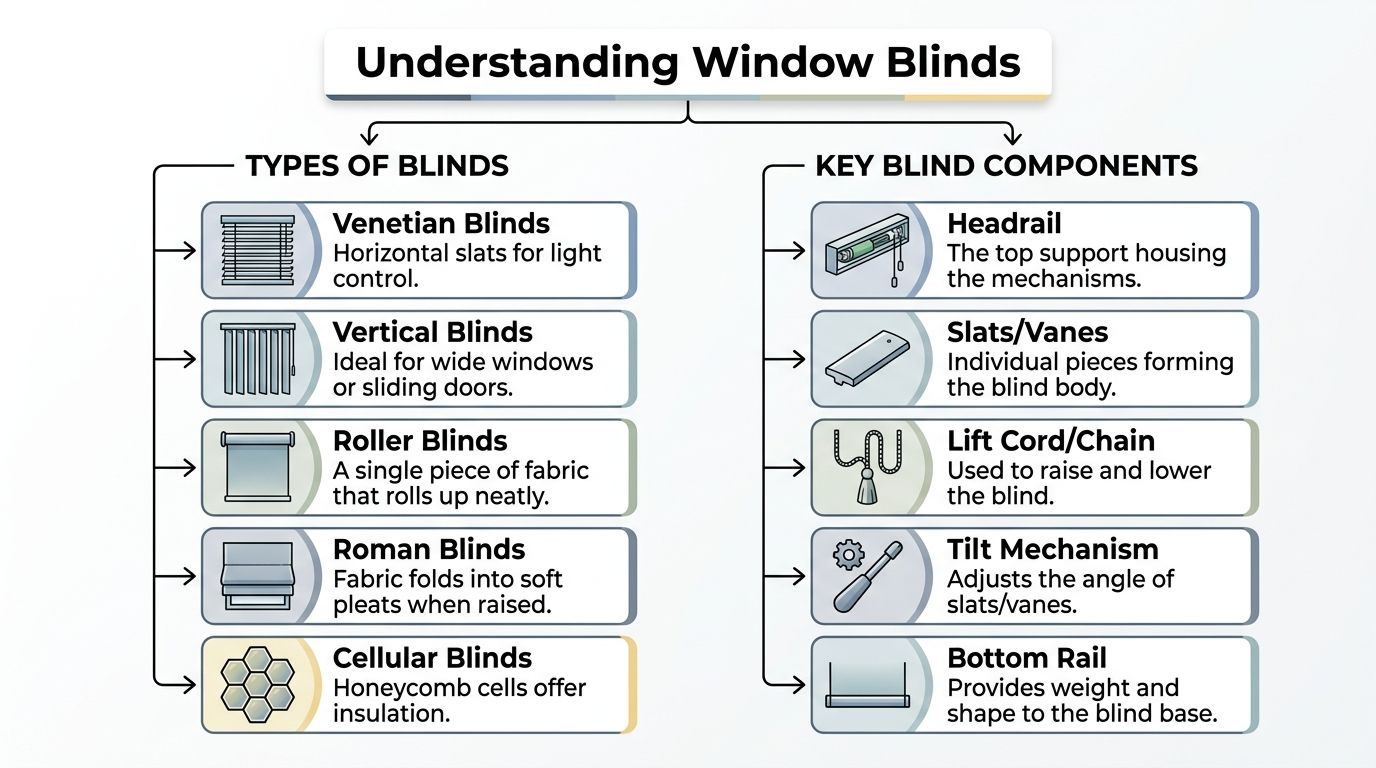
Venetian blinds are the standard horizontal slat blinds many homeowners know well. They give precise light control, and they work well in bedrooms, offices, and living spaces. In Phoenix, they are practical because you can angle slats to cut glare without blacking out the room entirely. The downside is simple. More moving parts and more surfaces mean more dust buildup.
Vertical blinds still make sense on wide openings and sliding glass doors. They are not fashionable in every home, but they remain one of the easier systems to service when a single vane gets damaged. In high-use patio areas, that matters. They also tend to handle broad openings better than many cheaper horizontal setups.
Roller blinds give a cleaner, more minimal look. They are useful when a homeowner wants fewer dust-catching surfaces than a slatted blind. The trade-off is reduced fine-tuned light control. They are either more open or more closed, with less middle ground.
Cellular blinds, also called honeycomb shades, are popular in rooms that take heavy solar load. Their structure is built for insulation, which is part of why they appeal to homeowners trying to tame afternoon heat. They look clean and perform well, but repairs can be less forgiving than with simpler mini-blinds.
Faux wood blinds are a strong fit for the Phoenix climate because they offer the look of painted wood with better resistance to common moisture and wear issues found in kitchens and bathrooms. They still need proper installation, though. A heavy blind mounted poorly will announce that mistake fast.
The parts homeowners should know by name
If you can name the part, you can usually describe the problem more accurately and get to the right fix faster.
| Component | What it does | What commonly goes wrong |
|---|---|---|
| Headrail | Holds the operating mechanism and mounting points | Dust, worn internal parts, bent hardware |
| Slats or vanes | Block and redirect light | Cracking, fading, bending, misalignment |
| Lift cord or chain | Raises and lowers the blind | Fraying, tangling, lock failure |
| Tilt mechanism or wand | Rotates slats for light control | Stripped gears, jammed rotation |
| Bottom rail | Weights the blind and keeps it straight | Uneven hanging, broken end caps, cord issues |
What performs well and what does not
In Phoenix, the best blind is often the one that matches the window exposure, not the one that looked best in a showroom.
- For west-facing rooms: Cellular shades and well-built faux wood blinds usually make more sense than bargain vinyl units.
- For sliding doors: Vertical blinds remain practical because individual vanes are easier to address than a full failed system.
- For dust-prone spaces: Simpler mechanisms usually age better than complicated, lightly built hardware.
- For hard-to-reach windows: Manual blinds can become frustrating fast. The operating method matters as much as the material.
Contractor view: Most blind problems start with mismatch. The blind is either too light-duty for the room, too heavy for the mounting method, or too exposed for the materials used.
A homeowner does not need to memorize every product category. It is enough to know the blind you have, what the main components are, and how those parts tend to fail in desert conditions.
Diagnosing Common Blind Problems and Repairs
Most blind failures are not mysterious. They follow patterns. In Phoenix, those patterns are heavily shaped by dust, repeated sun exposure, and the habit of forcing a mechanism that has already started to bind.
When a blind will not stay up
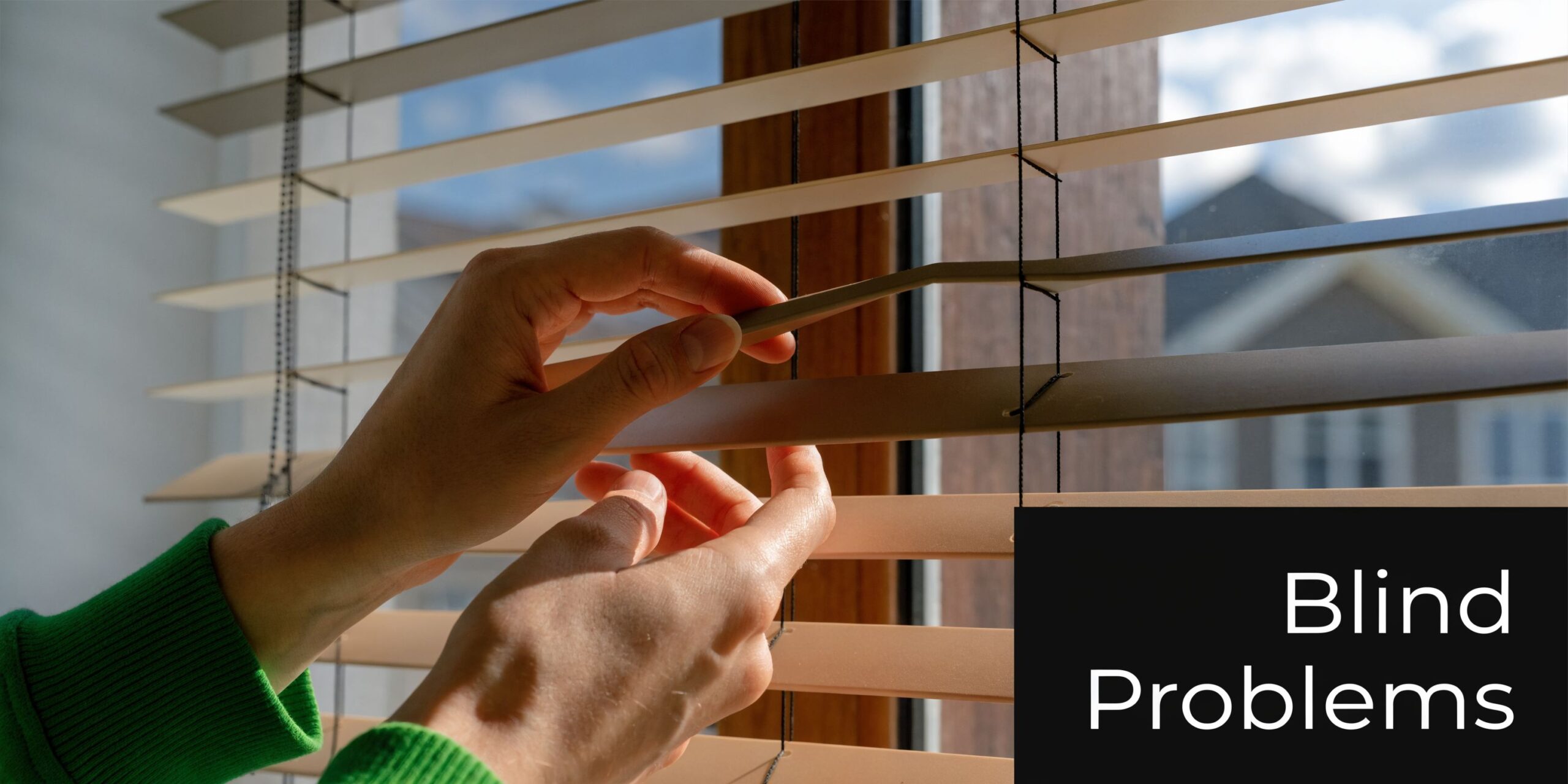
This is one of the most common service calls. On standard mini-blinds, the likely culprit is the cord lock mechanism inside the headrail.
Repairing a jammed cord lock in common mini-blinds can significantly restore functionality. Such jams are a frequent cause of stuck-blind complaints, and dust buildup in arid climates like Phoenix can substantially increase cord fraying rates. A professional can often fix the issue on-site quickly (We Fix Blinds on DIY window blind repairs).
What causes it? Fine dust works its way into the lock, pins stop moving cleanly, and the cords no longer catch or release the way they should. Homeowners often make it worse by yanking the cords at an angle.
What usually works
- Cleaning the headrail: Compressed air and proper lubricant can free a dirty mechanism.
- Checking cord alignment: If the cords are not feeding evenly, the lock may not engage.
- Replacing worn parts: If the lock is damaged rather than dirty, cleaning alone will not save it.
What does not work
- Pulling harder.
- Spraying random household oil into the mechanism.
- Tying off the cords as a “temporary” fix and calling it good.
When slats tilt badly or stop tilting
If the blind raises and lowers but the slats will not rotate, look at the tilt mechanism first. On some blinds that means a wand-driven gear. On others it is a cord or chain setup inside the headrail.
The failure can come from a stripped gear, a disconnected tilt rod, or slats that are out of alignment. In homes with heavy UV exposure, plastic internal parts become brittle long before the whole blind looks destroyed from across the room.
A high-level repair usually involves opening the headrail, identifying whether the problem is mechanical or positional, then either realigning the internal rod or replacing the failed component. This is a moderate repair. It is still manageable for a handy homeowner on a simple blind, but less so when the system is larger, older, or mounted high.
Here is a visual reference that helps homeowners recognize common failure points before they pull a blind apart:
When one side hangs lower than the other
A crooked blind is blamed on the blind itself, but the source may be different.
Common causes include:
- Uneven cord tension
- A shifted bracket
- A bent headrail
- A bottom rail issue
- A previous installation that was never level
For such cases, accurate diagnosis is essential. If the cords are feeding unevenly, the repair may be simple. If the mounting points are off, replacing parts inside the blind may do nothing.
Field tip: If a blind was always “a little off” from day one and gradually got worse, suspect the installation before you suspect the blind body.
When slats crack, warp, or look cooked
Phoenix sun can age blinds from the window side inward. A blind may still open and close while the slats themselves become fragile. This is common with lower-end plastics and older components exposed to strong afternoon sun.
In those cases, replacing a single slat can work if the rest of the blind is sound and matching parts are available. It does not work when multiple slats are brittle, faded differently, or starting to fail in sequence. Then you are usually putting a patch on a unit that is already near the end of useful service.
When the issue is motorized or high up
Motorized blinds, oversized shades, and blinds mounted over stairwells or tall entry glass belong in a different category. The problem may still sound simple. The work is not.
The challenge there is less about identifying a jam and more about safe access, wiring or motor replacement, and protecting surrounding materials while the blind is removed and reinstalled. That is where many homeowners cross from practical DIY into avoidable risk.
The Professional Blind Installation Process
A professional installation is mostly invisible when it is done correctly. The blind sits square, moves smoothly, and does not call attention to itself. What homeowners notice months later is whether it still works the same way it did on day one.

Measuring is not a formality
Good installs start with exact measurement, not “close enough” measurement. Inside mounts need clean width and height checks at multiple points because window frames are not always perfectly uniform. Outside mounts require decisions about coverage, light gaps, trim clearance, and how the blind will look when stacked open.
In Phoenix homes, that first step matters even more on retrofit work. Older homes often have settling, patched drywall, or stucco transitions around openings. If you install to the assumption that everything is square, the blind may look straight only until it starts operating.
Brackets decide whether the blind lives an easy life
The most important installation detail is often the least glamorous. It is bracket alignment.
Even a slight deviation can cause binding, and professionals use calibrated leveling tools and pre-drilled pilot holes to achieve substantial mounting strength per bracket, a practice tied to preventing many common DIY installation failures (Vision Blinds and Shutters on professional installation methods).
That matters because blinds are mechanical. If the brackets are not aligned, the headrail twists under load. Then the blind starts rubbing, cords wear faster, and slats stop moving cleanly.
Mounting changes with the surface
Not every wall or frame gets the same treatment.
- Drywall: Fastener choice and anchor integrity matter, especially on heavier faux wood blinds.
- Wood trim: Usually straightforward, but still needs accurate pilot holes and edge awareness.
- Stucco returns: Less forgiving and easier to chip if rushed.
- Metal or specialty frames: Require the right hardware and a careful hand.
A careful installer also checks for interference. Valances, handles, locks, deep sills, and nearby alarm sensors can all affect bracket placement.
What separates a durable install: The blind should cycle smoothly before the installer leaves, not just look straight from across the room.
Final adjustment is where many rushed jobs fail
After the brackets and headrail are in place, the blind still needs tuning. That includes verifying even drop, checking tilt action, and making sure the blind completes repeated open-close cycles without drag.
A contractor who does this well is not just “putting up blinds.” They are testing whether the system is supported evenly, whether the hardware is biting properly, and whether the blind clears the frame as intended.
For homeowners, this is the standard to expect:
- the blind sits level,
- the motion feels smooth,
- the slats close evenly,
- and nothing scrapes, twists, or snaps into place awkwardly.
If any of those are off on day one, the installation is not finished.
DIY vs Hiring a Phoenix Professional
This decision usually comes down to four things. Access, complexity, tools, and what happens if the first attempt goes wrong.
For some jobs, DIY is reasonable. For others, it saves little and creates a second job. Blind installation and repair in Phoenix also has one extra factor. Desert dust and sun often mean the visible problem is only part of the problem.
When DIY makes sense
A homeowner with patience can handle simple work on a standard, reachable blind.
Good DIY candidates include:
- Cleaning a dirty mechanism: If the blind is accessible and the issue is minor.
- Replacing one damaged slat or vane: Best when matching parts are already on hand.
- Straightening a small alignment issue: Only if the brackets are secure and the blind is healthy.
- Swapping basic hardware on a common unit: Manageable when the system is not motorized or oversized.
These jobs stay reasonable when the blind is at normal height, the parts are easy to identify, and no one needs to stand on a ladder in an awkward position for long.
When a professional is the smarter call
Some repairs look cheap until they are not.
Call a pro for:
- Motorized blind issues
- Large faux wood or heavy headrail systems
- Blinds over stairwells or high foyer windows
- Mounting into tricky surfaces
- Any job where the existing install may be out of level
- Repairs that involve repeated disassembly because the true cause is still unclear
The economics support that approach. In the U.S., the average blind repair is considerably less than full replacement and installation. Professional labor rates are generally competitive, and proper care can help blinds last for several years, which is why straightforward repairs are worth doing before jumping to replacement (HomeAdvisor blind repair and installation costs).
Cost comparison in practical terms
Below is a simple way to think about the trade-off. The DIY column remains qualitative because parts vary by brand and blind style.
| Repair Type | DIY Parts Cost Estimate | Professional Service Cost Estimate |
|---|---|---|
| Dirty cord lock cleanup | Low if you already have basic supplies | Often aligns with the lower end of repair pricing |
| Single slat or vane replacement | Low to moderate, if matching parts are available | Usually modest if no broader mechanism issue exists |
| Tilt mechanism repair | Moderate, plus time spent sourcing the right part | Higher than a basic cleanup, but often faster and cleaner |
| Motorized blind repair | Potentially expensive and easy to misdiagnose | Often the safer route because labor and part matching matter |
| Full reinstall after bad mounting | Low parts, high frustration | More efficient when brackets, anchors, and alignment all need correction |
The hidden DIY costs are not the parts. They are the follow-up issues. A stripped screw hole. A chipped stucco return. A bent headrail. A blind that now “works,” but only if you handle it gently.
The screen and window factor
Phoenix windows rarely live alone. A blind job often happens next to solar screens, insect screens, and dusty glass. It is easy to damage surrounding materials while wrestling with a headrail or leaning tools against the opening. If your screens already need attention, it makes sense to think about the opening as one system and review options for window screen repair at the same time.
Best rule of thumb: If the repair is low, light, and obvious, DIY can be fine. If it is high, heavy, electrical, or uncertain, the professional route usually costs less than doing the job twice.
The right call is not always the cheapest first move. It is the one that gets the blind working correctly without creating damage around it.
How to Choose a Trusted Local Contractor
A Phoenix blind job can look simple until the sun has baked the headrail, dust has worked into the mechanism, and the mounting surface turns out to be older drywall, hollow stucco, or wood trim that has already been patched once. The contractor you hire should know how those local conditions affect installation quality, repair options, and how long the fix is likely to hold.

Good blind work starts with observation. In Phoenix and Scottsdale, I would expect a qualified pro to ask about sun exposure, room orientation, window height, dust buildup, and whether the blind is rubbing against screens, cranks, or trim. Those details matter because a west-facing window in July puts very different stress on materials than a shaded opening on the north side of the house.
Multi-story work deserves extra scrutiny. Many local homes have tall glass, stairwell windows, and upper-story openings. Work at height requires proper access and safe handling, and poor technique can damage surrounding screens or solar components, which is one reason these jobs belong with qualified pros rather than casual DIY attempts (We Fix Blinds on misaligned blinds and multi-story challenges).
Questions worth asking before you book
Ask direct questions and listen for direct answers.
- What blind types do you install and repair most often in Phoenix-area homes?
- How do you tell the difference between a blind that needs cleaning, restringing, or full replacement?
- What is your process for high windows or stairwell access?
- How do you protect stucco returns, painted trim, screens, and glass during the job?
- Do you bring common replacement parts, or does every repair require a second visit?
- Are you bonded and insured, and do you explain the difference clearly?
- If the blind has sun warping or brittle plastic parts, will you repair it or recommend replacement? Why?
The best answer is usually specific. A weak answer stays vague, promises everything, or pushes replacement before checking the hardware.
It also helps to ask how they handle the full window area. Blind problems do not always stop at the headrail. Dusty tracks, damaged screens, mineral-stained glass, and loose mounting surfaces often show up together in Phoenix homes. A contractor who pays attention to the whole opening usually does cleaner work and causes fewer callbacks.
Check recent local reviews, but read them for detail instead of star count alone. Look for comments about punctuality, clean mounting, clear communication, and whether the repair lasted through a Phoenix summer. Heat exposes shortcuts fast.
If you want a company that understands blinds as part of overall window care, Sparkletech Window Washing handles blind service with the same attention we bring to screens, frames, and glass. Reach out if you want a local assessment and a clear recommendation on whether your blinds should be repaired, reinstalled, or replaced.