

In Phoenix, the average professionally installed solar screen costs between $80 and $280 per window, with about $160 per window as a useful middle ground. That's the starting point for the cost of solar screens here, but your final quote can move quite a bit depending on window size, material, labor, and how much direct sun your house takes.
If you're reading this in the middle of another long Arizona summer, you probably already know why solar screens come up so often. The west side of the house heats up by afternoon, certain rooms stay bright and hot no matter how low the thermostat goes, and the AC seems to run without much of a break. In Phoenix and Scottsdale, solar screens aren't a cosmetic upgrade first. They're usually a practical response to heat, glare, and daily cooling load.
A lot of homeowners get tripped up by bad pricing expectations. They hear "screens" and expect a small bill, or they hear "energy upgrade" and expect replacement-window pricing. In reality, solar screens usually land somewhere in the middle. They're often a manageable exterior retrofit, especially compared with full window replacement, but the wrong assumptions about materials or installation can still lead to a disappointing quote.
How Solar Screens Can Cut Your Summer AC Bill
By June in the Valley, the pattern is familiar. Morning sun warms the east-facing rooms, afternoon sun pounds the west side, and by early evening the AC is still trying to catch up. When a home has large uncovered windows, especially on the south and west exposures, you feel that heat long before you ever open the utility bill.
That's where solar screens earn their keep. They sit on the outside of the window, so they stop a meaningful amount of sun before it passes through the glass and heats the room. In a Phoenix house, that matters more than it does in a milder climate because the problem isn't occasional summer discomfort. It's repeated, intense solar exposure for months.
Homeowners usually ask the same first question. What will this cost me? The national baseline is straightforward: recent pricing guides put installed solar screens at about $160 per window on average, with a typical range of $80 to $280 per window according to HomeAdvisor's solar shade cost guide. In Phoenix, that range is a solid planning number, but sun exposure, size, and second-story access often decide where your home lands.
Practical rule: If your biggest comfort problem shows up in the afternoon, start by looking at west-facing windows before you think about screening the entire house.
Solar screens work best when they're part of a broader cooling strategy. Homeowners who pair them with basic HVAC maintenance usually get a clearer result because the house isn't fighting heat gain and mechanical inefficiency at the same time. If you want a plain-English overview of that bigger picture, Bear Valley Plumbing & Heating's advice gives a useful summary of how contractors approach energy-bill reduction from the HVAC side.
Before you request quotes, it also helps to look at the house the way an energy auditor would. A simple home energy audit checklist can help you identify which rooms are overheating, which windows get the harshest exposure, and whether the problem is really the whole house or just a few trouble spots.
Breaking Down Solar Screen Costs in 2026
The cost of solar screens gets confusing because contractors and suppliers don't all price them the same way. Some quote per window. Others think in square feet. Both approaches are normal, and both can be accurate.
For most Phoenix homeowners, the easiest way to think about it is per opening. That's how people usually buy them, and that's how many residential quotes are framed. In the U.S. market, solar screens are commonly sold as a window-by-window upgrade rather than a major whole-house renovation.
Estimated Solar Screen Costs in Phoenix 2026
| Cost Metric | Typical Low End | Typical High End | Notes |
|---|---|---|---|
| Per window installed | $80 | $280 | Average is about $160 per window based on national residential pricing |
| National average per window | $160 | $160 | Useful benchmark for standard-size openings |
| Per square foot installed | $5 | $8 | One consumer breakdown prices installed work in this range |
| Per square foot installed | $5 | $10 | Another guide shows a slightly broader range |
| Labor per hour | $40 | $80 | Labor is often quoted separately or folded into the screen price |
| Labor per window | $35 | $90 | Common on standard residential installs |
| Full-home labor per screen | $50 | $70 | Some projects come down on a per-screen basis when done in volume |
The square-foot view explains a lot. Angi's solar screen cost breakdown places installed pricing at roughly $5 to $8 per square foot, while another cited range goes to $5 to $10 per square foot. The same guide says labor runs about $40 to $80 per hour or $35 to $90 per window, and notes that larger whole-home jobs can bring per-screen pricing down to about $50 to $70.
What those numbers mean on a real house
In practice, standard windows are usually predictable. A straightforward single-story home with common rectangular openings tends to quote more cleanly than a house with oversized panes, custom shapes, or difficult second-story access.
A consumer pricing guide also notes that a large 48-by-60-inch window is about $160 on average, which is a good reminder that the "average per window" number isn't magic. Big windows eat material faster, and custom work slows down installation.
A cheap-looking quote often means one of two things. Either the screens are basic and the fit is simple, or the scope isn't fully defined yet.
Why Phoenix homeowners should use national averages carefully
National averages are useful for budget planning, not for pretending every home in the Valley is the same. Phoenix homes often have broad western exposures, tall front windows, and stucco exteriors that amplify heat around openings. That doesn't always make the screens themselves more expensive, but it does make good prioritization more important.
If you only need to calm down the hottest rooms, you may not need to screen every opening. If the whole house gets hammered by sun, the project can scale quickly. The best use of these numbers is to estimate your range before you talk to a contractor, not to treat them as a fixed quote.
What Determines Your Solar Screen Price
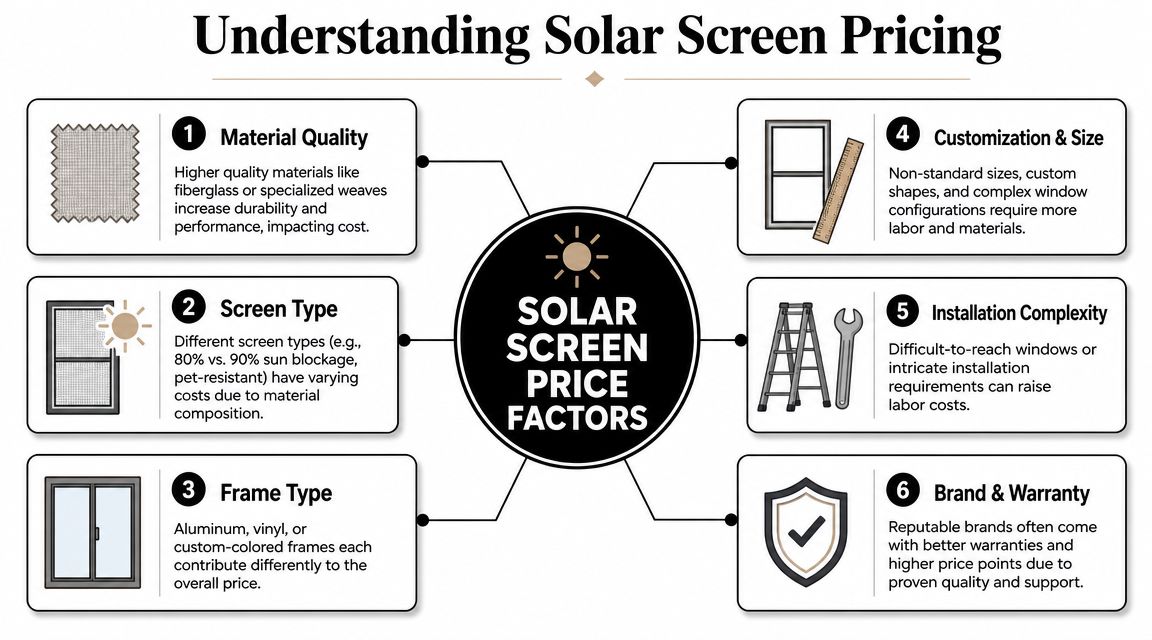
Two neighbors can live on the same street, have similar square footage, and still get very different quotes. That usually comes down to material, screen specification, window shape, and installation conditions. The cost of solar screens isn't random. It's tied to a handful of decisions that matter a lot in Arizona.
Material matters first
Material is one of the clearest price drivers. Arrowhead Solar Screen's cost guide lists fiberglass at roughly $40 to $100 per window, polyester at $60 to $120, and aluminum or metal at about $80 to $150 per window, often including installation.
Fiberglass is often the entry point. It works, and for many standard windows it makes sense. Polyester usually lands in the middle. Metal or aluminum-framed options tend to be the premium choice when durability matters more than first cost.
For Phoenix homes, I'd pay closest attention to exposure. A mild north-facing opening and a hard-hit west-facing opening don't need to be treated like they're doing the same job.
Shade level and visibility
Think of solar screen fabric like sunglasses tint. Darker and tighter weaves can improve solar control, but they can also change the view out and the amount of natural light coming in.
A common example is 90% shading fabric, which is marketed for stronger solar control. That can make sense on brutal west exposures. But if you use that same spec everywhere, some rooms may feel darker than you want. Homeowners sometimes chase maximum heat blocking and then realize they preferred a little more daylight in kitchens or living areas.
Size, shape, and frame details
Standard rectangular windows are the easiest to price and fit. The price usually climbs when the house has:
- Oversized glass that needs more fabric and sturdier framing
- Arched or custom-shaped openings that take more measuring and fabrication
- Color-matched or upgraded frames where appearance matters from the street
- Multiple second-story windows that slow installation
If you're already comparing screens to residential vinyl windows, it helps to separate the two projects mentally. New windows change the entire opening. Solar screens are an exterior add-on. That makes screens much less invasive, but fit and frame quality still matter if you want them to look clean from the curb.
South- and west-facing windows usually deserve the stronger conversation about durability, not just the lowest price.
What works and what doesn't
Here's the short version from a Phoenix perspective:
- What works: Matching tougher materials to the hottest exposures.
- What works: Screening the problem windows first if budget is tight.
- What doesn't: Choosing the cheapest fabric for the harshest side of the house.
- What doesn't: Treating every window like it needs the same screen spec.
If you want a better sense of how different fabrics and weaves affect visibility and performance, this guide to types of window screen mesh is a useful reference before you approve a quote.
DIY or Hire a Pro What to Expect
A lot of Phoenix homeowners start here after the first big electric bill hits. They price out solar screens online, see that the materials look affordable, and assume the whole job is a simple Saturday project. Sometimes it is. Sometimes the screens show up loose, the frame corners don't stay square, and the west-facing windows still look rough from the street.
The DIY case
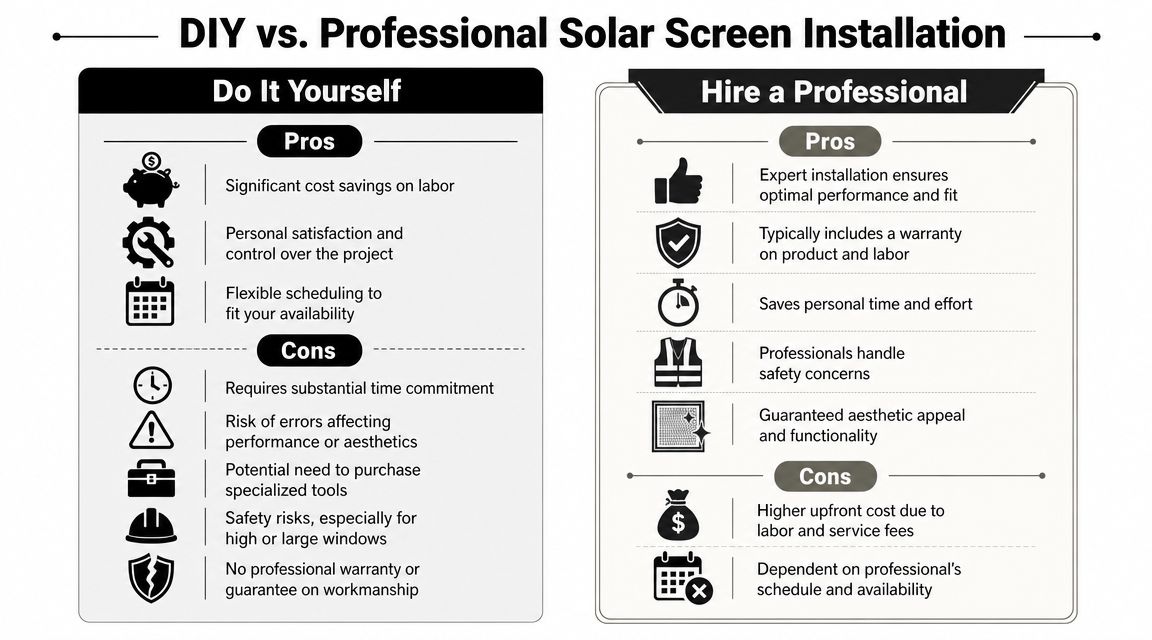
DIY can save money if the house gives you an easy project. Single-story homes with standard rectangular windows are the best candidates. If you already own basic screen tools and you're patient with measuring, building your own screens can be a reasonable way to cut costs.
It also works better when your expectations are practical. If your goal is to reduce glare and heat on a few trouble windows, DIY may be enough. If you want every front-facing screen to match cleanly and sit tight in the frame, the margin for error gets much smaller.
Where DIY usually goes sideways
In Phoenix, heat exposes sloppy work fast. A screen that is slightly off can rattle in monsoon winds, sit unevenly in the opening, or leave light gaps around the frame that look minor in the garage and obvious on the house.
The trouble spots are predictable:
- Second-story windows: Access is harder, slower, and less forgiving.
- Large or wide openings: Bigger screens need better frame strength and cleaner assembly.
- Sun-beaten exposures: West and southwest windows put more stress on materials and fit.
- Visible front elevations: Small alignment issues stand out from the curb.
The expensive part of DIY is usually not the material. It's rework. One bad measurement can mean buying new frame stock, new mesh, and spending another afternoon rebuilding the same unit.
The cheapest route on paper can cost more if you have to build the same screen twice.
What you're paying a pro for
A good installer is charging for more than labor. You're paying for accurate measurements, tighter frame fit, cleaner attachment, and fewer callbacks. On homes with mixed window sizes or hard afternoon exposure, that matters more than the lowest initial number.
Professional install usually makes more sense for larger homes, two-story sections, custom openings, and any window bank that faces hard west sun. Those are the areas where poor fit, weaker frames, or the wrong screen setup are easiest to regret in Arizona.
Before you sign a bid, review these questions to ask a solar screen contractor before hiring. That helps you compare quotes on the details that affect value, such as frame thickness, screen material, mounting method, and warranty coverage.
If the job is simple, DIY can be a fair choice. If the windows are high, oversized, or highly visible, hiring a pro usually buys better fit, better appearance, and less hassle in the Phoenix heat.
Are Solar Screens a Good Investment in Arizona
A Phoenix homeowner usually asks this after the first brutal run of summer electric bills. One room is bright, hot, and hard to cool by 3 p.m. The AC keeps running, but the west side of the house still feels loaded with heat. That is the situation where solar screens often earn their keep.
Why Arizona changes the math
National averages only get you so far. In Phoenix and Scottsdale, long cooling seasons, intense afternoon sun, and large west-facing glass shift the value calculation fast. A product that feels optional in a milder market can make a noticeable difference here, especially on windows that take direct summer sun for hours.
That does not mean every screen pays off equally.
A north-facing bathroom window with decent shade is rarely where I would put money first. A west-facing living room window with no exterior shade is a different story. In Arizona, the return usually comes from targeting the windows that add the most heat to the house, not from screening every opening just to say the whole home is done.
When the investment makes sense
Solar screens tend to be a good Arizona investment when a home has one or more of these conditions:
- Heavy west or southwest exposure: That is usually where the worst heat shows up.
- Large glass areas without shade: More exposed glass means more heat entering the room.
- Rooms that stay uncomfortable in late afternoon: Comfort problems usually point to the windows causing the load.
- High summer AC use: If your system runs hard every afternoon, cutting solar gain has more value.
- Older homes with less efficient windows: Exterior shading can help when full window replacement is not in the budget.
The best return is often partial, not whole-house.
I regularly see Arizona homeowners get better value by screening the toughest five or six windows first, then living with it for a summer before deciding on the rest. That approach keeps the budget focused on the problem areas and gives you a clearer read on comfort improvement.
What value actually looks like
Payback is only part of the decision. In this climate, the benefit usually shows up in four places at once:
- Hot rooms become more usable
- Glare drops during peak sun hours
- The AC has less afternoon heat to fight
- UV exposure on floors, furniture, and blinds is reduced
That combination matters in Phoenix because cooling season drags on for months. Even if the monthly savings are not dramatic on every house, better comfort in the rooms you use can still make the install worthwhile.
If you want a visual explanation of how exterior shading helps in hot-weather homes, this short video is a useful primer.
Where homeowners misjudge the return
The biggest mistake is treating solar screens as a simple yes-or-no purchase. In Arizona, they are usually a strong investment when the window selection is smart and the screen is matched to the exposure. They are less convincing on low-impact windows, heavily shaded sides of the house, or homes where the main complaint is insulation loss at night rather than solar heat during the day.
I would also weigh appearance and visibility. On front-facing windows in Scottsdale neighborhoods, some homeowners care as much about the exterior look as the energy benefit. That does not make the product less useful. It just means the right decision is not based on price alone.
For most Phoenix-area homes, solar screens are worth serious consideration if the house has hot west-facing rooms, glare problems, or summer cooling strain. The strongest value usually comes from selective installation on the windows that punish your AC the most.
How to Get an Accurate Solar Screen Quote
A good quote starts before the contractor arrives. If you want accurate pricing, walk your house first and take notes. The more specific you are, the less likely you'll get a vague estimate that changes later.
What to gather before you call
Write down these basics:
- Window count: Include only the openings you're considering.
- Sun exposure: Mark which windows face west and south first.
- Story level: Note which ones require ladder access.
- Unusual shapes: Arches, tall narrow windows, and oversized panes matter.
- Current condition: Mention damaged frames, bent screens, or missing hardware.
Photos help. So do rough width and height measurements, even if the contractor will remeasure.
What an accurate quote should include
Ask for a quote that spells out the actual scope. You want to know the screen material, whether installation is included, what frame style is being used, and whether there are added costs for access or customization.
If the bid is vague, expect surprises. If it's clear, comparing quotes gets much easier.
Homeowners in Scottsdale, Peoria, and the greater Phoenix area should also ask whether the company handles related screen work, cleaning, and repairs, especially if older screens need to be removed or matched. Since solar screens are an exterior product, fit and condition around the window opening matter more than many people expect.
Your Solar Screen Questions Answered
Some questions come up in almost every estimate conversation. Here are the practical answers homeowners usually want before they move forward.
Frequently Asked Questions
| Question | Answer |
|---|---|
| Do I need solar screens on every window? | No. In Phoenix, the best results often come from prioritizing the windows with the harshest direct sun, especially west- and south-facing openings. |
| Will solar screens make my house too dark inside? | They can reduce incoming light, especially with higher-shade fabrics. The right choice depends on the room. A media room and a kitchen usually don't need the same screen spec. |
| Do solar screens give privacy at night? | Not in the same way they help during daylight. At night, interior lighting changes visibility, so don't treat solar screens as a substitute for blinds, shades, or curtains. |
| Will they affect curb appeal? | They can, for better or worse. A well-fitted screen with the right frame color usually looks clean and intentional. Poor fit, mismatched frames, or inconsistent coverage across the front elevation can look patched together. |
One more practical point. HOA requirements vary by community, so it's smart to check before installation if your neighborhood has appearance rules about screen color or exterior changes. Some communities care a lot about anything visible from the street. Others barely address it.
If you're unsure whether screens or another upgrade make more sense, don't start with product names. Start with the problem. Too much glare, overheated rooms, fading furniture, or a punishing west exposure each point toward a slightly different solution.
If you want a local opinion on the cost of solar screens, screen condition, or whether a few problem windows are better candidates than a full-house install, Sparkle Tech Window Washing LLC serves Scottsdale, Peoria, Phoenix, and nearby areas with window screen repair, replacement, and related exterior window services.