


You notice the problem when you open a window at sunset. Dust blows in, the room heats up, and the screen that looked fine last year now sags, rattles, or shows tiny tears at the corners. In Phoenix, Scottsdale, Peoria, and the rest of the Valley, a screen isn’t just a bug barrier. It’s part shade control, part dust filter, part wear item that takes a beating from sun and monsoon season.
That’s why choosing among the main types of window screen mesh matters more here than it does in milder climates. Arizona homes deal with intense UV, hard wind bursts, airborne grit, and long cooling seasons. The wrong mesh can make a room feel darker than you want, choke airflow, or fail early on a door that gets used all day. The right one can improve comfort, protect finishes, and hold up better between service visits.
Most homeowners start with whatever the builder installed, usually standard fiberglass. That works, but it’s not always the best fit for every window or every exposure. A west-facing office, a patio slider with dogs, and a bedroom near landscaping may all need different screen priorities.
If you’re sorting through options right now, this guide gets straight to the point. These are the eight window screen mesh types that matter most for Arizona properties, plus the trade-offs that show up in real use. If you also care about broader upkeep habits for keeping Colorado Springs windows spotless, the same basic truth applies here too. The right material choice makes maintenance easier from day one.
1. Fiberglass Mesh
Fiberglass is the default for a reason. In the global window screen market, fiberglass mesh holds over 42% of total revenue, and standard mesh leads sales at 35%, which tells you how often homeowners and contractors still come back to this combination for dependable everyday use (window screen market data from Market Intelo). In Arizona, it remains the practical starting point for most homes.
It’s lightweight, easy to fit into frames, and forgiving during rescreening. That matters on older Phoenix homes where frames may not be perfectly square anymore. Fiberglass also resists rust, so you don’t get the corrosion concerns people associate with some metal products.
Where fiberglass works best
If you’ve got standard bedroom windows, guest rooms, rental properties, or a home where cost control matters, fiberglass is usually the right baseline. It’s especially common on houses built with simple removable screens and on apartment properties where managers need a material that’s easy to replace without fighting the frame.
The most familiar version is the standard 18×16 mesh, made with 18 horizontal strands and 16 vertical strands per square inch and a wire diameter of 0.011 inches. That setup allows up to 60 to 70% airflow while still blocking mosquitoes and larger insects, which is why it became the residential standard (screen mesh guide from Metro Screenworks).
Practical rule: Fiberglass is the best “good everywhere” screen, not the best “perfect anywhere” screen.
In Arizona, the weakness is sun exposure. Fiberglass does fine for a while, but it’s not the screen I’d trust longest on a punishing west-facing opening that bakes every afternoon.
What Phoenix homeowners should watch
Dust is the quiet enemy. Fine grit settles into the weave, dulls the look of the screen, and makes airflow feel weaker than it should. Monthly cleaning is a smart habit here, especially if your home sits near open lots, heavy traffic, or active landscaping. Sparkle Tech has a helpful guide on how to clean window screens without beating up the mesh.
A few real-world uses make sense for fiberglass:
- Budget-conscious replacements: Good for standard windows where you want clean sightlines and simple upkeep.
- Rental and seasonal homes: Easy to replace when a tenant or storm damages a panel.
- Large batches of rescreening: Practical when several worn screens need matching material.
If you want one mesh type for an entire home and you’re not dealing with pets, intense privacy concerns, or heavy sun management, fiberglass is still the most sensible first stop.
2. Aluminum Mesh
A screen that gets grabbed every weekend, pulled for cleaning, and rattled by afternoon wind needs more than basic flexibility. Aluminum mesh earns its spot on those openings because it stays flatter in the frame and feels firmer in the hand than fiberglass.
That difference shows up fast in Phoenix and Scottsdale. On patio doors, side-yard entries, and other high-contact screens, aluminum usually keeps a tighter appearance over time. Homeowners who care about a crisp, straight look often notice the upgrade right away.
Why it works well in Arizona
Arizona heat is brutal on anything under tension. Aluminum handles that stress better than softer mesh, especially on openings that face strong afternoon sun or get removed often for cleaning and service. I would not call it the universal answer for every window, but it is a strong fit where shape retention matters more than flexibility.
It also suits properties where appearance has to stay consistent. That includes commercial buildings, HOA communities, and custom homes where a wavy screen stands out from the curb.
Aluminum is the practical choice for screens that get handled a lot and still need to look sharp.
The trade-off is repair tolerance. Aluminum can kink during installation or removal, and once that crease is there, you usually keep seeing it. Fiberglass gives installers more forgiveness. Aluminum asks for a steadier hand.
Best uses around Phoenix and Scottsdale
Aluminum mesh makes the most sense in a few specific situations:
- Sliding patio doors: Holds its shape better with repeated opening, closing, and screen removal.
- Front entry and side-yard screens: Good where hands hit the frame regularly.
- Commercial and HOA properties: Keeps a cleaner, more uniform appearance across multiple units or elevations.
- Homes with strong sun exposure: Useful on openings where heat and daily use wear out softer mesh faster.
Dust still collects in the weave, and mineral residue around the frame can make metal screens look older if they are neglected. Clean them with a non-abrasive method and avoid bending the frame during removal. If a panel has torn, slipped loose, or developed creases, professional residential window screen repair usually produces a straighter result than a rushed DIY rescreen.
3. Pet Resistant Pet Proof Mesh
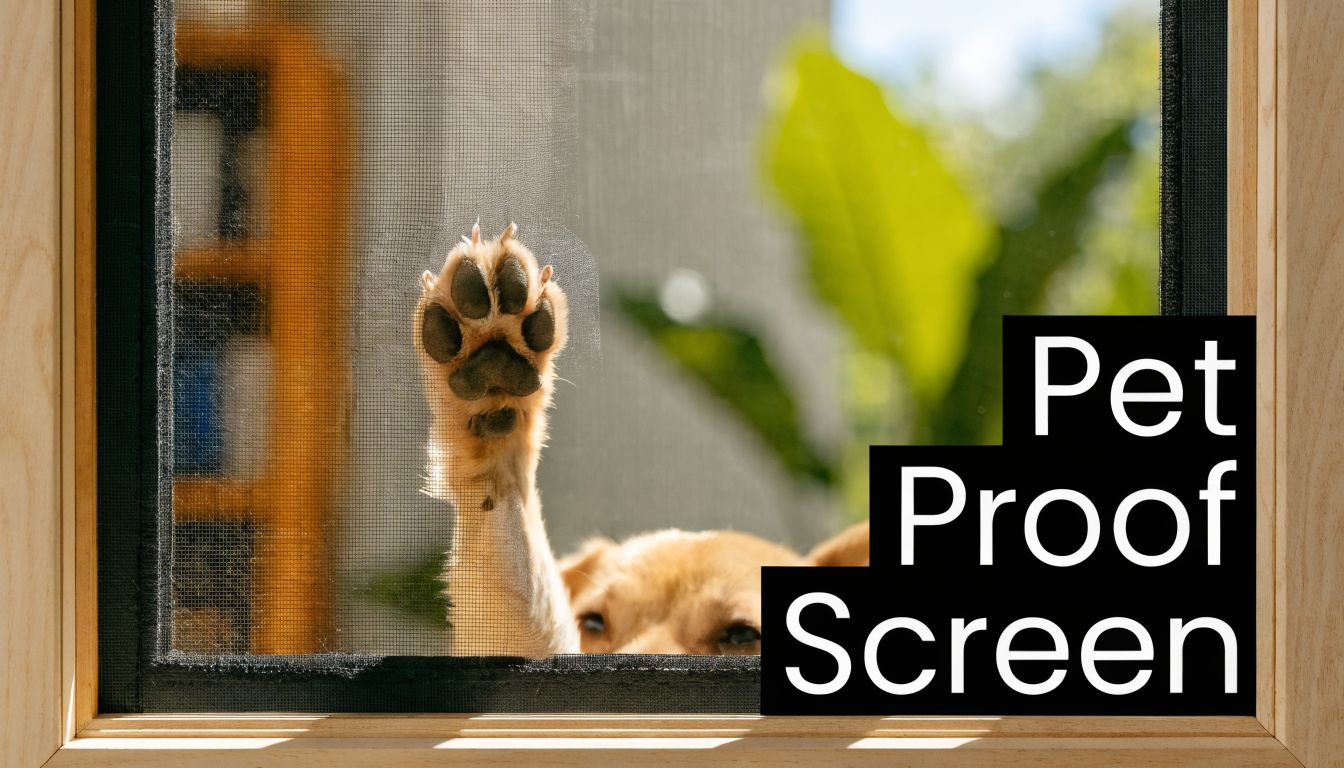
If you’ve got a dog that jumps at the backyard gate or a cat that tests every corner of a screen, standard mesh won’t last. Pet-resistant mesh exists for one reason. It handles abuse that would tear or stretch ordinary material.
This is one of the most useful specialty types of window screen mesh in Arizona because patio life is part of daily life here. Screens on sliders and lower windows get more contact from pets when doors stay open in the morning or after sundown.
What it does better than standard mesh
Pet mesh uses a heavier, tougher construction than the fiberglass found on many builder-grade screens. The point isn’t elegance. The point is survival. If you’ve replaced the same patio screen twice because a dog pushed through the lower panel, this is the upgrade that stops the cycle.
That doesn’t mean it’s perfect for every opening. Heavier mesh can feel less airy, and on some windows it won’t look as light or invisible as a standard charcoal screen. But on ground-floor windows and patio doors, durability matters more than subtlety.
For families in Peoria, north Phoenix, or Scottsdale with indoor-outdoor pets, I’d prioritize pet mesh where contact happens first. You don’t need it on every second-story bathroom window.
Where to install it first
Start with the problem areas.
- Patio sliders: This is usually the first failure point in a pet household.
- Low windows facing yards: Dogs see movement and press against the screen.
- Pet-friendly rentals: Stronger mesh cuts down on repeated turnover repairs.
- Homes with large breeds: Bigger animals expose weak mesh quickly.
Some pet-focused products are built for strength rather than fine visibility, so placement matters. Use them where scratching and pushing are predictable, then keep a lighter mesh on windows that are mostly about view.
If you’re dealing with torn lower corners, claw punctures, or a door screen that won’t survive another season, Sparkle Tech’s residential window screen repair service is directly relevant for replacing just the failed panels instead of guessing through a DIY fix.
4. Solar Screen Sun Control Mesh
Solar mesh makes the most Arizona-specific sense of anything on this list. A standard bug screen handles insects. A solar screen also helps manage glare and heat on windows that get hammered all afternoon.
That matters because desert exposure isn’t even across the house. A shaded north window and a west-facing living room window need different solutions. In homes around Phoenix and Goodyear, the windows that feel uncomfortable at certain hours are usually the ones that benefit most from solar mesh.
Why solar screens fit the local climate
Existing screen advice often focuses on bugs and visibility, but Arizona homeowners have a separate problem. Heat load and UV punishment are constant. Background material on desert conditions notes that solar screens with UV-blocking performance are part of the answer in arid zones, especially where plain metal screens can reflect heat and where homes need more targeted sun control for exposed openings (desert-climate screen discussion from Quality Window Screen).
That’s why solar screens show up so often on south- and west-facing glass. They’re less about making a screen stronger and more about making a room more livable.
Before-and-after comfort is easy to notice in home offices, upstairs bedrooms, and living rooms with broad afternoon sun. The room often feels less harsh, and screens can also help protect furnishings from constant exposure.
Here’s a visual overview many homeowners find useful before choosing a shade level:
The main trade-off
Solar mesh is not the “best looking from every angle” option. It darkens the opening more than standard insect screen, and some homeowners love that while others miss the brighter interior feel.
The right solar screen usually goes on the right windows, not every window.
That’s especially true in Arizona. If a room already struggles for natural light, covering every opening with dense solar mesh can solve one problem and create another. For patio enclosures and outdoor openings, Sparkle Tech’s guide to the best screen for porch can help you think through openness versus sun control.
If you’re also comparing indoor options, some homeowners pair solar screens with shades, shutters, and blinds that block UV to fine-tune light at different times of day.
5. No-See-Um Ultra-Fine Mesh
A common Phoenix call goes like this. The standard screens look fine, but tiny bugs still get through around dusk, especially near irrigated landscaping, pool areas, or backyard misters. In Scottsdale and the East Valley, I see it most often on patio-side bedrooms and casita windows that stay open during the cooler parts of the day.
No-see-um mesh solves a specific problem. Its tighter weave blocks smaller insects than a standard screen, but you pay for that extra protection with a little less airflow and a slightly more closed-in feel.
That trade-off matters in Arizona. During our mild mornings and evenings, homeowners want moving air. If you install ultra-fine mesh on every window in the house, some rooms can feel less breezy than expected. Sparkle Tech typically recommends using it selectively, where small-insect pressure is consistent, instead of treating it like a whole-house upgrade.
Where it makes sense
The best candidates are openings near moisture, vegetation, and evening activity. Bugs congregate where people do.
- Patio-adjacent bedrooms: Good for windows opened at night or before sunrise.
- Rooms facing pools, spas, or water features: Better at blocking tiny pests that show up around damp areas.
- Windows near dense shrubs or garden beds: Useful where irrigation creates a more insect-friendly pocket.
- Guest houses and casitas: A smart upgrade if those windows stay open during shoulder seasons.
There is also a housekeeping benefit. Fine mesh tends to stop more floating debris and larger dust particles than a standard screen, which can help around Arizona yards that throw pollen, lint, and plant matter toward open windows.
The mistake to avoid
Overusing it.
Ultra-fine mesh works best as a targeted fix. If only two or three openings have the bug problem, screen those first and live with them for a few weeks. That approach usually gives homeowners a clearer answer than replacing every screen at once. In hot, dry climates like ours, comfort is not just about insect control. It is also about keeping enough airflow where you want to enjoy it.
6. Stainless Steel Mesh
Stainless steel mesh is the heavy-duty end of the spectrum. Most homeowners won’t need it throughout the house, but some properties absolutely do benefit from it.
This is the screen for places where failure is expensive, access is difficult, or traffic is constant. Think retail storefronts, institutional buildings, utility areas, and high-contact commercial openings. On a custom home, stainless steel can also make sense for select doors or windows where damage keeps repeating.
Where stainless steel earns the premium
The material’s appeal is simple. It’s hard to deform, hard to tear, and built for a much more punishing environment than standard residential mesh. If a property manager is tired of replacing damaged screens in common areas, stainless starts to look less like overkill and more like a rational choice.
In Arizona, it also fits sites exposed to grit and regular handling. Fine dust can make any screen look dirty, but steel itself isn’t the weak point. The bigger concern is making sure the frame and installation match the strength of the mesh.
Use stainless steel when replacement disruption is the bigger problem than material cost.
That’s why it shows up more often in commercial settings than in tract homes. A single premium mesh on the wrong frame doesn’t solve much.
Best fit scenarios
A few places stand out:
- Commercial entries and storefronts: Better for constant use and periodic abuse.
- Institutional properties: Good where durability has to outweigh appearance concerns.
- Custom security-minded applications: Useful when a tougher barrier is the goal.
- Hard-to-service openings: Smart if access for repeated replacement is a hassle.
For most standard residential windows, stainless steel is more material than you need. But on the right opening, it can save repeated service calls and reduce the frustration of fixing the same issue again and again.
7. Charcoal Graphite Mesh
Late afternoon in Phoenix is when charcoal graphite mesh makes its case. Sun is hitting the west side of the house, the room is bright, and a light-colored screen starts to read like a layer over the view. A darker mesh is less visually distracting, so your eye goes past the screen instead of stopping at it.
That matters on Arizona homes with real sightlines to protect. In Scottsdale, I see this choice come up on houses facing mountain views, golf courses, desert washes, and open common areas. Sparkle Tech often recommends charcoal on those openings because homeowners notice the difference right away from inside the room, even when the mesh itself is still a standard screen material.
Where charcoal graphite works best
Charcoal graphite is a finish choice with a clear practical benefit. It improves outward visibility and usually blends better with dark frames, black trim, and many newer window packages used across the Valley. On contemporary homes, it tends to look cleaner from the curb too.
The trade-off is maintenance. Arizona dust, pollen, and hard water residue can show faster on dark mesh, especially on windows near irrigation overspray or busy streets. If the home gets regular cleaning, that is manageable. If screens are rarely washed, the visual advantage drops off.
Good places to use charcoal mesh
- View windows: Strong fit for living rooms, dining areas, and primary bedrooms where people look out every day.
- West-facing and south-facing openings: Helpful where intense sun makes lighter screens more noticeable.
- Homes with dark window frames: Usually a better visual match on black, bronze, or dark bronze finishes.
- Scottsdale and Phoenix neighborhoods with HOA standards: Keeps screens from drawing attention on the front elevation.
Charcoal does not add strength, improve pet resistance, or replace a solar screen where heat control is the main goal. Its value is visual. If the priority is a cleaner view through the screen and a sharper match to the house, charcoal graphite is one of the easiest upgrades to justify.
8. Bronze Mesh
Bronze mesh is often chosen for appearance first, and that’s not a bad reason. In Arizona, a lot of homes use warm stucco, stone accents, terracotta tones, and bronze or brown window frames. A screen that works with that palette can look far more natural than a cooler gray.
This category can include bronze-toned fiberglass or metal screening, depending on the product line. It’s less about changing the core function and more about matching the house while keeping the screen from standing out.
Why bronze suits Southwestern architecture
On desert-style homes, bronze tends to feel softer and more integrated than black or bright silver. It pairs well with tan, adobe, and earth-tone finishes, especially in neighborhoods where exterior color coordination matters.
That doesn’t mean it outperforms charcoal in every situation. If your top priority is the sharpest outward view, charcoal often wins. Bronze is the better fit when the exterior look is part of the decision.
A good example is a Paradise Valley or Scottsdale home with bronze-clad windows and warm stonework. A mismatched screen can look like an afterthought. Bronze mesh keeps the visual language consistent.
Best uses for bronze mesh
- Southwestern and desert-style homes: Strong aesthetic match for warm finishes.
- Visible front elevations: Helpful where screens are easy to spot from the street.
- Bronze or brown window frames: Creates a cleaner, coordinated look.
- Design-conscious remodels: Good when every exterior detail is being updated together.
Ask to see a sample in natural light before committing. Bronze can read differently in morning sun, afternoon glare, and shade. On the right home, though, it looks like it belonged there from the start.
Comparison of 8 Window Screen Mesh Types
| Material | 🔄 Implementation Complexity | ⚡ Resource Requirements | 📊 Expected Outcomes | 💡 Ideal Use Cases | ⭐ Key Advantages |
|---|---|---|---|---|---|
| Fiberglass Mesh | Low, DIY-friendly, easy repairs | Low cost; minimal tools; monthly cleaning; lifespan ~5–7 yrs | Good visibility, basic insect protection, moderate durability | Budget homes, standard residential windows | Economical, clear view, rust-proof |
| Aluminum Mesh | Moderate, heavier, may need pro install | Higher upfront (≈30–50% more); periodic pro cleaning; long life | Superior strength and puncture resistance; lasts ~10–15+ yrs | High-traffic areas, commercial, sliding doors | Durable in heat/UV, structural integrity |
| Pet Resistant Mesh | Moderate, often professional install recommended | Medium cost (+$15–25/window); tighter weave needs more cleaning | Resists claws/punctures; maintains airflow/visibility; ~8–10 yrs | Homes with pets; ground-floor windows and patio doors | Prevents pet breaches; long-lasting under abuse |
| Solar Screen (Sun Control) Mesh | High, best with professional alignment/installation | Medium–high cost ($20–30/window); specialized material; may reduce daylight | Reduces solar gain 50–90%, UV up to 99%, cuts AC load 10–30% | West/south-facing windows, energy-focused homes/office | Major cooling and UV protection; glare reduction |
| No-See-Um (Ultra-Fine) Mesh | Moderate, careful handling and cleaning required | Medium cost ($15–25/window); frequent gentle cleaning; fine weave | Blocks gnats/mosquitoes and filters pollen; slight airflow/light loss (~15–20%) | Areas with small insects, allergy-sensitive rooms, patios | Superior tiny-insect protection; improves indoor air quality |
| Stainless Steel Mesh | High, specialized, professional installation | Very high cost ($40–60+); minimal upkeep long-term; specify 316 for max corrosion resistance | Near-indestructible; 20+ year lifespan; negligible degradation | Commercial, institutional, very high-traffic locations | Ultimate durability and corrosion resistance |
| Charcoal / Graphite Mesh | Low, same as standard fiberglass installs | Low cost; same maintenance as fiberglass; dyed material | Improved inside visibility and contrast; standard durability (~5–7 yrs) | Living rooms, bedrooms, homes prioritizing view/aesthetics | Better visual clarity, reduced glare, aesthetic blend |
| Bronze Mesh | Low–Moderate, standard install, consider color matching | Low–medium cost; standard maintenance; tinted finish | Warmer aesthetic and improved visibility; similar durability to fiberglass | Southwestern/desert-style homes, stucco exteriors | Aesthetic match for warm tones; distinctive appearance |
From Choice to Care Next Steps for Flawless Window Screens
The best screen for an Arizona home usually isn’t one screen for everything. It’s the right match for the opening, the exposure, and the way that part of the house gets used. Fiberglass still makes sense for a lot of standard windows because it’s practical, familiar, and easy to service. Aluminum earns its keep on doors and higher-contact areas. Pet mesh solves a very specific household problem. Solar mesh is often the smartest move on punishing west- and south-facing windows.
That’s the best way to think about types of window screen mesh in Phoenix, Scottsdale, and the surrounding cities. Don’t shop by category name alone. Shop by problem. If the issue is claw damage, choose for strength. If it’s glare and heat, choose for sun control. If it’s preserving a view, color and openness matter more than brute toughness.
Maintenance matters just as much as selection. Desert dust settles fast, and once it loads into the weave, even a good screen starts performing like a neglected one. Airflow feels weaker. Visibility drops. Frames and corners show wear sooner because dirt keeps sitting on the material. Regular cleaning and timely repair are what stretch the value of whichever mesh you pick.
There’s also a point where replacement makes more sense than trying to nurse along an old panel. Torn corners, loose spline, sagging door screens, and brittle sun-baked mesh usually won’t improve with a quick patch. A proper rescreen or replacement gives you a tighter fit, better function, and a cleaner look from both inside and outside.
For homeowners and property managers in the Valley, professional help is especially useful when screens have to fit correctly the first time, whether that means matching existing frames, choosing a better material for local conditions, or cleaning screens without damaging the mesh. Sparkle Tech Window Washing LLC is one local option for screen cleaning, repair, and replacement in the greater Phoenix area.
If your screens look tired, block your view, or no longer match the way you use your windows and doors, now’s a good time to fix that. The right mesh won’t just keep bugs out. It can make your home brighter where you want brightness, cooler where you need relief, and easier to maintain through another Arizona summer.
If your screens need cleaning, repair, or full replacement, Sparkle Tech Window Washing LLC serves Scottsdale, Peoria, Phoenix, and nearby communities with window screen service adapted to local conditions.