


A lot of Phoenix homeowners notice screen problems the same way. A monsoon moves through, the dust settles, and one screen is hanging loose at the corner. Or the summer sun has cooked the mesh so badly that it feels brittle when you touch it. What looked like a small issue last season suddenly turns into bugs indoors, sagging mesh, and frames that don’t sit right anymore.
That’s why residential window screen repair in the Valley isn’t the same as generic advice you’ll find online. In Scottsdale, Peoria, and across the greater Phoenix area, screens deal with intense UV, alkaline dust, thermal expansion, and wind-driven debris. A repair that might hold up in a milder climate often fails fast here.
Your Guide to Window Screens in the Valley of the Sun
A familiar local scene goes like this. You open a window after a storm to air out the house, and the screen that looked fine a month ago now has a torn corner, loose spline, or a section of mesh that’s started to crumble. Most homeowners first think it’s random wear. In Phoenix, it usually isn’t.
Sun exposure does real damage to common screen materials. In extreme desert climates like Phoenix, fiberglass screens can lose 20% to 30% of their tensile strength after just 2 to 3 years due to photodegradation from intense UV exposure, according to Home Depot’s window screen repair guidance. That matters because weak mesh doesn’t just tear easier. It also stops holding tension well, so screens get baggy, noisy in the wind, and more likely to pull away from the frame.
The local pattern is usually easy to spot once you know what you’re seeing. South- and west-facing windows often show the earliest brittleness. Patio sliders collect dust and grit in the track. Older frames start loosening after repeated heat cycles. Then monsoon season exposes every weak point at once.
Desert screen repair is less about patching a hole and more about correcting the reason the hole happened.
Homeowners usually want a simple answer. Patch it, rescreen it, or replace it. The right call depends on the mesh condition, frame shape, and how much more life the assembly realistically has left.
That’s the practical lens to use. Not whether a repair is technically possible, but whether it will last through another Phoenix summer and the next round of wind, dust, and heat.
Diagnosing Common Screen Damage in Arizona Homes
The first step in smart residential window screen repair is figuring out what failed. A torn mesh panel and a warped frame can look like the same problem from across the room, but they need different fixes.
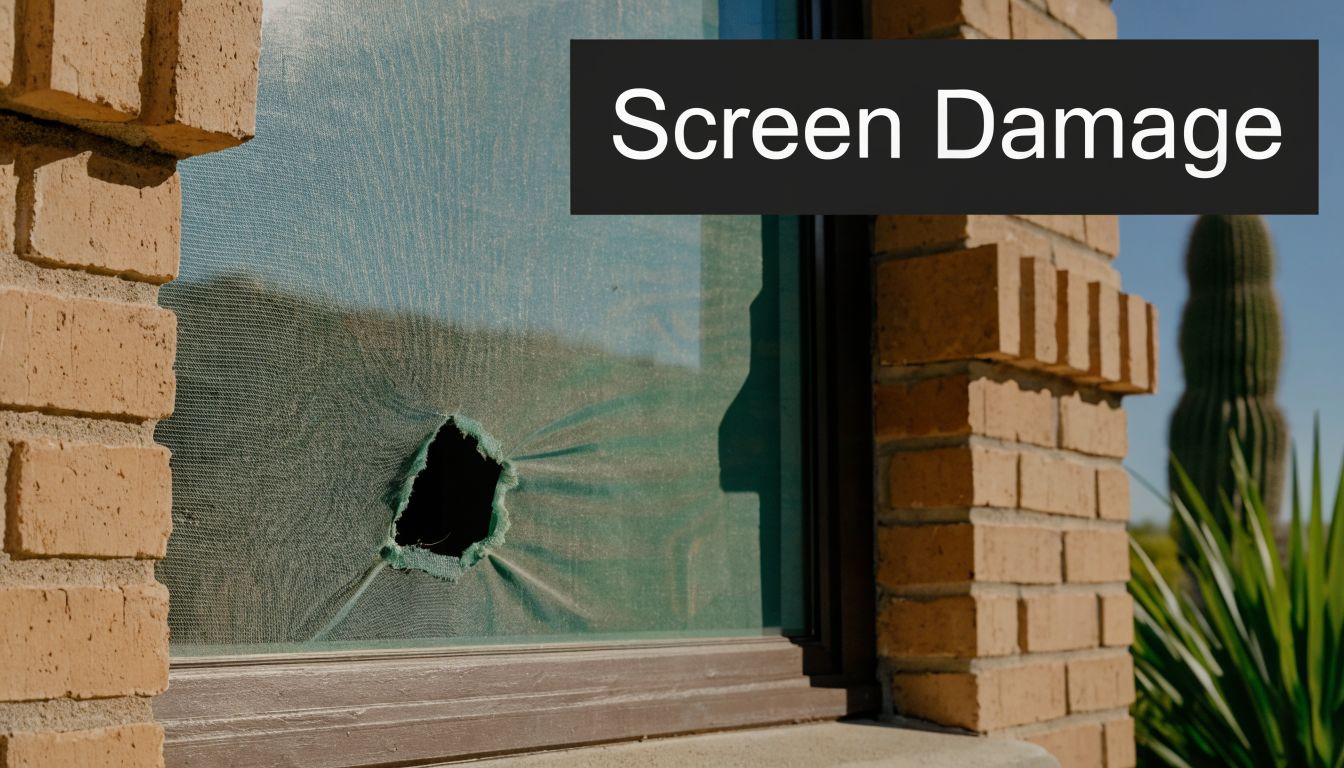
UV-brittle mesh
This is one of the most common Phoenix failures. The mesh looks faded, dry, and slightly chalky. When you press it gently, it may crack, split, or crumble instead of flexing.
That’s very different from a clean tear caused by impact. Brittle mesh means the material itself has aged out. A patch on sun-damaged mesh rarely solves much because the surrounding area is already weak.
Spline pullout after wind
Monsoon winds often expose weak spline grip. Instead of a hole in the center, you’ll see the screen pulling loose at one edge or corner. The mesh may still be mostly intact, but it has come out of the groove.
This usually points to one of three issues:
- Old hardened spline that no longer compresses properly
- Debris-packed grooves that prevent a snug hold
- Frame movement that changes tension and lets the spline walk out
If the screen started buzzing or fluttering before it failed, that’s a clue the tension had already gone bad.
Bent or corroded frames
Frames matter more than most homeowners think. Bent or corroded aluminum frames, common from Phoenix’s alkaline dust and monsoon moisture, can accelerate mesh failure by 50% due to uneven tension, and professional protocol calls for checking bends greater than 1/16 inch and cleaning spline grooves before rescreening, based on Sailer Windows’ repair guidance.
If a frame rocks on a flat surface, won’t sit square in the window, or shows corner separation, the repair isn’t just about mesh anymore.
A new screen installed on a bent frame can look good for a day and fail early because the tension is uneven from the start.
Pet and impact damage
Pet damage usually has a different look than sun damage. You’ll often see clawing near the bottom half of the screen, repeated pressure points, or mesh distortion around one favorite viewing spot. Impact damage from patio furniture, toys, or storm debris tends to create a more obvious puncture or stretched area.
A quick way to sort the issue is to ask two questions:
- Is the damage isolated or widespread?
- Does the frame still hold a consistent shape?
If the answer is isolated damage on a stable frame, a repair may make sense. If the whole panel looks tired, loose, or brittle, full rescreening usually gives a better result.
Choosing the Right Materials and Tools for a Lasting Repair
Material choice matters more in Phoenix than in milder climates. Homeowners often focus on color or price first, but durability starts with choosing a mesh and spline combination that can handle heat, dust, and repeated expansion.

Mesh options that make sense in Arizona
Fiberglass mesh is still the most common residential choice because it’s easier to work with and widely available. It’s often fine for many windows, especially where budget matters. But it’s also the material most likely to show UV age first in the desert.
Aluminum mesh holds up better against sun exposure and offers stronger long-term rigidity. The trade-off is that it’s less forgiving during installation. If the spline fit or tension is off, aluminum can buckle or telegraph mistakes more visibly than fiberglass.
Solar screen materials make sense for homes with heavy sun exposure, especially on west-facing windows. Some homeowners start with just the hottest rooms and expand from there. If you’re comparing options for porches and sun-exposed openings, Sparkle Tech has a helpful local breakdown on the best screen for porch use in Arizona.
Pet-resistant mesh is worth considering when damage keeps recurring near the lower sections of windows or patio doors. It’s stiffer than standard mesh, so the installation needs to be clean. Otherwise corners and edges can telegraph tension problems.
The frame and spline matter just as much
Most failed repairs aren’t caused by mesh alone. They fail because the frame wasn’t inspected, cleaned, or matched with the right spline. Bent or corroded aluminum frames can speed up failure through uneven tension, which is why a proper repair starts with frame inspection before any new mesh goes in.
For residential work, the spline choice changes how the screen behaves over time. Vinyl spline offers more flexibility. Rubber spline gives a firmer hold. Which one works better depends on the mesh type and how well the groove still holds material after years of exposure.
A practical tool kit usually includes:
- Spline roller for controlled installation
- Flathead screwdriver for careful spline removal
- Utility knife with a sharp blade for trimming
- Scissors for controlled cuts on mesh rolls
- Brush or compressed air to clean the groove before reinstalling
A good visual walkthrough can help if you want to see the basic setup and handling before buying materials.
What works and what usually disappoints
Some homeowners try to save an aging frame with fresh mesh even when the corners are loose and the groove is dirty. That usually becomes a redo. The mesh may be new, but the foundation isn’t stable.
Other times the opposite mistake happens. A perfectly usable frame gets discarded when a proper cleaning, new spline, and fresh mesh would’ve solved the problem.
Field rule: Match the repair to the weakest component. If the frame is the weak point, better mesh won’t fix it.
The right repair isn’t always the cheapest material on the shelf. In Phoenix, it’s the combination that holds shape, stays tight, and doesn’t come back apart after the next season of heat and wind.
An Overview of DIY Residential Screen Repair
DIY screen work can be satisfying if you like hands-on projects and the frame is in decent condition. The key is staying realistic. A clean-looking result and a durable result aren’t always the same thing, especially in desert heat.
Patching versus full rescreening
Small damage can sometimes be patched. That makes the most sense when the rest of the mesh is still strong, the frame is square, and the screen isn’t already at the end of its life. If the material feels dry or brittle in several places, patching usually becomes temporary at best.
Full rescreening is the better route when the mesh is sagging, faded, torn in multiple spots, or pulling out along the edge. It takes more time, but it gives you a chance to correct tension across the whole frame instead of just covering one failure point.
The part most DIY jobs get wrong
The basic process sounds simple. Remove the old spline, lift out the old mesh, clean the groove, cut new material, roll in the new spline, and trim the excess. The details are what separate a solid repair from one that fails fast.
Expert rescreening technique calls for cutting new mesh with a 2 to 3 inch overlap and using a spline roller under even tension. Overtightening can reduce the mesh’s failure load by 15% to 25%, while improper spline rolling techniques increase micro-tears by 40%, according to Tried and True Glass.
That’s why homeowners often struggle with rescreening even when they use the right tools. They pull too hard on one side, rush the roller, or try to force old brittle spline back into a dirty groove.
A realistic DIY sequence
If you’re doing it yourself, this order gives you the best shot at a clean result:
Remove the old spline carefully
Start at a corner and lift it out without gouging the groove. If you tear up the channel, the new spline won’t seat well.Inspect the bare frame before anything else
Set it on a flat surface. Check for wobble, corner separation, corrosion, or twisting.Clean the groove thoroughly
Dust and debris make a tight-looking install feel loose later. A brush works. Compressed air helps.Cut the mesh oversized
Leave enough excess so you can control alignment while rolling it in.Roll the spline with steady pressure
Don’t rush. The goal is even tension, not maximum tension.Trim only after the mesh is secure
Trimming too early makes it hard to correct mistakes.
Slow spline rolling beats force. Most bad DIY screens fail because someone tried to muscle the install instead of controlling it.
DIY limits in a Phoenix climate
Heat changes how forgiving materials feel during installation. A frame that already expanded and contracted for years may not react like a fresh one from the store. Old corners can spread slightly. Grooves can lose bite. Brittle mesh can hide damage until you start tensioning it.
The other issue is consistency. One DIY screen may come out fine. Matching several screens across the front of a home is harder. Different levels of tension show up quickly when the sun hits them, especially on elevations that get strong afternoon light.
A reasonable DIY project is one stable frame, straightforward access, and standard mesh. Once the repair involves multiple damaged screens, recurring wind failure, or any frame correction, the margin for error gets a lot smaller.
Knowing When to Hire a Screen Repair Professional
There’s a point where DIY stops being practical and starts becoming repeat work. In Phoenix, that point often arrives sooner than homeowners expect because the climate exposes small mistakes quickly.
The jobs that usually justify a pro
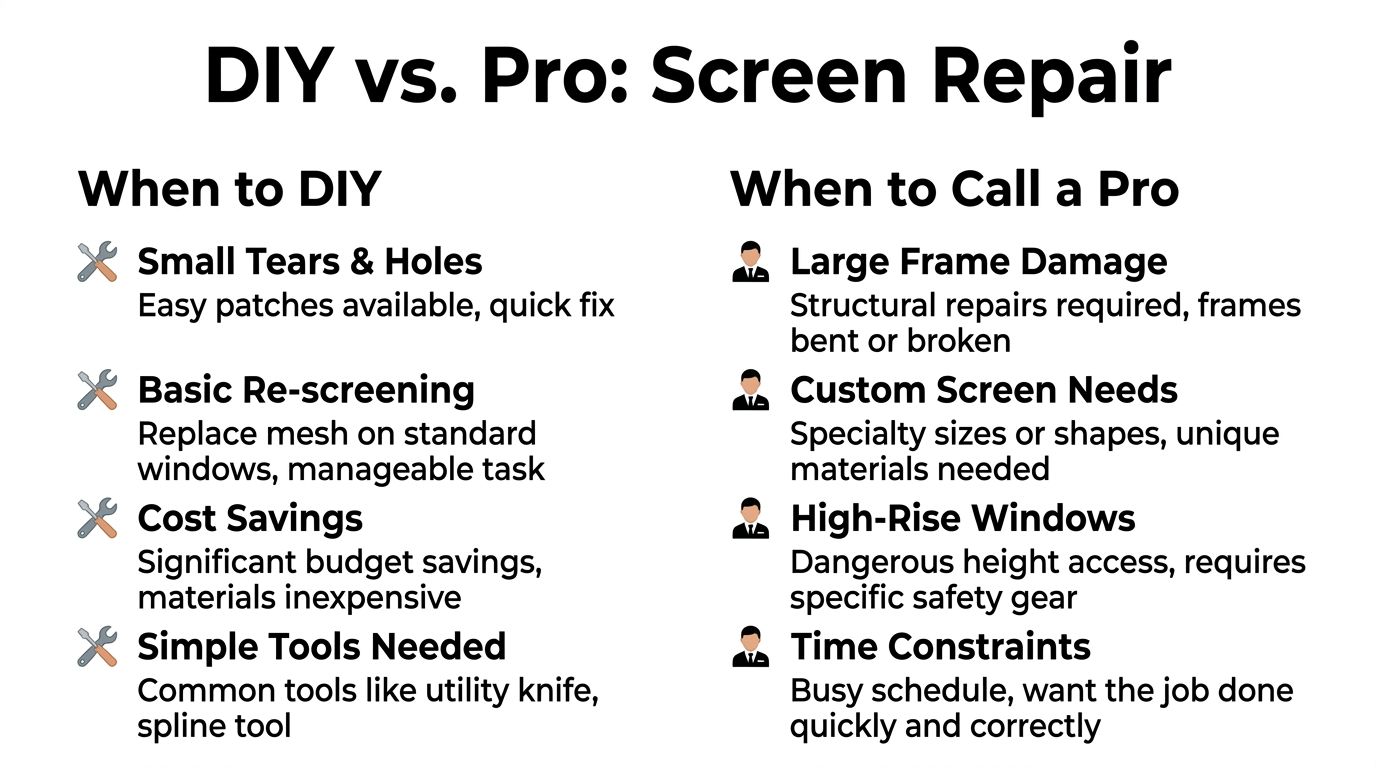
A professional is usually the smarter call when the screen issue involves the frame, access, or material selection rather than just the mesh itself.
- Second-story or hard-access windows need safe removal and reinstall, not just bench work.
- Bent frames or loose corners often require correction before any new mesh goes in.
- Specialty materials like solar or heavier pet mesh are less forgiving if the spline fit is off.
- Whole-home matching matters when you want a consistent finish across many windows.
Property managers and homeowners planning broader upkeep often benefit from looking at screen repair as part of overall exterior care. Resources on Expert Home Improvement Services can help frame that bigger maintenance decision.
The long-term value is usually the deciding factor
Professional window screen replacement offers a strong return, with homeowners recovering 50% to 70% of the cost through improved property value, and while DIY repairs may cost $30 to $60, professional work tends to deliver better long-term durability across an 8 to 10 year screen lifespan, according to Angi’s window screen cost guide.
That’s the part many people miss. DIY can look cheaper on day one. It often is. But if the screen has to be redone because the frame wasn’t addressed, the spline didn’t hold, or the tension was uneven, the actual cost includes your time, another set of materials, and another round of installation.
If the same screen has already failed once after a DIY repair, the problem usually isn’t bad luck.
DIY versus professional service at a glance
| Factor | DIY Repair | Professional Service (Sparkle Tech) |
|---|---|---|
| Scope | Works best for simple mesh issues on one stable frame | Better suited for single repairs, bulk jobs, and frame-related issues |
| Tools and setup | Homeowner buys tools and handles material matching | Technician arrives with tools, mesh options, and replacement components |
| Consistency | Can vary from screen to screen | More uniform finish across multiple windows |
| Time | Depends on your learning curve and availability | Completed as scheduled without using your weekend |
| Risk of redo | Higher when tension, spline fit, or frame condition is misjudged | Lower when frame prep and installation are handled correctly |
A simple rule for deciding
Hire a pro if you answer yes to any of these:
- Do you see frame damage, warping, or corrosion?
- Are multiple screens failing at once?
- Is the screen on an upper level or awkward to remove?
- Do you want specialty mesh installed cleanly the first time?
If all you have is one accessible screen with a small, isolated issue, DIY may be fine. If the repair needs to last through Phoenix weather and look consistent across the home, professional service is usually the better long-term call.
Understanding Window Screen Repair Costs in Phoenix
Price matters, but screen repair quotes only make sense when you know what’s included. In Phoenix, the final number depends on the mesh type, frame condition, and whether the job is one screen or a group of them.
As of early 2026, the national average cost for professional residential window screen repair is about $321 per screen, with a typical range of $147 to $522, while basic rescreening of a single window averages $30 to $60 and bulk repairs can drop to $20 to $30 per window, according to this 2026 window screen repair cost guide.
What changes the quote
The biggest pricing variable is whether the existing frame can be reused. A straightforward rescreen on a sound frame is one category of job. A repair that needs frame correction, new corners, or a full rebuild is another.
Material choice also changes cost. Standard mesh keeps pricing more moderate. Specialty materials, heavier-duty options, or custom sizes raise the quote because the labor and fit tolerance change with them.
Why bulk jobs usually make more sense
Single-screen service often carries the least efficiency. There’s still travel, setup, inspection, and handling for one opening. When several screens are repaired during the same visit, the per-screen cost usually improves because the workflow becomes more efficient.
That’s especially relevant in Phoenix neighborhoods where homes often have many windows with similar exposure patterns. If one south-facing screen has failed from age and sun, nearby screens may not be far behind.
The cheapest quote isn’t always the lowest cost over time. If a low bid skips frame prep or uses mismatched materials, the redo comes sooner.
Budgeting with realistic expectations
For homeowners, the practical move is to ask for a quote based on three things:
- How many screens need work
- Whether frames are reusable
- What mesh type you want installed
That keeps the comparison honest. A low price for basic mesh on one reusable frame isn’t directly comparable to a quote that includes rebuilding damaged screens or upgrading material for desert exposure.
The Sparkle Tech Advantage for Your Home
A screen can look fine from the patio and still fail the first time a July dust storm pushes against it. In Phoenix, that gap between how a screen looks and how it performs is where a lot of homeowners get stuck. Sun-baked mesh, dry spline, packed frame channels, and slightly twisted frames often show up together, especially on older homes with heavy west exposure.
Sparkle Tech Window Washing LLC handles window cleaning, screen cleaning, and screen repair across Scottsdale, Peoria, and the greater Phoenix area. For homeowners, that matters because screen work in the desert is rarely an isolated problem. Heat, dust, and monsoon wind affect the screen, the frame, and the window opening as a system.

What that means for homeowners
The advantage of hiring a local company is judgment. A technician who works in Phoenix every week knows the difference between a screen that needs fresh mesh and one that will keep giving trouble because the frame is already out of square or the corners have loosened from years of heat cycling.
That changes the repair plan. A shaded north-side bedroom screen may only need a straightforward rescreen. A west-facing living room screen that has taken years of UV exposure may need different mesh, new spline, and frame correction if you want it to last past one more summer.
Good service also saves time after the repair. Clean frame channels, properly seated spline, and the right screen tension help the panel slide back in without fighting the track or popping loose during wind.
Service that fits real household schedules
Screen repair should not turn into a day-long disruption. Sparkle Tech offers service that works for busy households, including jobs where homeowners do not need to stay on site if access has already been arranged.
That practical side matters in larger Phoenix homes where screen issues often overlap with dusty glass, dirty tracks, and general exterior buildup. Handling those tasks in one visit is usually more efficient than splitting them up.
Homeowners who want to keep repaired screens in better shape between service visits can follow this guide on how to clean window screens without damaging the mesh or frame. If you are also reviewing glass care, this resource on proper window cleaning techniques offers helpful background.
Why local pattern recognition matters
Phoenix homes tend to fail in repeatable ways. Afternoon sun makes some screens brittle long before others show visible wear. Monsoon season exposes loose corners and poor spline fit fast. Fine desert dust settles into frame channels and turns a simple reinstall into a frustrating fit problem.
A crew that sees those patterns regularly wastes less time on guesswork. The result is a repair that matches the actual exposure on your home, not a generic fix that looks acceptable for a few months and then starts loosening again.
Proactive Maintenance to Extend Your Screen's Lifespan
Once screens are repaired, simple maintenance goes a long way in the desert. Dust, heat, and seasonal wind don’t just make screens look dirty. They wear on mesh, corners, and spline fit over time.
A maintenance routine that actually helps
You don’t need a complicated checklist. A few repeat habits make the difference:
- Brush off loose dust regularly so grit doesn’t stay packed into the mesh and frame edges.
- Inspect screens before monsoon season and check corners, spline edges, and any screen that already showed movement last year.
- Wash gently with mild soap, water, and a soft brush or cloth instead of aggressive spraying.
- Look at the frame while cleaning because loosened corners and slight bends are easier to catch early.
For homeowners who want a more detailed local routine, Sparkle Tech has a practical guide on how to clean window screens.
Cleaning matters more than most people think
A lot of screen wear starts as neglected buildup. Dust and debris in the frame channel can affect how well the screen seats and how long the spline stays secure. Gentle washing also gives you a chance to spot brittleness or small edge failures before they turn into larger tears.
If you’re reviewing care methods for the glass and surrounding assembly as well, this resource on proper window cleaning techniques gives useful context on why gentler methods protect surfaces better than harsh scrubbing.
What not to do
Some of the worst damage comes from well-meant maintenance.
- Don’t pressure wash screens. It’s rough on mesh and can loosen edges.
- Don’t ignore rattling or fluttering. Movement is often an early warning.
- Don’t keep patching sun-brittle mesh. Repeated small fixes on failing material usually waste time.
A quick seasonal check is enough for most homes. If the screen still feels flexible, sits square, and stays tight in the frame, you’re in good shape. If it’s getting noisy, loose, or brittle, deal with it before the next stretch of heavy heat or wind.
If your screens are torn, loose, brittle, or past their useful life, Sparkle Tech Window Washing LLC can help with practical residential screen repair, cleaning, and replacement across Scottsdale, Peoria, and the greater Phoenix area. It’s an easy way to get screens fitted correctly for desert conditions without spending your weekend fighting spline, warped frames, and repeat repairs.