
Before you dive into a solar investment, it's essential to get a handle on the real-world numbers. In Arizona, the average cost for a home solar panel system typically lands between $2 and $3 per watt before you factor in any rebates or credits. For most homeowners, that translates to an initial price tag of around $25,000 to $50,000.
Your Quick Guide to Home Solar Panel Costs
Thinking about solar panel costs is a lot like buying deli meat—the price is listed per pound, but what you actually pay depends on how much you put in your cart. In the solar world, our core metric is the cost-per-watt. It’s a handy figure that bundles everything—panels, inverters, labor, and permits—into one straightforward number for easy comparison.
The best part? This fundamental cost has been on a downward slide for years. Over the last decade, the average price to install solar has fallen by a staggering 70%. Back in 2010, homeowners were looking at paying around $7 per watt. Today, the game has completely changed. You can explore more about these solar panel pricing trends to see just how much the market has shifted in favor of homeowners.
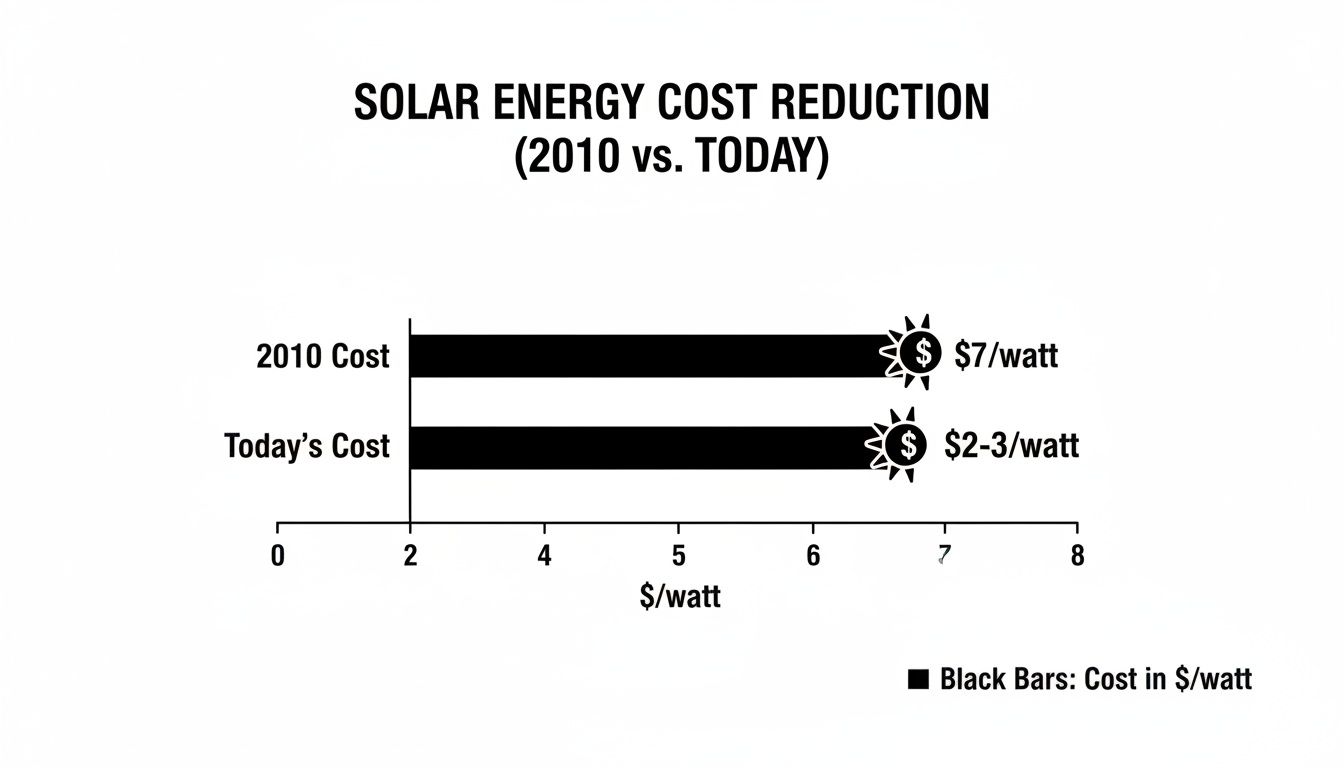
This chart really puts it in perspective, showing how solar has gone from a fringe, expensive technology to a smart, mainstream upgrade for homes across the valley.
Breaking Down the Numbers
So, what does this actually mean for your wallet? Let's translate the cost-per-watt into some real numbers for typical system sizes here in the Phoenix and Scottsdale area. The math is simple: just multiply the system size (in watts) by the cost-per-watt.
The single biggest game-changer for your bottom line is the federal Solar Investment Tax Credit (ITC). This powerful incentive lets you deduct a massive 30% of your total system cost right off your federal taxes, slashing your net investment significantly.
To give you a clearer picture, here’s a look at what you can expect to pay for common system sizes, both before and after that crucial tax credit.
Estimated Home Solar System Costs in Arizona (Before & After Federal Tax Credit)
| System Size (kW) | Average Cost Before Incentives | Estimated Cost After 30% Federal Tax Credit |
|---|---|---|
| 5 kW | $12,500 – $17,500 | $8,750 – $12,250 |
| 8 kW | $20,000 – $28,000 | $14,000 – $19,600 |
| 10 kW | $25,000 – $35,000 | $17,500 – $24,500 |
| 12 kW | $30,000 – $42,000 | $21,000 – $29,400 |
| 15 kW | $37,500 – $52,500 | $26,250 – $36,750 |
As you can see, the ITC provides a massive discount, making the decision to go solar much more manageable. Understanding this baseline cost is the first and most important step in figuring out your own potential investment and payback.
Decoding the Key Factors in Your Solar Quote

If you've started collecting solar quotes, you've probably noticed they can be all over the map. Why does one company’s price look so different from another, even for the exact same house? The answer goes way beyond a simple cost-per-watt average. Several key variables directly influence that final price tag.
Think of it like building a custom car. A basic engine and standard features will cost less than a high-performance engine with all the luxury add-ons. In the same way, the average cost of solar panels for home installation is shaped by the specific parts you choose and the unique layout of your property.
System Size and Energy Needs
The single biggest driver of your total cost is the system's size, which we measure in kilowatts (kW). This isn't about your home's square footage; it's all about how much electricity your family actually uses.
A household with an electric vehicle, a pool pump, and the AC blasting all summer will need a much larger (and more expensive) system than a smaller, more energy-conscious family.
The roof itself is also a huge factor. A big, open, south-facing roof is the perfect canvas for a solar installation, often allowing an installer to use fewer, more standard panels. But if your roof has a complex shape or limited sun-drenched space, you might need to spring for more powerful—and pricier—panels to generate the same amount of electricity.
Hardware and Equipment Choices
Not all solar gear is created equal. The specific hardware listed in your quote plays a massive role in the final number. It really comes down to a few key components.
- Solar Panels: High-efficiency monocrystalline panels cost more upfront but pack more punch, generating more power in a smaller footprint. They’re perfect for homes with limited roof space. On the other hand, standard polycrystalline panels are more budget-friendly but a bit less efficient.
- Inverters: These are the brains of the whole operation. They convert the DC power your panels collect into the AC power your home actually uses. Basic string inverters are the most affordable option, but microinverters or power optimizers cost more while delivering better performance, especially if parts of your roof get shady during the day. Digging into the differences between active vs passive solar energy systems can help clarify the role this hardware plays.
A solar quote is more than a price—it’s a customized energy solution. The equipment quality, roof condition, and installation complexity are just as important as the final cost in determining long-term value and performance.
Overlooked Installation Factors
Finally, a few on-the-ground details can add to your project's cost. The condition of your roof is a major one. If it needs repairs or a full replacement before panels can go on, that's an extra expense you’ll need to budget for.
Things like complex rooflines, a really steep pitch, or the need for significant electrical upgrades can also drive up labor costs. Even local permitting fees, which differ between cities like Scottsdale and Phoenix, get baked into the total. A good, thorough quote will account for all these variables so there are no nasty surprises down the road.
How Arizona Solar Incentives Maximize Your Savings
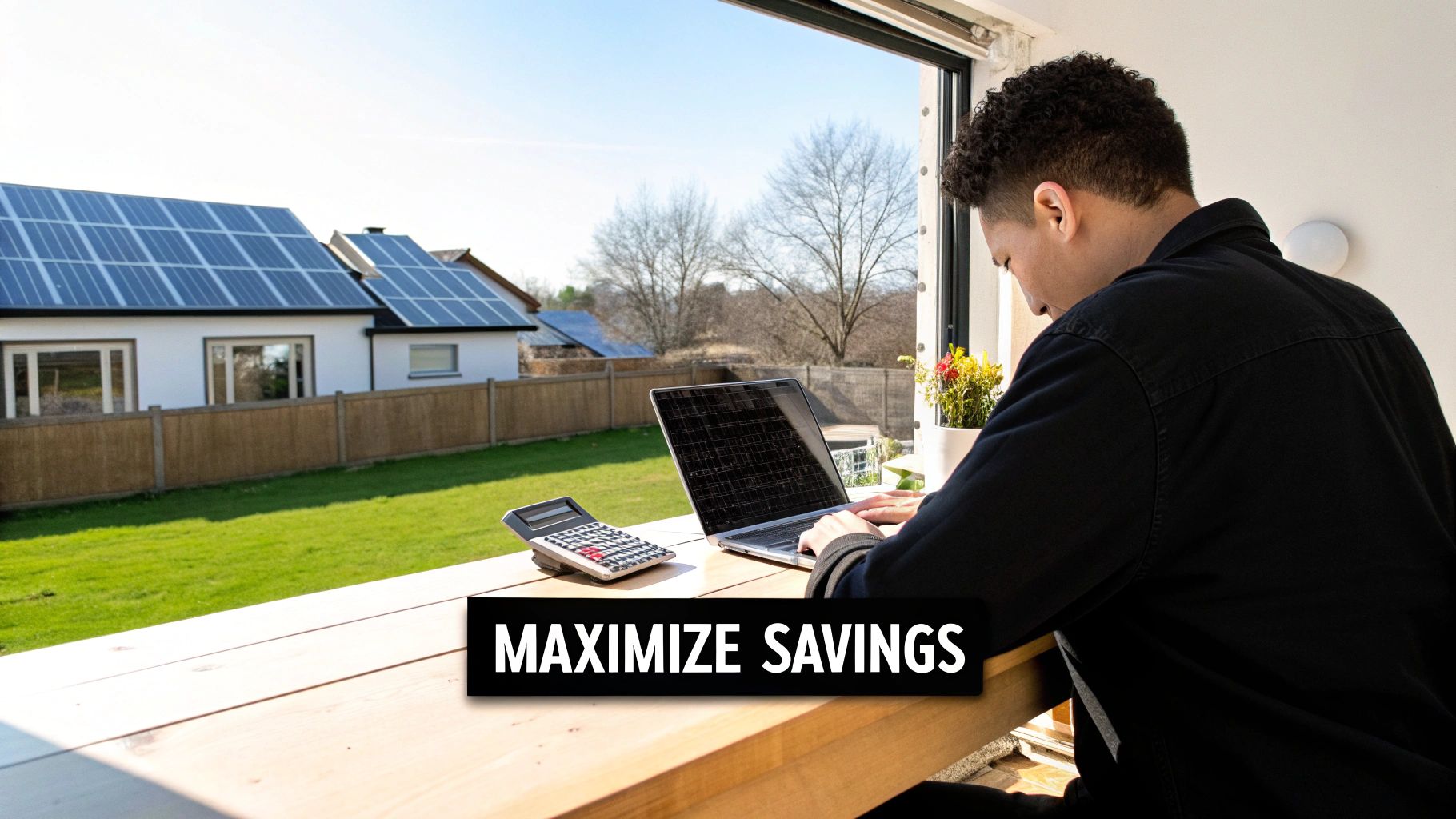
When you get that first quote for a solar panel system, it’s important to see it for what it is: the starting line. It's a bit like the sticker price on a new car—it’s a real number, but it’s not what you’ll actually pay once you factor in all the available discounts and rebates.
Here in Arizona, a fantastic combination of federal and state incentives can dramatically lower the true average cost of solar panels for home investments. Learning how to stack these benefits is the secret to getting an incredible return on your investment. We're not talking about small-time coupons here; these are major financial programs designed to make going solar a reality for homeowners like you.
Let's break down exactly how they slash that final price tag.
The Federal Solar Investment Tax Credit
The biggest game-changer for most homeowners is the federal Solar Investment Tax Credit (ITC). Now, this isn't just a standard deduction. It's a powerful, dollar-for-dollar credit that directly knocks down the amount of federal income tax you owe.
Right now, the ITC lets you claim a credit for 30% of the total cost of your solar energy system. That includes everything—the panels, inverters, battery storage, and even the labor and permitting fees.
So, what does that look like in the real world? If your total system cost is $30,000, the 30% tax credit gives you $9,000 back. Your net cost effectively plummets to just $21,000 after you file your taxes. It’s a massive discount that makes a huge difference.
To qualify for the ITC, you must own your solar system (not lease it) and have enough tax liability to claim the credit. It’s always smart to have a quick chat with a tax professional to see how this applies to your specific financial picture.
Arizona-Specific Solar Perks
On top of the hefty federal credit, Arizona rolls out the welcome mat with its own set of incentives that make the deal even sweeter. These state-level benefits are designed to clear financial hurdles and help more people across the Valley switch to solar.
Here are the key Arizona incentives you need to know about:
- Residential Arizona Solar Energy Credit: This state tax credit lets you claim 25% of your solar system's cost, up to a maximum of $1,000. It might seem small compared to the federal ITC, but it's another direct cut to your state tax bill, and every dollar counts.
- Solar Equipment Sales Tax Exemption: This one is a big deal. Arizona completely exempts solar energy equipment from state sales tax. With sales tax rates hovering around 8% in the Phoenix area, this saves you hundreds, or even thousands, of dollars right off the bat.
- Property Tax Exemption: One of the best long-term perks is that Arizona law prevents the added value from your solar system from increasing your property tax bill. Your home’s value will almost certainly go up, but your property taxes won't, making sure your investment doesn't turn into a new tax burden down the road.
When you combine these state benefits with the powerful 30% federal ITC, homeowners in Scottsdale and Phoenix can slash the upfront cost of going solar. This not only shortens your payback period but also maximizes your savings for years to come.
Financing Your System and Calculating Your Payback Period
Even with a big chunk of the cost covered by incentives, a new solar system is a major purchase. The good news is, you almost certainly don't have to pay for it all at once. There are a few well-traveled paths that make going solar affordable from day one, each with its own trade-offs.
The most common way people buy their systems is with a solar loan. It works just like any other home improvement loan—you finance the total cost and pay it off over time. The huge advantage here is that you own the system from the moment it's installed, meaning all the tax credits and incentives go directly to you.
Another route is a solar lease or a Power Purchase Agreement (PPA). With these, a solar company installs panels on your roof, but they continue to own and maintain them. You just pay a fixed monthly fee for the power they generate, which is typically less than what you were paying the utility company. It's a fantastic low-effort, no-money-down option, but the trade-off is that the company, not you, gets to claim the tax credits.
Choosing Your Financial Path
So, which one is right for you? It really comes down to your personal financial goals. Are you focused on getting the absolute best long-term return on your investment, or is avoiding an upfront cost the most important thing?
- Solar Loan: This is your ticket to maximizing long-term savings. You're building equity in an asset, you get to pocket all the incentives, and once the loan is paid off, the electricity is completely free for decades to come.
- Lease or PPA: These are all about immediate savings with zero initial investment. It's a great fit if you'd rather not take on a new loan or if your tax appetite isn't large enough to take full advantage of the federal credit.
The key takeaway is that financing makes solar accessible to almost everyone. A cash purchase will always give you the fastest and highest return, but a solar loan delivers all the benefits of ownership with a monthly payment that's often right around what your old electric bill used to be.
What Is Your Solar Payback Period?
After figuring out how to pay for it, the next question is always, "When does it pay for itself?" This is what we call the solar payback period—the point where your total savings on electricity bills officially cancel out your initial investment.
Figuring this out is actually pretty straightforward. First, you need your net cost. That's the total price minus the 30% federal tax credit and any other state or local rebates. Then, you just have to figure out how much you'll save on power each year, which you can estimate from your past utility bills.
Let's run through a quick example. Say your net system cost is $21,000, and you're saving about $2,500 a year on electricity. Your payback period would be 8.4 years ($21,000 ÷ $2,500).
Here in Arizona, with our endless sunshine and high electricity rates, most homeowners in the Phoenix and Scottsdale area find their systems pay for themselves in 8 to 12 years. After that, every single watt your panels produce is pure profit.
Protecting Your Solar Investment for the Long Haul
Your solar journey doesn't end once the installation crew leaves your driveway. That's really just the beginning of a long, productive relationship with your home's new power plant. To make sure your panels are cranking out maximum savings for their entire 25 to 30-year lifespan, a little proactive care is all it takes.
Think of it like a high-performance car. Solar panels are incredibly durable and don't have moving parts, but they still need some basic attention to operate at their peak. We're not talking about constant, costly repairs—just simple, periodic checks to protect your investment and keep the energy flowing.
Most of this is just common sense, like doing a quick visual check after a big monsoon storm to make sure all the connections look solid. But the single most important maintenance task, especially here in the Valley, is keeping those panels clean.
The Impact of Dust and Grime in Arizona
Living in the Sonoran Desert means we're constantly fighting a battle against dust, pollen, and airborne grime. A thin layer might not look like much, but it's like putting a pair of dusty sunglasses over your panels, blocking precious sunlight and throttling their ability to generate power.
It's a bigger deal than most people think. Studies have shown that dirty solar panels in dusty climates like Phoenix and Scottsdale can lose a staggering 25% to 30% of their efficiency. This isn't a small dip; it's a huge loss of power that shows up as smaller savings and a bigger APS or SRP bill every single month.
This drop in performance happens slowly, so you might not even notice it day-to-day. But over a year, that lost energy really adds up, stretching out your system's payback period and cutting into your total return on investment.
Why Professional Cleaning is a Smart Strategy
It can be tempting to just grab a garden hose and spray the panels down, but that's often a bad idea. First, our hard tap water leaves behind mineral deposits that can bake into a hazy film, sometimes making the problem even worse. More importantly, climbing onto a hot, sloped roof with water hoses and cleaning gear is a serious safety risk.
This is where professional cleaning stops being an "expense" and becomes a critical part of your energy strategy. Here’s why it's such a smart move:
- Maximized Production: The pros use purified, deionized water and the right soft-bristle brushes to get every speck of dirt off without leaving any residue. Your panels get back to peak performance right away.
- Safety and Expertise: Trained technicians have the right safety gear and know how to navigate a roof without hurting themselves or damaging your panels and shingles.
- A Second Set of Eyes: A good cleaning service usually includes a quick visual inspection. They can often spot potential issues like small cracks, loose wiring, or bird nesting problems that you might easily miss from the ground.
Investing in a regular professional cleaning ensures your system is generating every last kilowatt-hour it can. Knowing how to keep your panels in top shape is just as important as choosing the right ones in the first place. For a more detailed look, check out our guide on how to maintain solar panels for long-term success.
Think of it this way: a small, recurring investment in cleaning protects your much larger one, ensuring you get the full financial benefit from your solar system for decades to come.
Why Professional Cleaning Is a Smart Financial Move
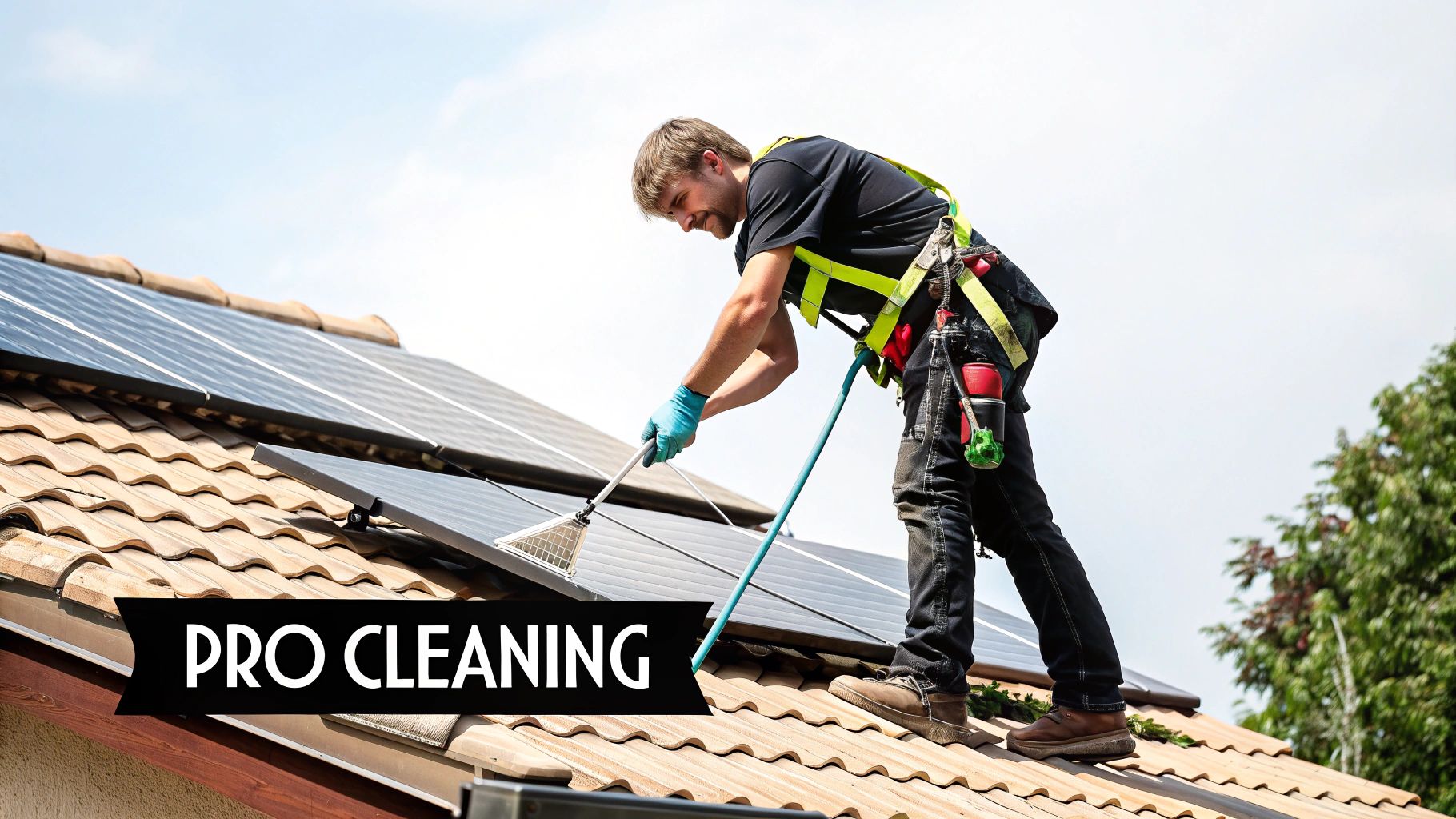
It’s easy to see professional solar panel cleaning as just another optional chore, but that’s a perspective that can quietly cost you a lot of money. It’s better to think of it as a key part of your investment strategy—a small action that protects your system’s big financial returns.
The logic here is pretty straightforward. Think of a dirty solar panel like a car engine with a clogged air filter. The engine still turns over, but it’s working harder, guzzling more fuel, and just not giving you the power you paid for. It's the same with your panels; when that layer of desert dust and grime builds up, they can't effectively absorb sunlight. This inefficiency directly cuts your energy production and, you guessed it, pads your utility bills.
Calculating the Value of a Clean Panel
The amount of energy lost to dirty panels isn't trivial. In a dusty environment like Scottsdale, it's not uncommon to see a production drop of 25% or more. For a typical home solar system, that can translate to hundreds of dollars in lost energy savings each year.
Now, weigh that loss against the cost of having a pro come out and clean your panels. In almost every scenario, the value of the electricity you get back is far greater than the price of the service. You're not just spending money on a cleaning; you're essentially buying back the power you were losing and getting your system back to peak performance.
Professional cleaning is not an expense—it's an investment in peak performance. It guarantees you are capturing every possible dollar of savings your solar system was designed to produce, turning a small, predictable cost into a significant financial gain.
More Than Just a Cleaning Service
Beyond the numbers, hiring a professional just makes sense. Getting up on a roof with ladders, hoses, and cleaning gear is a risky proposition. A slip can lead to serious injury or damage to your expensive panels and roof tiles. A licensed, insured specialist takes all that risk off your shoulders.
If you're curious about what goes into a proper cleaning, our guide on how to clean solar panels dives into the specific techniques and specialized equipment the experts use.
Ultimately, professional cleaning is a strategic decision that maximizes your return on investment. It keeps your system running at full capacity, protecting the very savings that convinced you to go solar in the first place.
Have More Questions? We've Got Answers
Even with a detailed breakdown, it's natural to have a few more specific questions when you're thinking about the cost of going solar. Here are some of the most common things we get asked by homeowners in Phoenix and Scottsdale.
Does Adding a Battery Drive Up the Cost?
It sure does. A solar battery is a separate, significant investment. You can expect it to add anywhere from $10,000 to $20,000 (sometimes more) to your total project cost, depending on the size and brand of the battery.
While that's a big jump in the initial price tag, a battery gives you something really valuable: energy independence. It keeps your lights on during a grid outage and can be a smart way to get around those expensive peak-hour electricity rates from your utility company.
How Often Do My Solar Panels Actually Need to Be Cleaned?
Here in the dusty Sonoran Desert, you can't just set them and forget them. All that dust, dirt, and grime builds up fast and can really cut into your energy production.
To keep your system running at peak efficiency, we strongly recommend a professional cleaning at least once or twice a year. It’s especially smart to get them cleaned after a big monsoon storm or during those heavy spring pollen seasons. A clean panel is a productive panel.
A Quick Note on Home Value: While a solar system definitely adds to your home's value, Arizona state law gives you a huge break. You get a full property tax exemption on the added value from your solar panels, so you get all the upside without the higher tax bill.
So, Will My Property Taxes Go Up After I Install Solar?
Nope! This is one of the best solar perks Arizona offers. State law is very clear: while solar panels absolutely increase the market value of your home, that added value is completely exempt from your property tax bill.
It's a fantastic incentive that lets you make a major home improvement and slash your energy bills without worrying about a bigger tax burden every year. It just makes the financial side of going solar that much better.
Ready to make sure your solar investment is protected and producing every bit of power it can? Sparkle Tech Window Washing LLC offers professional, safe, and effective solar panel cleaning services all over the Valley. You can get a free quote today by visiting us at https://sparkletechwindowwashing.net.