


You wait until the sun drops, crack open the patio door, and hope for ten minutes of decent air before the mosquitoes, flies, and drifting dust remind you why the door usually stays shut. That's a familiar Phoenix routine. A lot of homeowners want the evening breeze, but they don't want bugs in the kitchen, pet hair blowing through the house, or a flimsy screen slapping around every time the wind picks up.
That's where bug door screens earn their keep. The right one lets you use the door the way you wanted to use it in the first place. Open for airflow, closed to pests. The wrong one turns into another maintenance headache, especially here, where heat, dust, and daily use expose every weak point fast.
I've seen people buy screens based on the online listing photo instead of how the door gets used. That's usually where the trouble starts. A magnetic screen might seem fine for a light-use back door, then fail once kids, dogs, deliveries, and hot weather put it under real pressure. A retractable unit can look clean and modern, then start binding once dust gets into the track and the frame goes slightly out of alignment.
If insects are already established indoors, a screen helps prevent more from getting in, but it won't solve the whole problem by itself. In that case, it's worth looking at resources like Newmarket professional fly removal, because sometimes the issue is part exclusion, part active pest control.
Enjoy the Breeze Without the Bugs
Phoenix homes are built for indoor and outdoor living. French doors, sliders, back patios, pool access doors, side garage entries. They all invite airflow, but they also create easy entry points for flying pests if the screen isn't doing its job.
A good bug door screen gives you a usable opening, not just a covered one. That means it has to close reliably, sit square in the frame, and hold up after repeated trips in and out. In this climate, convenience matters, but durability matters more.
Practical rule: If a screen only works when everyone in the house uses it gently, it's not the right screen for a Phoenix doorway.
The other part people miss is that not all bug pressure is the same. A shaded front entry behaves differently from a west-facing patio door that gets blasted with afternoon sun and grit. If the opening gets heavy traffic, wind, or direct heat, the screen type has to match that reality or it won't last.
That's why generic buying advice usually falls short here. You don't just need a screen that fits the opening. You need one that keeps working after dust storms, hot hardware, warped trim, and constant use start testing it.
What Exactly Are Bug Door Screens
Bug door screens are screen systems made for doors, not just window openings. Their job is simple on paper. They allow airflow and light while blocking insects. In practice, they have to do that on a moving, high-traffic opening where people, pets, and weather keep stressing the frame, mesh, latch, and track.
That's what separates a decent door screen from a cheap add-on. A bug door screen has to function as a barrier and as part of the doorway. It needs to open, close, align, and seal.
More than a convenience item
Screening has a long history in American homes. The first true insect screens appeared in the 1820s in America, and after 1861 Gilbert and Bennett helped launch the modern wire-mesh screen. Before that, people often relied on cheesecloth or kept windows shut to keep insects out, according to this history of insect screens.
That shift mattered because it changed how people lived in warm weather. Homes could stay ventilated without opening the door to every flying pest outside.
Why door screens are harder than window screens
Window screens mostly sit still. Door screens don't.
They deal with:
- Repeated movement from sliding, swinging, or retracting
- Impact and pressure from people pushing through, pets jumping, and gusts hitting the mesh
- Alignment issues because door frames and hardware show wear faster than fixed windows
- Closure demands since a tiny gap at a door can defeat the whole point
A bug door screen is only as good as its seal. A neat-looking mesh panel doesn't help if the edge lifts, the magnets separate, or the frame racks out of square.
That's why buying by appearance alone is risky. The question isn't whether the screen looks clean on install day. It's whether it still closes tight after months of use.
A Guide to Screen Types and Materials
Not every bug door screen solves the same problem. Some are built for convenience. Some are built for constant use. Some look great until the first season of hard weather. If you compare them, the trade-offs get clearer.
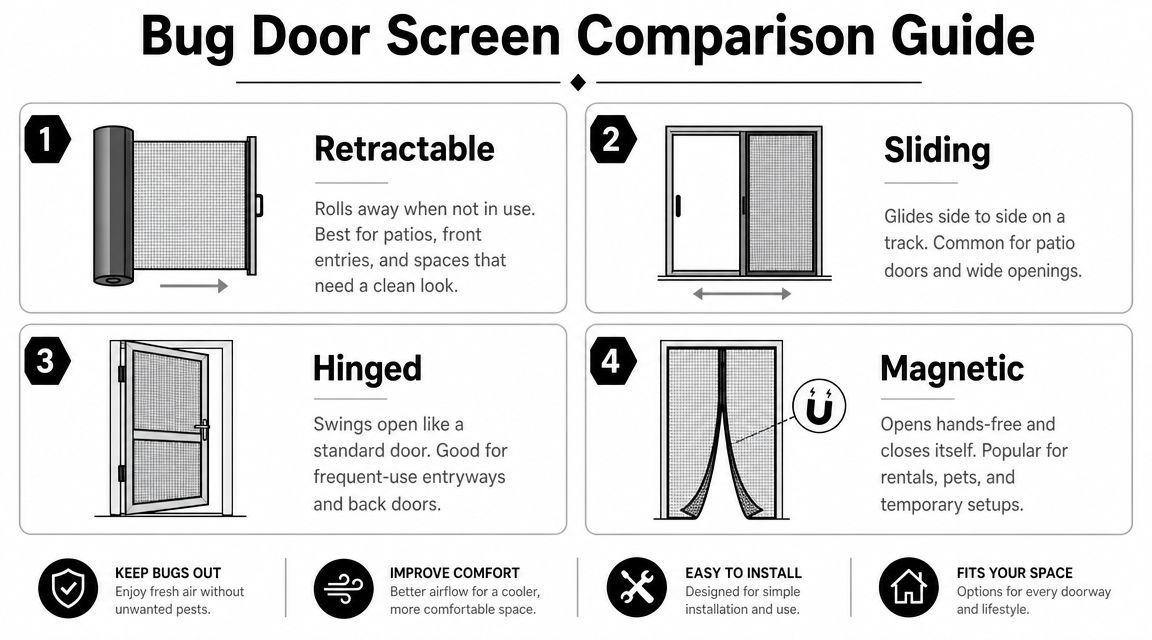
Retractable screens
Retractable screens roll or slide into a housing when you don't need them. Homeowners like them because they're discreet and keep the doorway looking open.
They work well when:
- Appearance matters and you don't want a fixed screen visible all the time
- The doorway gets moderate use rather than constant in-and-out traffic
- You're disciplined about maintenance and will keep tracks clean
Their weak points are usually the moving parts. Dust in the track, tension issues, and minor misalignment can turn smooth operation into dragging, fraying, or poor closure. In Phoenix, that matters.
Sliding screens
Sliding bug door screens are common on patio doors. They move in a track parallel to the glass door and are straightforward when the frame and rollers are in decent shape.
They make sense for:
- Standard patio sliders
- Homes where the screen stays in place most of the season
- People who want a familiar, simple system
The downside is that tracks collect debris fast. Once dirt builds up, the rollers wear and the door starts feeling rough or loose. If the frame bends even slightly, gaps show up.
Hinged screens
A hinged screen door swings open like a regular door. It's a practical choice for side entries, back doors, and some front security-door setups.
Good use cases include:
- Single exterior doors
- Households with frequent traffic
- Openings where a rigid frame helps maintain shape
A well-built hinged screen is often more forgiving than a light retractable unit. The trade-off is space. You need room for the swing, and the closer or latch has to stay adjusted.
Magnetic screens
Magnetic screens are usually mesh panels that split in the middle and snap back together with magnets. They're sold heavily on convenience, and for the right opening they can be useful.
They fit best when:
- You need a temporary or low-cost option
- The doorway gets light use
- You want easy pet and kid access without hardware changes
They're the least forgiving in harsh conditions. If the mounting surface isn't right, the magnets won't seal consistently. If the mesh stretches or sags, the center gap becomes the failure point.
A quick side-by-side view
| Screen type | Works well for | Common failure point |
|---|---|---|
| Retractable | Clean look, moderate-use doors | Track debris, tension, misalignment |
| Sliding | Patio doors, familiar operation | Dirty tracks, worn rollers, frame gaps |
| Hinged | Frequent use, rigid structure | Hardware wear, swing clearance issues |
| Magnetic | Light use, temporary setups | Poor seal, sagging, mounting failure |
Screen materials matter as much as the frame
The mesh itself changes how the screen performs. Some materials prioritize visibility. Others prioritize toughness. Some handle everyday abuse better.
Common options include:
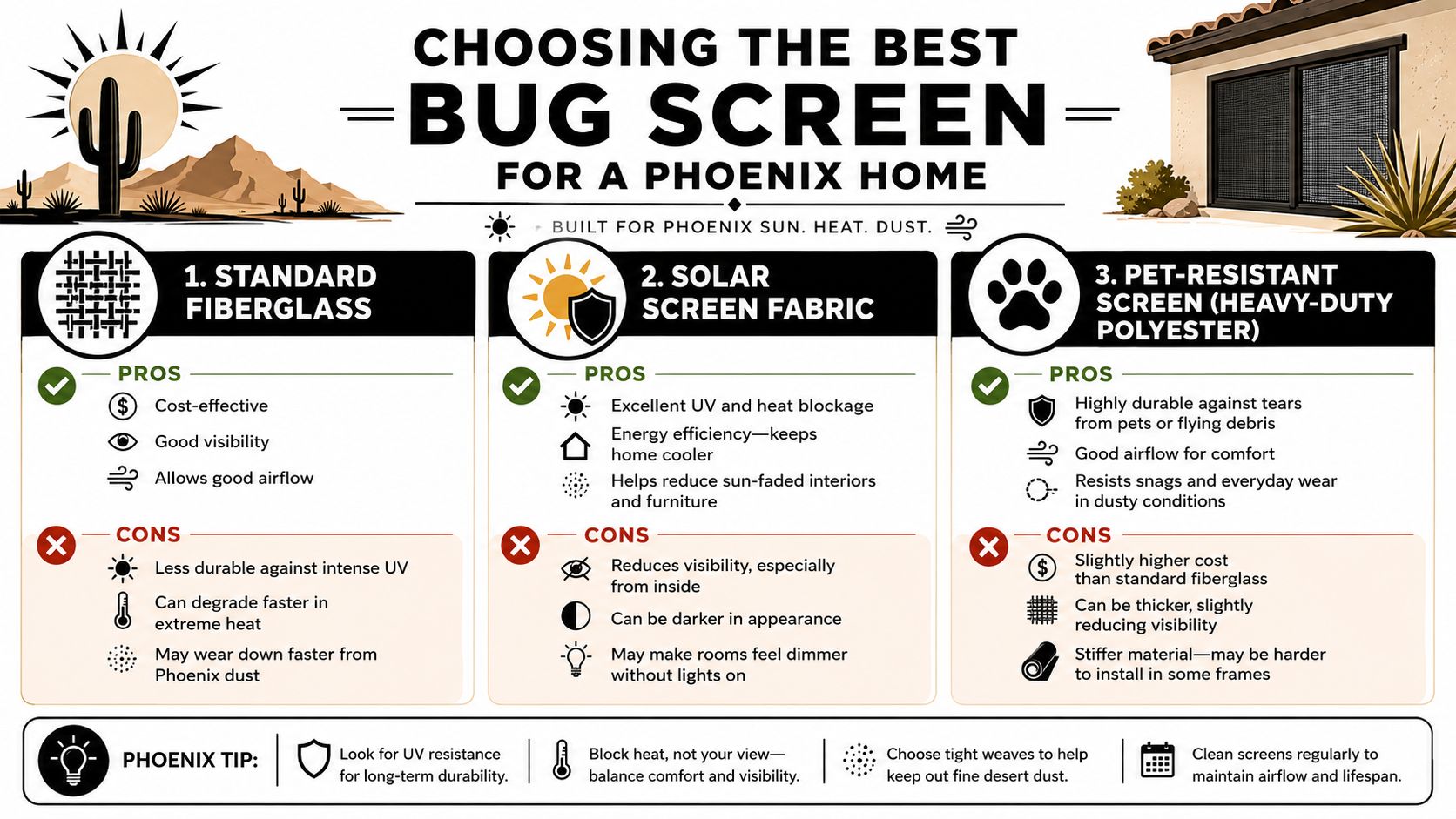
- Standard fiberglass keeps good visibility and airflow, but it's usually not the material I'd trust most on a punishing high-use doorway.
- Aluminum mesh feels firmer and can hold shape well, but if the frame takes impact, the mesh can crease and stay that way.
- High-visibility mesh improves the view outward, which many homeowners love on patio openings, though it still needs a sturdy frame behind it.
- Pet-resistant mesh is thicker and tougher, which helps when claws, toys, or regular bumps would tear lighter mesh.
Mesh size and bug exclusion
A lot of buyers focus on frame style and ignore the mesh spec. That's a mistake. Mesh count, wire diameter, and material type are the main variables that determine what gets through and what stays out. Higher mesh counts usually block smaller pests better, but they can also reduce airflow and visibility, as explained in this guide to screen mesh types and in Metro Screenworks' mesh selection overview.
That trade-off matters in Arizona. If your main complaint is large flies, standard mesh may be enough. If tiny gnats or no-see-ums are the issue, you need a tighter mesh and you should expect a different feel when air moves through it.
Don't choose mesh by insect name alone. Choose it by the smallest pest you actually need to block, then decide whether the airflow trade-off is worth it.
Choosing the Best Bug Screen for a Phoenix Home
Phoenix is hard on anything mounted to an exterior opening. Sun cooks plastics and adhesives. Dust gets into rollers and tracks. Wind tests corners, magnets, and pull bars. A screen that works fine in mild conditions can age fast here.
What usually fails first in Phoenix
Cheap magnetic screens are often first to show trouble. The mesh starts to sag, the attachment points loosen, and the center seam stops sealing the way it did at the start. They can still make sense as a temporary solution, but I wouldn't treat them as a long-term answer for a main patio door.
Retractable screens are better looking and often more refined, but they aren't automatically tougher. For hotter, windier climates like Phoenix, durability is a major issue that gets overlooked. High-traffic doors and exposure to strong wind or heat can lead to sagging, misalignment, and closure failure in less durable magnetic or retractable designs, as noted by Chase Doors on bug screen durability.
What tends to hold up better
For everyday residential use, I usually trust more rigid systems on demanding openings. A solid sliding screen for a patio door, or a properly built hinged screen for a regular entry, often gives fewer headaches than a lightweight convenience product.
That doesn't mean retractables are a bad choice. It means they need the right location.
A retractable screen is more sensible when:
- The opening is somewhat protected
- The household will use it with reasonable care
- The owner is willing to clean tracks and monitor alignment
A rigid framed screen is usually the safer bet when:
- The door gets heavy daily traffic
- The opening catches wind
- Kids, pets, or guests push through without thinking about the hardware
Material choices for desert conditions
Phoenix homeowners should think in terms of exposure, not catalog labels.
Consider these practical pairings:
- West-facing patio door. Lean toward sturdier mesh and a more stable frame. This opening takes heat and regular evening use.
- Pool or backyard access. Prioritize durability and repairability over minimalist looks.
- Low-use side door. A simpler screen setup can work because the wear cycle is lighter.
- Pet traffic. Skip delicate mesh. Use a tougher fabric even if the view is slightly less crisp.
Some bug screen door systems also use mesh with a 65% shade factor, which can reduce solar heat gain while still allowing airflow in applications where pest control and heat management both matter, according to Blue Giant's bug screen door specifications. That idea is especially useful in Phoenix, where a screen sometimes needs to do more than one job.
If the door is one of the main ways your family moves in and out of the house, buy for abuse tolerance first and appearance second.
DIY Screen Cleaning and Minor Repairs
Most bug door screens don't fail all at once. They decline a little at a time. Dust builds up. Tracks get gritty. A corner loosens. A small tear turns into a bigger one. Basic maintenance can stretch the life of a screen a lot, especially in Arizona.
Clean the mesh before it starts looking bad
Don't wait until the screen is visibly caked with dust. Fine desert debris embeds into mesh and can make screens look older than they are.
A simple routine works:
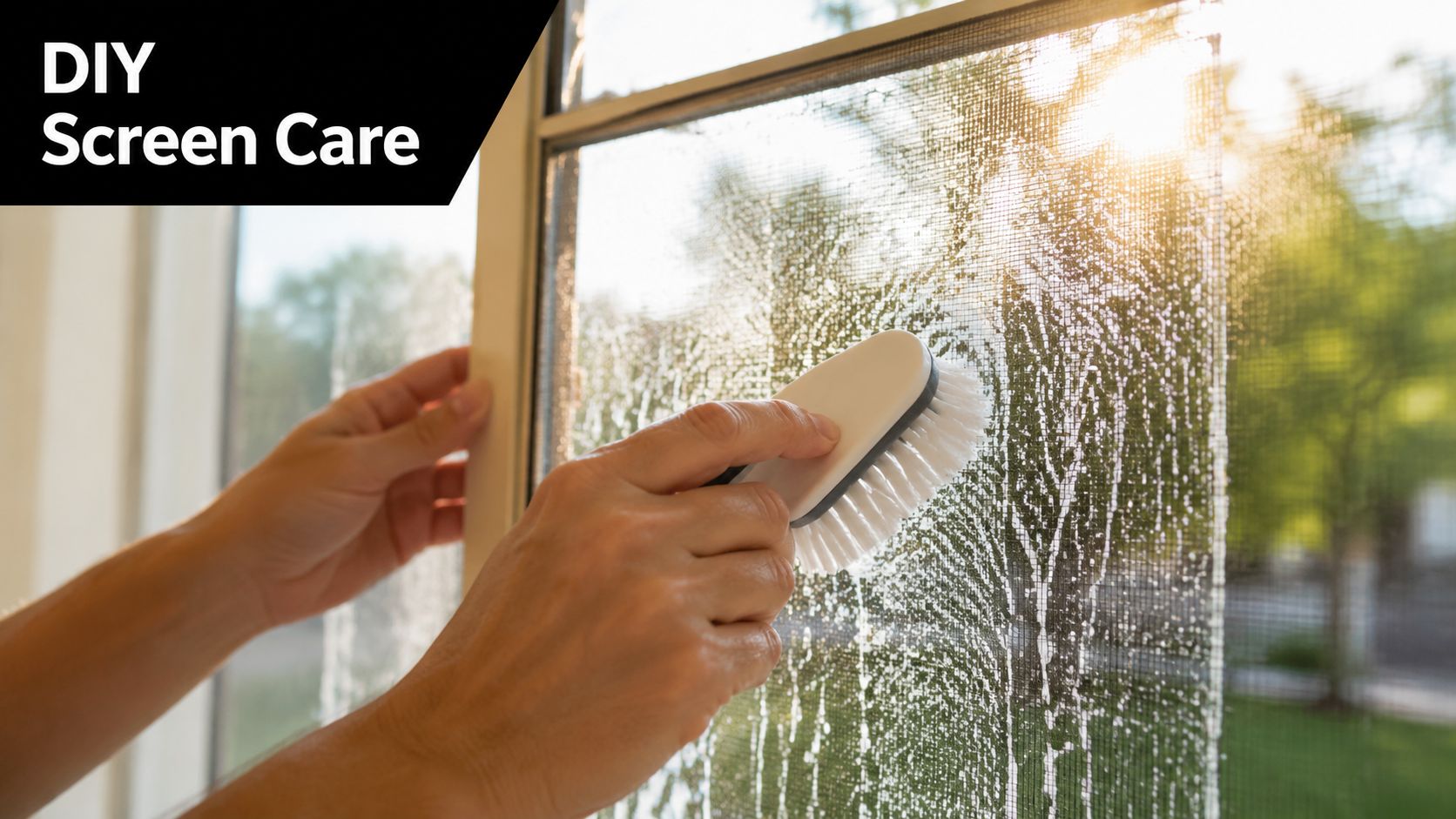
- Remove loose dust first with a soft brush, dry microfiber cloth, or vacuum with a brush attachment.
- Wash gently using mild soapy water and a soft sponge or cloth.
- Rinse lightly and avoid blasting the mesh so hard that you stretch it or pop it loose at the spline.
- Let it dry fully before closing up a retractable housing or reinstalling a panel.
If you want a homeowner-friendly walkthrough, this guide on how to clean window screens is useful because the same cleaning habits apply to many bug door screens.
Keep tracks and moving parts clear
Sliding and retractable units usually suffer more from debris than from age alone. Sand and dust act like grinding compound in the track.
Focus on:
- Track channels where dirt packs into corners
- Rollers and guides that start to drag
- Bottom rails where pet hair and leaves collect
- Latch points where buildup prevents full closure
If your patio door itself needs adjustment before the screen can work properly, outside references can help. I've seen homeowners use hardware tips from Neasden to understand basic patio door alignment before deciding whether they need a repair call.
Patch small damage early
Tiny holes are worth fixing. Once insects find the opening, the screen stops doing its job.
You can usually handle:
- Small punctures with a screen patch kit
- Loose spline sections if the frame is still square
- Minor edge separation if the mesh hasn't shrunk or torn badly
Skip DIY patching if the mesh is brittle all over or the frame is bent. In those cases, the patch only delays the proper repair.
A quick visual demo helps if you haven't done screen cleaning before:
Why maintenance matters beyond appearance
Screen barriers have long been tied to health as well as comfort. Historical accounts note that in the 1930s, “nearly a third of the inhabitants…had chronic malaria” in homes without window screens in parts of the rural South, as described in this screen door history article. The point for homeowners today is straightforward. A neglected screen with holes and gaps isn't just dingy. It isn't doing its basic job.
Signs You Need Professional Screen Repair
Some screen problems are easy homeowner fixes. Others waste your time if you keep tinkering with them. Once the issue involves frame shape, hardware alignment, or a failed retracting system, the repair usually stops being a casual weekend project.
Problems that usually go beyond DIY
Call for professional help when you see any of these:
- Bent or warped frame. If the frame won't sit square, new mesh alone won't solve the gap.
- Retractable screen that binds or won't retract properly. This often points to alignment, tension, or internal hardware trouble.
- Large tears or repeated patch failures. If the damage affects a wide section, replacement is cleaner than stacking repairs.
- Broken handles, rollers, closers, or latch hardware. Once the movement system fails, performance drops fast.
- Persistent edge gaps even after cleaning and adjustment. That usually means the screen or doorway is out of true.
Why larger systems need trained repair
Screen systems can get surprisingly technical. For large commercial and specialty openings, bug screen doors may use mechanical lifts, photo-eyes, and pneumatic reversing edges, and some are built for openings up to 14 ft by 14 ft, according to Blue Giant's industrial bug screen door details. Residential systems are simpler, but the lesson is the same. Some repairs need the right tools, replacement parts, and setup experience.
If the fix requires force to make the screen close, stop. A screen should move cleanly and seal cleanly. Forcing it usually creates the next repair.
Get Expert Screen Service from Sparkle Tech
When cleaning and minor patching aren't enough, it makes sense to hand the work off. Sparkle Tech's screen repair service in Phoenix covers bug screen cleaning, repair, rescreening, and fabrication for sun and bug screens, which is useful for homeowners dealing with worn mesh, damaged frames, or screens that no longer fit or seal the way they should.

For Phoenix-area properties, that kind of service is practical because the problems are usually layered. A screen may need more than washing. It may need the frame checked, the mesh replaced, and the fit corrected so the opening closes off insects again.
The company serves Scottsdale, Peoria, Phoenix, Mesa, Glendale, Gilbert, Surprise, Goodyear, Anthem, Paradise Valley, and nearby areas. It also notes that homeowners don't need to be home if access is arranged, and the business states that it protects property surfaces during service and backs work with a 10-day service and rain guarantee, based on the publisher information provided above.
If your bug door screens are loose, cloudy with dust, torn, or not sealing anymore, getting them inspected is often cheaper than living with a bad screen through another long warm season.
If your patio, French, or side entry screens need cleaning, repair, or full replacement, contact Sparkle Tech Window Washing LLC. They handle window screen cleaning and repair across the greater Phoenix area, including Scottsdale and Peoria, with service arranged around your schedule.