


By late spring in Phoenix, a lot of homes start telling on themselves. The west-facing bedroom feels hotter than the rest of the house by noon. The living room TV catches a hard glare every afternoon. You lower the blinds, but the room still feels bright, warm, and a little baked. Then summer hits, and your AC never seems to get a break.
That's usually when people start asking about solar screens.
Around the Valley, solar screens aren't a cosmetic upgrade. They're a practical exterior layer that helps deal with intense sun before it turns your glass into a heat source. If you're already looking at ways to cool the outside of the house too, these shade solutions for patios are worth reviewing alongside your window strategy because patios, sliders, and exposed glass often work together to trap heat around the home.
If you want to figure out where your house is gaining heat before you spend money, a simple home energy audit checklist can help you spot the biggest trouble windows first.
Beating the Phoenix Heat Starts at Your Windows
In Phoenix, the windows that get hit hardest usually aren't subtle about it. South-facing rooms stay bright all day. West-facing windows dump late-afternoon sun right where people sit, work, and watch TV. The result isn't just discomfort. It's a house that feels uneven, with some rooms staying manageable and others heating up fast.
That's why solar screens matter here more than they do in milder climates.
A lot of homeowners first try interior fixes. They close blinds, add curtains, or tint one problem window. Those steps can help with glare, but in extreme heat they often feel like you're reacting after the damage is already underway. In a Phoenix summer, once the sun has loaded the glass with heat, the room is already fighting uphill.
Phoenix rule of thumb: If one side of the house always feels hotter, start by looking at the exterior of those windows, not just the coverings inside.
Solar screens are built for that exact problem. They're meant to sit on the outside and intercept sunlight where it does the most good. That changes the conversation from “How do I darken this room?” to “How do I keep this room from heating up so fast in the first place?”
For homeowners, that usually means a more livable family room, office, or bedroom. For businesses, it often means less glare on front windows, more comfort near storefront glass, and fewer complaints from staff seated by sun-exposed offices.
Phoenix heat punishes weak window strategies. Solar screens work because they address the problem at the point of impact.
What Are Solar Screens and How Do They Work
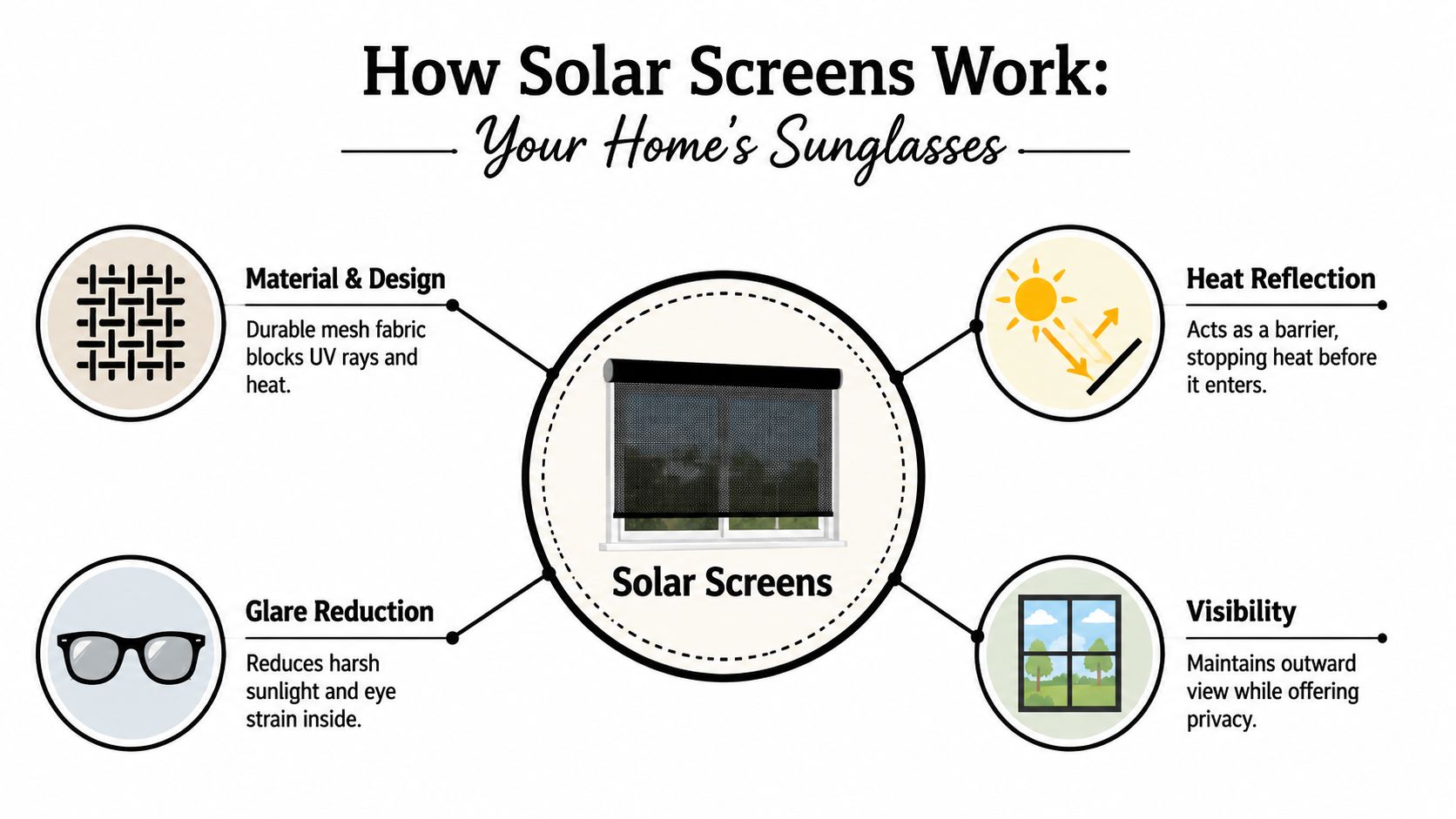
Solar screens are exterior window screens made from dense mesh fabric designed to cut the sun before it hits the glass. In Phoenix, that matters because the biggest window problem is not just brightness. It is solar gain loading the glass hour after hour, especially on west and south exposures.
They mount in a frame over the outside of the window, and the fabric filters part of the sunlight, glare, and UV exposure before that energy reaches the pane. That outside placement is the whole point. Interior blinds and curtains can darken a room, but the heat has already reached the window by then.
Solar screens are commonly sold by openness level, often in 80% and 90% options. A higher blockage screen gives you more protection from sun and glare, while a more open weave keeps a clearer view to the outside. As noted by Solar Screen Outlet's explanation of common solar screen performance, products vary by weave and openness, which is why two screens can look similar but perform differently on the house.
What the mesh is doing
The fabric is engineered to manage light and heat, not just darken the window for appearance.
That mesh helps with several jobs at once:
- Reduces solar heat at the glass so sun-exposed windows are less aggressive
- Cuts glare on TVs, monitors, and front office glass
- Filters UV exposure to help slow fading on floors, furniture, and finishes
- Adds daytime privacy by making it harder to see in from outside
In the field, a primary difference is how the room behaves in the afternoon. A window with the right screen usually feels less harsh, less glaring, and easier to sit near during peak sun.
Why openness and color matter
Installers talk about openness because the weave controls the trade-off. Tighter fabric blocks more sun, but it also reduces visibility and daylight more. More open fabric preserves the view better, but it gives up some shading performance.
Color plays into that too. Darker fabrics often maintain a better outward view from inside, while lighter colors can change the look of the home and the feel of the room. On Phoenix homes, the best choice usually depends on orientation, how the room is used, and whether the owner cares more about protection or view.
For example, a west-facing family room often benefits from a tighter, darker screen. A front window where appearance matters more may call for a different balance. Vivid Skylights' guide for smart homes gets into how homeowners combine shading strategies, but for standard Phoenix windows, solar screens remain one of the most practical exterior options.
One maintenance point gets overlooked in generic guides. Dust, monsoon residue, and hard water buildup can clog the mesh over time and change how the screens look and breathe. In Phoenix, that means cleaning matters. We see screens last better and perform more consistently when they are washed carefully and checked for frame damage, torn corners, and sun-brittle spline instead of being left to bake for years.
The Top Benefits for Phoenix Homes and Businesses
The biggest benefit of solar screens in Phoenix is simple. They make sun-exposed glass less punishing.
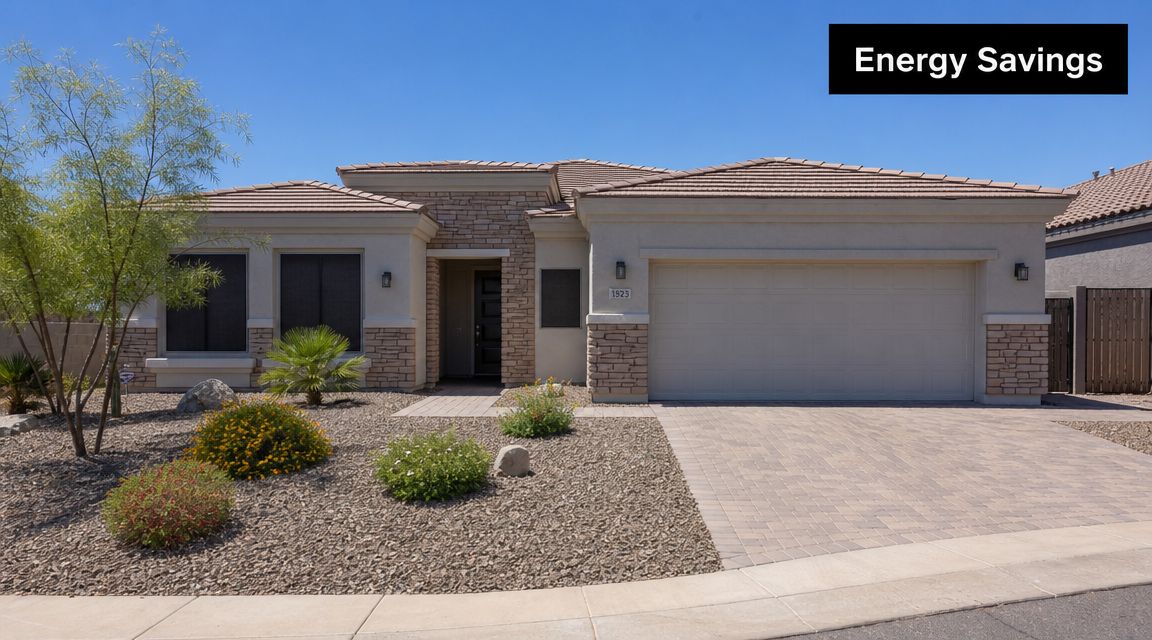
When a home has large windows facing west or south, the discomfort usually shows up the same way every day. The room gets bright long before it gets unusable. Then the heat builds, the glare gets harsher, and everybody ends up adjusting their routine around the sun. Solar screens change that pattern by softening the sun's impact at the window.
Comfort you notice right away
The first thing that's noticed isn't a utility statement. It's the room itself.
Common improvements include:
- Less glare on screens so TVs, monitors, and phones are easier to see
- More usable rooms in the afternoon especially offices, living rooms, and upstairs bedrooms
- Better daytime privacy from the street or neighboring properties
- A steadier indoor feel in rooms that used to spike in temperature fast
For businesses, that can mean a front office that doesn't feel like a greenhouse by mid-afternoon. For homeowners, it often means you stop avoiding one side of the house.
Protection for interiors
Phoenix sun is hard on interiors. Floors, furniture, and decorative finishes all take the hit when windows stay exposed day after day. A solar screen adds a practical layer between those surfaces and direct sun.
That matters in houses with wood floors near sliders, upholstered furniture near picture windows, or offices where equipment sits in bright light all afternoon.
A better fit for how people live now
A lot of homes now use large windows, open living spaces, and home offices. Those features look great, but they can also create hot spots and glare problems. If you're comparing solar screens with automated interior options, this Vivid Skylights' guide for smart homes gives useful context on where motorized shades fit and where exterior sun control still has the edge.
Interior convenience matters. Exterior protection matters too. In Phoenix, that combination is often what makes a room livable.
After you've seen the basic benefits, it helps to watch how these systems are used in practice:
On real homes, the pattern is consistent: the toughest windows are usually the ones getting direct late-day sun, and they're the first places where solar screens earn their keep.
Choosing Your Solar Screen Fabric Type and Color
Picking solar screens isn't just choosing “light” or “dark.” The main decision comes down to how you want to balance heat control, visibility, glare reduction, and curb appeal.
If you want a primer on common screen materials before talking to an installer, this guide to types of window screen mesh is a useful place to start.
Focus on openness before color
The most important performance choice is usually the mesh density, often discussed as openness. That tells you more about how the screen will behave than color alone.
Technical guidance from Insolroll notes that the effectiveness of a solar screen depends more on mesh density than color alone, while lighter colors can increase reflectance and premium fabrics are engineered to block significant heat across various colors, which lets homeowners choose based on appearance without a major performance trade-off, as outlined in Insolroll's explanation of how solar screen shades work.
That matters because people often assume color is everything. It isn't.
What different choices feel like in real life
Here's the practical version:
| Choice | What you'll usually notice |
|---|---|
| Darker fabric | Better outward visibility and strong glare control |
| Lighter fabric | Brighter appearance from outside and potentially more reflective look |
| Tighter mesh | More sun blocking, more privacy, less openness |
| More open mesh | Better view outward, more daylight, less aggressive shading |
None of those choices are automatically right. They depend on the window.
A west-facing bedroom may call for stronger sun control. A front room where you care about appearance from the street may push you toward a different fabric or color. A commercial storefront may need a balance between visibility and comfort.
Match the screen to the elevation
Don't choose one fabric blindly for every side of the house if your exposures are very different.
A practical way to consider it:
- West-facing windows: Usually need the most aggressive sun management.
- South-facing glass: Often benefits from strong daytime control without making the room feel shut down.
- Street-facing windows: Appearance and privacy may matter as much as pure heat blocking.
- Patio and backyard sides: Outward visibility is often more important because people spend time looking out.
The right solar screen package is rarely about one “best” color. It's about giving each side of the home the level of control it actually needs.
In Phoenix, products that look fine on paper can still feel wrong in the house if the openness is mismatched to the room. That's why samples and real elevation-by-elevation decisions matter.
Comparing Solar Screens with Window Film and Awnings
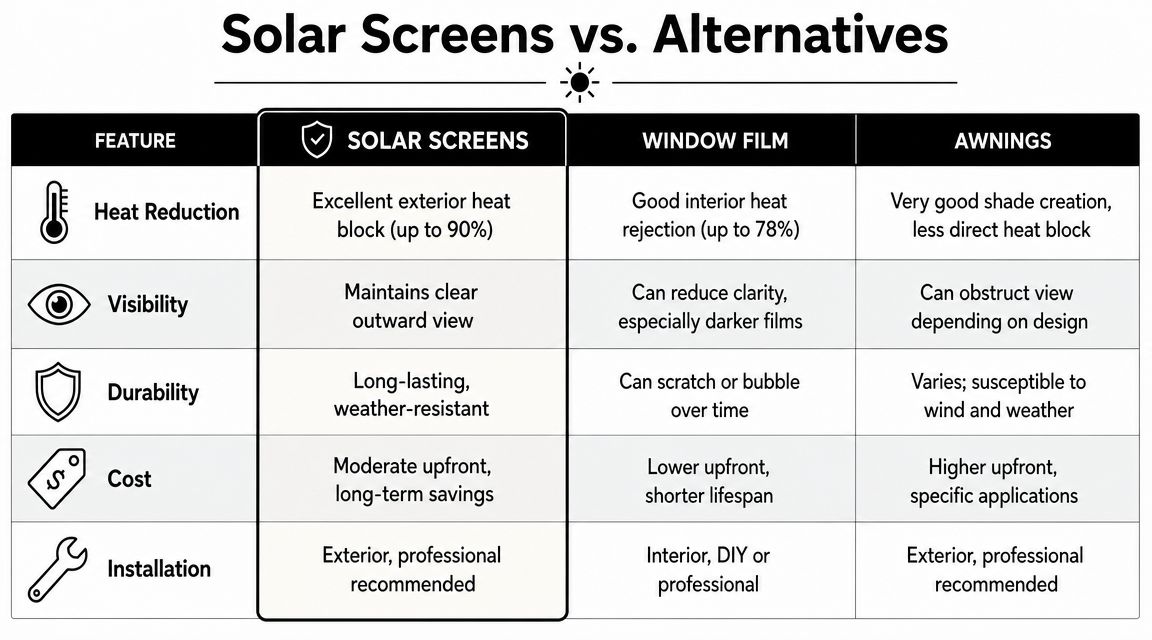
Most Phoenix homeowners don't evaluate solar screens in a vacuum. They're usually deciding between screens, window film, and some type of exterior shade structure such as an awning.
Each option solves a different part of the problem.
Solar screens
Solar screens are a strong fit when you want exterior heat control at the window without fully changing the architecture of the house. They preserve the basic shape of the home, maintain a usable outward view, and help with glare and daytime privacy at the same time.
They're especially practical on homes with repeated window patterns where a consistent look matters.
Good fit for:
- Whole-home coverage on sun-exposed elevations
- Bedrooms and living areas where glare and privacy both matter
- Commercial windows that need comfort without a major exterior buildout
Trade-offs:
- You'll still see the screen fabric
- Night privacy is limited
- They need periodic cleaning in dusty desert conditions
Window film
Window film is often chosen because it's less visually obvious from a distance and can be applied without adding an exterior frame or screen. It can make sense when HOA restrictions, architecture, or access issues make exterior products harder.
If you're looking specifically at film, this expert car window film advice is automotive-focused but still helps explain how people think about glare, tint darkness, and visibility trade-offs.
Film tends to make the most sense when:
- You want a low-profile appearance.
- Exterior mounting isn't practical.
- Your main concern is glare reduction rather than maximum exterior interception.
Its limitations are straightforward. Film stays on the glass, so it doesn't create the same physical buffer outside the window. It also doesn't provide the mesh look or daytime privacy effect many people want from solar screens.
Awnings
Awnings work differently. Instead of filtering sunlight at the window surface, they create shade by physically covering the opening area from above or beyond. On the right elevation, that can be very useful.
They often work best on:
- Patio doors and large openings
- Architectural styles that suit a visible shade element
- Specific windows that take direct overhead or angled sun
The downside is that awnings are a much bigger visual statement. They can also be less flexible if your problem is spread across many windows rather than one standout opening.
Side-by-side decision table
| Option | Best at | Less ideal when |
|---|---|---|
| Solar screens | Exterior window heat control with view retention | You want a completely invisible treatment |
| Window film | Low-profile glare control on the glass | You want an exterior barrier effect |
| Awnings | Creating broader shade over select openings | You need a subtle whole-home solution |
If your main problem is sun hitting the glass directly for hours, exterior solutions usually make more sense than interior-only fixes.
For many Phoenix properties, solar screens land in the middle in a good way. More targeted than an awning. More exterior-effective than a film-only approach. Less architectural disruption than building shade structures across multiple openings.
Installation and Professional Screen Maintenance
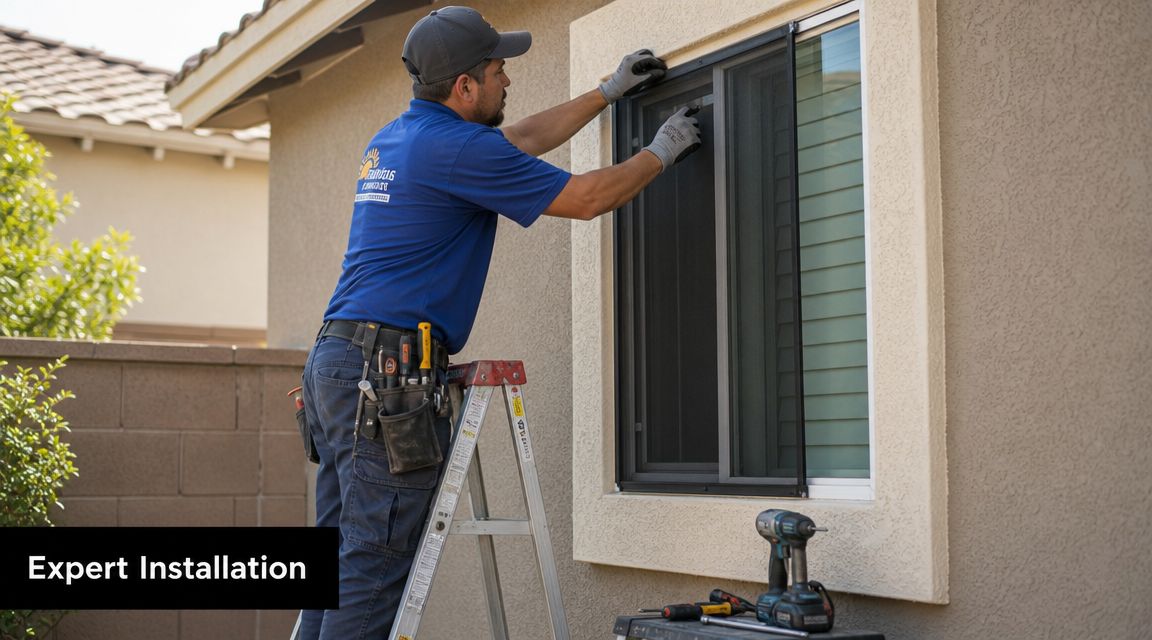
A solar screen only works as well as it fits.
Loose corners, poor sizing, weak attachment points, and sloppy framing all reduce the point of installing it in the first place. In Phoenix, where sun and dust are constant, installation quality matters just as much as fabric choice.
Exterior placement matters most
For serious heat control, exterior mounting is the standard to beat. Industry guidance on exterior window coverings reports shading coefficient ranges of 0.14 to 0.33 for exterior installations versus 0.50 to 0.70 for interior installations, showing that exterior placement reduces solar heat gain more effectively because it stops the sun before it reaches the glass, as explained by Efficient Window Coverings in its exterior solar screen guidance.
That's the technical way to say what Phoenix homeowners already feel. If the heat never gets to the glass as directly, the room starts with an advantage.
What professional installation gets right
A good installer pays attention to details people don't usually notice from the ground.
That includes:
- Accurate measuring so the frame sits clean and consistent
- Secure mounting that holds up to weather and repeated removal for cleaning
- Uniform appearance across the front of the house
- Proper fit around problem openings like deep-set windows or larger spans
DIY can work on straightforward windows if you're comfortable measuring and mounting. But once the home has multiple elevations, tall windows, or a need for a clean exterior look, professional installation usually saves frustration.
Desert dust changes the maintenance conversation
Phoenix doesn't just expose screens to sun. It coats them with dust.
That buildup matters for two reasons. First, dirty screens look tired fast, especially on the front of the house or on commercial glass. Second, packed-on dust and debris make any screen system look older and less uniform than it should.
A basic maintenance rhythm should include:
- Visual checks for bent frames, loose corners, or torn mesh
- Gentle cleaning to remove dust accumulation
- Repair before replacement when the frame is solid but the mesh is worn
- Window cleaning at the same time so you're not reinstalling a clean screen over dirty glass
Clean the glass and the screen together. If you skip one, the whole window still looks neglected.
For homeowners who don't want to remove, wash, inspect, and reinstall screens themselves, companies that handle window cleaning and screen service can simplify the upkeep. One local option is Sparkle Tech Window Washing LLC, which offers window cleaning along with screen cleaning and repair in the Phoenix area.
That kind of service is useful when you want to preserve the appearance of the house and keep the screens functioning without turning it into a weekend project.
Frequently Asked Questions About Solar Screens
How much do solar screens typically cost in the Phoenix area
Pricing varies by window size, frame type, mesh choice, quantity, and installation complexity. A single small window and a full-home package are completely different jobs. If you want local pricing factors laid out more clearly, this guide on the cost of solar screens is a practical starting point.
Will solar screens make my house too dark inside
Usually not if the mesh is chosen well for the room. The inside light changes, but in a good installation the room should feel softer and more comfortable, not gloomy. The windows that need the strongest protection are often the same windows creating the worst glare and heat.
Can people see into my home at night with solar screens
During the day, solar screens can improve privacy because the brighter outdoor conditions work in your favor. At night, when your interior lights are on, privacy drops. If nighttime privacy matters, pair solar screens with curtains, roller shades, or another interior treatment.
How long do solar screens last in Arizona sun
Lifespan depends on fabric quality, frame quality, sun exposure, and maintenance. In Phoenix, materials live a hard life. Screens on the harshest elevations usually age faster than screens in shaded or protected areas, and neglected dust buildup never helps. Good materials and regular care matter more than wishful thinking.
Are solar screens worth it for businesses too
Yes, especially on storefront glass, office windows, and any commercial space where glare and afternoon heat affect customers or staff. The value isn't only about cooling. It's also about making front-facing glass more comfortable and usable throughout the day.
If your windows are taking the full hit of the Phoenix sun, it's worth treating the screens and the glass as one system. Sparkle Tech Window Washing LLC provides window cleaning plus screen cleaning and repair for homes and businesses across the greater Phoenix area, which can help you keep existing solar screens looking right and working the way they should.